

BMW X3 Service Costs
Transparent pricing, OE-quality parts and open, honest advice.
BMW X3 Service Costs – Reliable Care Without Main Dealer Prices
Select your BMW model below (or enter your registration) to view fixed service costs using our Service Calculator.
Looking for the X3 M? It’s listed on our
M Cars page.
Looking for Fixed-Price BMW X3 Servicing?
Use our BMW X3 Service Calculator to check transparent pricing, explore service packages, and plan your maintenance with confidence.
We service all BMW X3 models — including the xDrive20d, xDrive30e plug-in hybrid, and performance M40i and M40d variants — using only OE-quality parts to maintain performance, warranty protection, and long-term reliability.
Our fixed prices include parts, labour, and VAT. No hidden extras. We always reset the onboard service computer and update digital service records (where supported).
Conveniently located near Birmingham, just off the M5 and M6 motorways, we’re trusted by BMW X3 owners across the West Midlands.
Why Choose Us for Your BMW X3 Servicing?
Transparent Fixed Pricing
All costs include parts, labour, and VAT — no hidden extras.
Digital Service Updates
Service computer reset and digital service history updated (where fitted).
Genuine OE-Standard Parts
We use BMW-spec parts to ensure performance and warranty protection.
All Models Expertly Serviced
Including petrol, diesel, hybrid, xDrive and M Sport X3 variants.
Convenient Location
Based in Great Bridge, West Midlands – DY4 7LH. Easy access from Birmingham, Dudley and Wolverhampton.
Trusted by BMW Owners
Hundreds of loyal customers. Specialist care without main dealer prices.
BMW X3 Fixed-Price Servicing Guide
Important: The service prices shown below are typical examples. Exact pricing varies by model, engine size, and fuel type. For a precise quote, please select your model above.
All services include VAT, parts, labour, onboard service computer reset, and digital service record updates (where fitted). No hidden charges — just clear, honest pricing.
| Service | What’s Included | Price |
|---|---|---|
| Bronze Service | Oil and filter using BMW-spec oil | From £150.00 |
| Silver Service (4 Cylinder) | Oil, filter, air filter | From £200.00 |
| Gold Service (4 Cylinder) | Oil, air, cabin filter | From £280.00 |
| Platinum Service (4 Cylinder Petrol) | Gold + spark plugs | From £425.00 |
| Silver Service (6 Cylinder) | Oil, air filter | From £240.00 |
| Gold Service (6 Cylinder) | Oil, air, cabin filter | From £325.00 |
| Platinum Service (6 Cylinder Petrol) | Gold + spark plugs | From £475.00 |
| Platinum Service (Diesel) | Gold + fuel filter | From £375.00 |
| Brake Fluid Flush | High-performance DOT4 brake fluid | £100.00 |
| MOT | Official MOT test | £50.00 |
| Diagnostic Check | BMW diagnostic scan and technician report | £80.00 |
What’s Included with Your BMW X3 Service?
- Fixed-price servicing with OE-quality parts
- Service computer reset and digital record update
- Brake, suspension, steering and engine checks
- Tailored for petrol, diesel, xDrive and M Sport X3s
- Full invoice transparency — no hidden extras
Need Help Choosing the Right BMW X3 Service?
Use our Service Calculator at the top of this page to compare options for your BMW X3. Prefer to talk? Call 0330 999 0020 — we’re here to help.
Knowing which generation your BMW X3 belongs to matters for servicing. Engines, oil specifications, service intervals, and common faults all vary significantly between generations. Use the table below to identify your generation, then explore the details for engine codes, body styles, and service points. The E83 was BMW's first compact SUV and the model that established the X3 in the UK market. Launched in 2003 and built under contract by Magna Steyr in Graz rather than at a BMW plant, it shared its platform and much of its mechanical architecture with the E46 3 Series. Production ran until 2010, with a substantial LCI facelift in 2006 that addressed many of the early car's criticisms — interior plastics, ride quality, and exterior styling. The xDrive all-wheel-drive system fitted to every E83 was a significant step on from the viscous-coupling 4WD of the earlier E30 and E46 325iX/330xD models. The system used an electronically controlled multi-plate clutch to vary torque distribution between the axles, normally split 40:60 front-to-rear but capable of sending up to 100% of available torque to either axle when required. This is the same xDrive principle still used today. The E83 was never the most refined SUV in its class — particularly pre-facelift — but it has aged into a practical, mechanically straightforward used car. Most surviving examples in the UK are now in the £2,000–£6,000 bracket, which means they're being bought as working tools rather than as appreciating classics. Service economics matter accordingly. M47TU (2.0 litre four-cylinder, common-rail, pre-facelift 2004–2007) — fitted to the 2.0d (110 kW). The same M47TU as the E46 320d, with the same broad fault profile: swirl flaps in the intake manifold (deletion is standard practice), DPF condition where fitted, EGR cooler attention, and injector wear at higher mileages. N47 (2.0 litre four-cylinder, LCI 2007–2010) — fitted to the 2.0d and 18d from 2007. The N47 introduced the well-known rear-of-engine timing chain issue that affects this entire engine family in the 1, 3, and 5 Series too. Symptoms include a distinctive rattle from the rear of the engine, particularly on cold start. Replacement requires engine removal — substantial labour cost — but the failure mode is well understood and many cars have already had the work done at some point. Service history is critical when buying. M57 (3.0 litre inline-six, common-rail, 2003–2010) — fitted to the 3.0d (150/160/210 kW depending on year). The M57 is the engine to have in an E83 — strong torque, good refinement, and a far better long-term ownership proposition than either of the four-cylinder diesels. Service points centre on swirl flaps (intake manifold), EGR cooler, and the same cooling system attention as the petrol cars. The E83 is the generation where the X3 established its UK presence, and most of what we service today is in working-tool territory. Pre-facelift cars are now 19–23 years old; LCI cars 15–19 years. The service approach reflects this — sympathetic mechanical maintenance, honest assessment of corrosion and chassis condition, and a realistic view of what's economic to put right on a £3,000–£6,000 car. Cooling system — the dominant E83 service item. The E83 inherits the well-documented cooling system weaknesses of the E46-era plastics: water pump (electric on N52, mechanical on M54), thermostat housing, expansion tank, and the various coolant hoses all have a finite service life. Preventive replacement of the cooling system as a group at around 100,000 miles is far cheaper than dealing with a head gasket failure caused by overheating. We check coolant condition, expansion tank integrity, and water pump operation on every E83 we see. N47 timing chain (2007–2010 diesels). The single most important pre-purchase check on a late E83 diesel. The chain runs at the rear of the engine and is not service-replaceable without engine removal. Symptoms include rattle from the rear of the engine on cold start, and in advanced cases, running issues caused by chain stretch affecting cam timing. We diagnose suspected cases with a borescope inspection and recommend replacement before the chain jumps. Service history showing the work already done is a substantial positive on any used E83 2.0d. xDrive transfer case. The transfer case in the E83 uses an electric servo motor to actuate the multi-plate clutch. Failure of the servo motor (a known issue across early xDrive vehicles) produces a 4WD warning light and intermittent loss of drive to the front axle. The motor is replaceable as a separate item — substantially cheaper than transfer case replacement — and we service this on a fault-by-fault basis. Front suspension wear. The E83 is hard on its front lower control arm bushes and front anti-roll bar drop links. Symptoms include knocking over bumps and vague steering. These are straightforward, scheduled wear items on a car of this age and we replace them as part of routine MOT preparation. The E83 is the generation where the X3 established its UK presence, and most of what we service today is in working-tool territory. Pre-facelift cars are now 19–23 years old; LCI cars 15–19 years. The service approach reflects this — sympathetic mechanical maintenance, honest assessment of corrosion and chassis condition, and a realistic view of what's economic to put right on a £3,000–£6,000 car. Cooling system — the dominant E83 service item. The E83 inherits the well-documented cooling system weaknesses of the E46-era plastics: water pump (electric on N52, mechanical on M54), thermostat housing, expansion tank, and the various coolant hoses all have a finite service life. Preventive replacement of the cooling system as a group at around 100,000 miles is far cheaper than dealing with a head gasket failure caused by overheating. We check coolant condition, expansion tank integrity, and water pump operation on every E83 we see. N47 timing chain (2007–2010 diesels). The single most important pre-purchase check on a late E83 diesel. The chain runs at the rear of the engine and is not service-replaceable without engine removal. Symptoms include rattle from the rear of the engine on cold start, and in advanced cases, running issues caused by chain stretch affecting cam timing. We diagnose suspected cases with a borescope inspection and recommend replacement before the chain jumps. Service history showing the work already done is a substantial positive on any used E83 2.0d. xDrive transfer case. The transfer case in the E83 uses an electric servo motor to actuate the multi-plate clutch. Failure of the servo motor (a known issue across early xDrive vehicles) produces a 4WD warning light and intermittent loss of drive to the front axle. The motor is replaceable as a separate item — substantially cheaper than transfer case replacement — and we service this on a fault-by-fault basis. Front suspension wear. The E83 is hard on its front lower control arm bushes and front anti-roll bar drop links. Symptoms include knocking over bumps and vague steering. These are straightforward, scheduled wear items on a car of this age and we replace them as part of routine MOT preparation. The F25 was the generation where the X3 became a serious volume product for BMW. Production moved from Magna Steyr to BMW's own Spartanburg plant in South Carolina, the car grew substantially in size and quality, and sales climbed to a level that established the X3 as one of BMW's most important models globally. UK production ran from late 2010 to October 2017, with a comprehensive LCI facelift in mid-2014. Mechanically the F25 sat alongside the F30 3 Series, sharing engines, the ZF 8HP eight-speed automatic gearbox (which replaced the six-speed of the early cars), and much of the broader BMW modular parts catalogue. Every UK F25 was xDrive — there was no sDrive option in this generation in the UK market. Engine displacement designations changed mid-life as BMW transitioned away from displacement-true naming, so 20i, 28i, and 35i sit alongside the displacement-true 20d and 30d. The F25 is now firmly in the modern-used-car territory that defines most of our X3 servicing work. Service Calculator pricing applies in the normal way, and the parts catalogue is shared with the broader F-series BMW range, which keeps costs reasonable. The car's reputation for reliability is honestly mixed — the diesel engines are strong; the early petrol engines (N20, N55) have specific issues we cover below. N20 (2.0 litre four-cylinder, twin-scroll turbo, 2011–2017) — fitted to the 20i, 28i (245 hp), and xDrive20i/28i. The N20 is the central petrol engine of the F25 generation and the one with the most significant service history attached. Timing chain wear is the headline issue: the chain, guides, and tensioner can wear prematurely (typically 60,000–100,000 miles) and the failure mode — a rattle from the front of the engine, particularly on cold start — can progress to chain jump and catastrophic engine damage if ignored. Preventive replacement on any high-mileage N20 with a chain rattle is standard practice. Other points: oil filter housing gasket leaks, valve cover gasket leaks, and the usual VANOS solenoid attention. N55 (3.0 litre inline-six, single twin-scroll turbo, 2011–2017) — fitted to the 35i. The N55 is a strong engine but inherits the wider N55 family's appetite for valve cover gasket replacement, oil filter housing gasket leaks, and water pump failure (electric, typically 80,000–100,000 miles). The charge pipe between turbo and intercooler is plastic on the N55 and a well-known failure item — aftermarket alloy replacements are commonly fitted. Carbon build-up on the intake valves (direct injection) is the other long-term consideration; walnut blasting at around 70,000 miles is sensible preventive maintenance. B48 (2.0 litre four-cylinder, LCI 2017 only) — fitted to a small number of very late F25 production cars. The B48 is BMW's modular replacement for the N20 and largely resolves the timing chain issues of its predecessor. Few F25s have it. N47 (2.0 litre four-cylinder, common-rail, pre-facelift 2010–2014) — fitted to the 20d (135 kW) and 18d. The same N47 as the late E83, with the same well-known rear-of-engine timing chain issue. Many F25 2.0d cars have already had the chain replaced at some point; service history is the key pre-purchase consideration. B47 (2.0 litre four-cylinder, LCI 2014–2017) — fitted to the post-LCI 20d. The B47 is the modular replacement for the N47 and the timing chain issue was substantially addressed. The B47 is a much more relaxed ownership proposition than the N47 it replaced. Service points include EGR cooler attention (B47 EGR coolers were the subject of a BMW recall covering thermal events), DPF condition, and the swirl flap attention common to BMW four-cylinder diesels of this era. N57 (3.0 litre inline-six, common-rail, 2010–2017) — fitted to the 30d (190 kW) and the 35d xDrive (230 kW twin-turbo variant). The N57 is one of BMW's best diesel engines — strong torque, good refinement, durable when properly maintained. Service points centre on swirl flaps, EGR cooler, timing chain attention at very high mileages, and the usual diesel injector care. The 35d twin-turbo variant adds the second smaller high-pressure turbocharger to the picture but the failure modes are well understood. The F25 is the X3 generation we see most often in routine workshop traffic. Cars are typically 8–15 years old, mechanically modern, parts well-supported, and within the Service Calculator pricing model. Most of what we do on F25s is scheduled maintenance, predictable wear, and the specific engine-family items below. N20 timing chain — the defining F25 service item on petrol cars. Of all the engines fitted to the F25, the N20 is the one with the most consistent ownership-cost surprise attached. The timing chain, guides, and tensioner wear prematurely — typically symptomatic between 60,000 and 100,000 miles — and the failure mode is severe: chain jump destroys the engine. We treat any N20 with a cold-start rattle as urgent. Preventive replacement is a substantial job but materially cheaper than engine replacement. We check chain condition on every N20 F25 we see and discuss the options honestly with owners. ZF 8HP gearbox fluid service. The eight-speed ZF automatic was officially described by BMW for many years as "sealed for life." It is not. We recommend fluid and pan replacement at 60,000–80,000 miles. The job is straightforward, materially extends gearbox life, and addresses the harsh-shift symptoms that develop in neglected boxes. Most F25s we see have either had this done late or not at all. N55 charge pipe and water pump. Two predictable F25 35i items. The plastic charge pipe between the turbocharger and intercooler will fail eventually — we recommend pre-emptive replacement with an aftermarket alloy item on any high-mileage 35i. The electric water pump is a scheduled-failure item typically between 80,000 and 100,000 miles; symptoms include intermittent overheating warnings and the engine running hotter than normal. xDrive transfer case actuator. Same servo-motor failure mode as the E83. The actuator on the F25 transfer case wears and can fail, producing a 4WD warning light and clunking on take-off. The actuator is replaceable as a separate item — far cheaper than full transfer case replacement. Front suspension and steering. The F25 wears front lower control arm bushes, front anti-roll bar drop links, and tie rod ends as scheduled items on a car of this age. We typically address these alongside MOT preparation. The electric power steering rack is generally durable but the steering angle sensor in the column can fail and trigger ABS, traction control, and lane-keep warnings together. The F25 is the X3 generation we see most often in routine workshop traffic. Cars are typically 8–15 years old, mechanically modern, parts well-supported, and within the Service Calculator pricing model. Most of what we do on F25s is scheduled maintenance, predictable wear, and the specific engine-family items below. N20 timing chain — the defining F25 service item on petrol cars. Of all the engines fitted to the F25, the N20 is the one with the most consistent ownership-cost surprise attached. The timing chain, guides, and tensioner wear prematurely — typically symptomatic between 60,000 and 100,000 miles — and the failure mode is severe: chain jump destroys the engine. We treat any N20 with a cold-start rattle as urgent. Preventive replacement is a substantial job but materially cheaper than engine replacement. We check chain condition on every N20 F25 we see and discuss the options honestly with owners. ZF 8HP gearbox fluid service. The eight-speed ZF automatic was officially described by BMW for many years as "sealed for life." It is not. We recommend fluid and pan replacement at 60,000–80,000 miles. The job is straightforward, materially extends gearbox life, and addresses the harsh-shift symptoms that develop in neglected boxes. Most F25s we see have either had this done late or not at all. N55 charge pipe and water pump. Two predictable F25 35i items. The plastic charge pipe between the turbocharger and intercooler will fail eventually — we recommend pre-emptive replacement with an aftermarket alloy item on any high-mileage 35i. The electric water pump is a scheduled-failure item typically between 80,000 and 100,000 miles; symptoms include intermittent overheating warnings and the engine running hotter than normal. xDrive transfer case actuator. Same servo-motor failure mode as the E83. The actuator on the F25 transfer case wears and can fail, producing a 4WD warning light and clunking on take-off. The actuator is replaceable as a separate item — far cheaper than full transfer case replacement. Front suspension and steering. The F25 wears front lower control arm bushes, front anti-roll bar drop links, and tie rod ends as scheduled items on a car of this age. We typically address these alongside MOT preparation. The electric power steering rack is generally durable but the steering angle sensor in the column can fail and trigger ABS, traction control, and lane-keep warnings together. The G01 was the generation where the X3 moved onto BMW's CLAR (Cluster Architecture) platform, shared with the G20 3 Series, G30 5 Series, and the wider modern BMW range. Production ran from November 2017 to mid-2024, with a substantial LCI facelift in 2021. The G01 also brought the first proper M-division X3 — the F97 X3 M and X3 M Competition with the S58 twin-turbo straight-six. Mechanically the G01 is built around BMW's modular B-series engines — the B48 four-cylinder petrol, B58 straight-six petrol, B47 four-cylinder diesel, and B57 straight-six diesel — all paired to the ZF 8HP eight-speed automatic gearbox with xDrive on every UK retail variant. The 30e plug-in hybrid arrived in 2020, adding electrified powertrain options to the X3 line-up for the first time in the UK. The G01 is mechanically the most up-to-date X3 generation we currently see in volume servicing. Most G01s we work on are still within manufacturer warranty extension or have just emerged from it, and Service Calculator pricing applies in the normal way. The car's reputation for reliability is materially stronger than the F25 it replaced — the B-series engines have substantially fewer issues than the N20 and early N55, and the broader build quality is a step on. B48 (2.0 litre four-cylinder, twin-scroll turbo, 2017–2024) — fitted to the xDrive20i, xDrive30i (post-LCI), and as the petrol component of the xDrive30e plug-in hybrid. The B48 is BMW's modular four-cylinder replacement for the N20 and largely addresses the timing chain issues of its predecessor. Service points are conventional: VANOS solenoids, valve cover gasket attention at higher mileages, and the usual oil service intervals. Direct injection means carbon build-up on intake valves is a long-term consideration; we recommend walnut blasting at around 80,000 miles. B58 (3.0 litre inline-six, single twin-scroll turbo, 2017–2024) — fitted to the xDrive30i (early), M40i, and 30i variants. The B58 is widely regarded as one of BMW's best modern engines — strong, durable, and free of most of the issues that affected the N55 it replaced. Service points centre on cooling system attention (the B58 is sensitive to coolant condition), regular oil service, and the usual VANOS solenoid care. S58 (3.0 litre inline-six, twin-turbo, 2019–2024) — F97 X3 M and X3 M Competition — the M-division engine, also fitted to the G80 M3, G82 M4, and F98 X4 M. The S58 is a substantial engine in service terms — see our M cars page for full detail. Headline points: rod bearing attention (preventive replacement is a known specialist procedure), cooling system condition, and the usual M-car careful-maintenance posture. B47 (2.0 litre four-cylinder, common-rail, 2017–2024) — fitted to the xDrive20d (and pre-LCI 18d). The B47 carries forward from the LCI F25 with continued refinement. EGR cooler attention remains a known item (some early B47s were the subject of BMW recall action), DPF condition matters on cars used predominantly for short journeys, and the swirl flap care common to BMW four-cylinder diesels applies. Long-term ownership economics on a B47 20d are some of the best in the modern BMW range. B57 (3.0 litre inline-six, common-rail, 2017–2024) — fitted to the xDrive30d and M40d. The B57 is the modular six-cylinder diesel replacement for the N57 and an excellent long-distance engine — strong torque, good refinement, and a relaxed ownership profile. Service points centre on EGR cooler, DPF condition, injector care at very high mileages, and the AdBlue system on post-Euro-6d cars. The M40d shares the engine with the B58-equivalent state of tune and adds M Performance suspension and braking. xDrive30e plug-in hybrid (2020–2024) — combines the B48 2.0 litre petrol engine with a 12 kWh battery and an electric motor integrated into the ZF 8HP gearbox housing. UK system output 215 kW / 292 hp combined, with around 28 miles of WLTP electric-only range. The 30e adds the high-voltage battery, AC charging hardware, and electrified gearbox to the standard B48 service picture. Service points include high-voltage system inspection, battery state-of-health monitoring (we have the diagnostic equipment to check this independently of the dealer), and the usual ZF 8HP fluid attention adapted for the electrified variant. The 30e is a sensible used-PHEV proposition for owners with predictable short commutes who can charge at home. The G01 is the X3 generation where modern BMW reliability has materially improved on what came before. The B-series engines are stronger than the N-series they replaced, the build quality is a step on from the F25, and the parts catalogue is broadly shared with the wider current BMW range. Service Calculator pricing applies in the normal way. Most of what we do on G01s is scheduled maintenance and predictable wear rather than fault-driven repair. ZF 8HP gearbox fluid service — still essential. Despite continued "sealed for life" wording from the manufacturer, we recommend fluid and pan replacement at 60,000–80,000 miles on every G01. The job pays for itself in extended gearbox life and avoids the harsh-shift symptoms that develop in neglected boxes. This applies equally to the 30e — the electrified gearbox uses the same ZF 8HP base architecture and benefits from the same service. B47 EGR cooler attention. Early G01 20d cars were captured in the wider BMW B47 EGR cooler recall covering potential thermal events. Most affected cars have had the work done by main dealers under the recall, but service history should confirm this. We check this on every B47 G01 we see. B58 cooling system condition. The B58 is a strong engine but materially sensitive to coolant condition and water pump health. We check coolant condition on every B58 we service and recommend preventive water pump replacement at around 100,000 miles. Early intervention is substantially cheaper than dealing with a thermal event. 30e high-voltage system and battery health. The 30e adds the high-voltage system to the standard B48 service picture. We carry the diagnostic equipment to assess battery state-of-health independently and can advise honestly on long-term battery condition — particularly useful for owners considering selling, or for buyers considering a used 30e. The hybrid-specific service work is straightforward for properly equipped independents; we do not need to refer this work to a main dealer. X3 M (F97) — specialist service profile. The F97 X3 M and X3 M Competition with the S58 engine are full M-division cars and warrant the careful-maintenance posture we apply to all S58-equipped vehicles. See our M cars page for full detail. Headline service items include preventive rod bearing replacement on owners' preferred schedule, careful oil service intervals, and cooling system attention beyond what the standard G01 requires. The G45 is the current X3 generation, in UK showrooms from late 2024. It builds on the CLAR platform shared with the wider modern BMW range, with revised exterior and interior design, BMW's Curved Display infotainment, and a model lineup that has narrowed in some respects from the G01 it replaced. There is no longer a combustion X3 M in the G45 generation — the M50 xDrive with the B58 mild-hybrid straight-six is the performance flagship for this generation. Every G45 in the UK is electrified to some degree. The petrol B48 and B58 engines are 48V mild-hybrid; the diesel B47 and B57 are also 48V mild-hybrid; the xDrive30e PHEV combines the B48 with a substantially larger battery than the G01 30e it replaces, offering meaningfully longer electric-only range. The full battery-electric role within BMW's current lineup has passed to the new iX3 (NA5) on the separate Neue Klasse platform — that is a distinct model rather than a G45 variant. The G45 is still very early in its UK fleet life. Most cars in the wild are under three years old and still within manufacturer warranty. We are tooled and equipped to service the G45 outside of warranty, including the full diagnostic, coding, and software-update suite, and we expect to see meaningful G45 workshop traffic from approximately 2027 onwards as warranties expire. Owners considering us for early scheduled servicing are welcome to do so now. B48 (2.0 litre four-cylinder, twin-scroll turbo, 48V mild-hybrid, 2024–present) — fitted to the xDrive20 (sold as 20 xDrive in some markets). The B48 in G45 form adds 48V mild-hybrid integration to the existing B48 architecture: an integrated starter-generator provides brief electric assist, idle-stop refinement, and modest economy gains. Mechanically the engine is broadly the B48 we know from the G01, with the same general service profile. B58 (3.0 litre inline-six, single twin-scroll turbo, 48V mild-hybrid, 2024–present) — M50 xDrive — fitted to the M50 xDrive performance flagship, producing around 393 hp combined. The B58 in M50 form carries the same broad service profile as the G01 B58, with 48V mild-hybrid integration added. We expect the M50 to be the performance G45 we see most of in the workshop in future years — strong engine, durable architecture, modern parts support. B47 (2.0 litre four-cylinder, common-rail, 48V mild-hybrid, 2024–present) — fitted to the xDrive20d. The B47 in G45 form adds 48V mild-hybrid integration to the long-established B47 architecture. Mechanically and from a service perspective, this is broadly the engine we already know well from the late G01 and the wider BMW range, with the same general service profile and a refined long-term ownership outlook. B57 (3.0 litre inline-six, common-rail, 48V mild-hybrid, 2024–present) — fitted to higher-spec diesel variants in markets that take them; UK availability has been more limited in the G45 generation than in the G01. Same broad B57 service profile as the G01, with 48V mild-hybrid integration added. xDrive30e plug-in hybrid (2024–present) — combines the B48 2.0 litre petrol engine with a substantially larger battery pack than the G01 30e it replaces. Quoted WLTP electric-only range is meaningfully improved (BMW quotes up to around 56 miles in optimal conditions on equivalent markets, with UK figures varying by spec). System output around 295 hp combined. The 30e in G45 form is a credible plug-in proposition for owners with predictable commuting patterns and home charging. Note on the iX3. The new iX3 (model code NA5), with UK customer deliveries beginning in March 2026, is a separate model on BMW's new Neue Klasse platform — it is not a G45 variant. The G45 X3 and the NA5 iX3 share the X3 name but very little else. We service both; iX3 NA5-specific service detail will appear on a dedicated iX3 page as the model establishes itself in the UK fleet. The G45 is currently early-fleet — most cars are still within manufacturer warranty. Our scheduled service offering for the G45 is fully equipped, including B-series engine service expertise, ZF 8HP fluid service, 48V mild-hybrid system diagnostics, PHEV-specific service capability on the 30e, and the full coding and software-update suite that modern BMWs require. Owners taking the warranty path will see us in due course as cars age out of cover. ZF 8HP gearbox fluid service — preventive maintenance. Even on the latest G45 cars, we recommend fluid and pan replacement at the 60,000–80,000 mile interval despite continued manufacturer "sealed for life" wording. The job applies equally to the 30e variant. Service economics on this are unchanged from previous generations. 48V mild-hybrid system diagnostics. The G45's 48V architecture introduces an integrated starter-generator and an additional 48V battery alongside the conventional 12V system. The 48V system is generally robust but adds diagnostic complexity in fault-finding and requires correctly-equipped tooling for service work. We have the necessary diagnostic suite and the technical training to work on this system. Software updates and coding. The G45 inherits BMW's recent move to over-the-air software update capability alongside dealer-installed updates. We have the tooling and access to perform coding work, programming changes, and software updates appropriate for an independent BMW specialist. Some specific updates remain main-dealer-only; we are honest about which is which on a case-by-case basis. xDrive30e battery health assessment. As with the G01 30e, we carry the diagnostic equipment to assess high-voltage battery state-of-health independently. For G45 owners considering selling, or for buyers considering a used 30e once cars reach the secondary market in volume, this is a service we can provide without needing to involve a main dealer. Found your model? Get an exact service price in seconds using the Service Calculator at the top of this page, or call us to discuss your specific car.Generations of the BMW X3
Generation
Years
Chassis codes
Body styles
Platform
First generation (E83)
2003–2010
83; LCI facelift 2006; shared platform with E46 3 Series
5-door SUV
BMW E83 (E46-derived); all-wheel drive (xDrive); manufactured by Magna Steyr, Graz, Austria
Second generation (F25)
2010–2017
F25; LCI facelift 2014
5-door SUV
BMW F25 (rear-wheel drive base with xDrive); manufactured at BMW Plant Spartanburg, South Carolina
Third generation (G01)
2017–2024
G01; LCI facelift 2021; F97 X3 M and X3 M Competition
5-door SUV
BMW CLAR (Cluster Architecture); manufactured at BMW Plant Spartanburg, South Carolina
Fourth generation (G45 — current)
2024–present
G45; G48 (long-wheelbase, China only)
5-door SUV
BMW CLAR (revised); manufactured at BMW Plant Spartanburg, South Carolina
Show details for the First generation (E83)
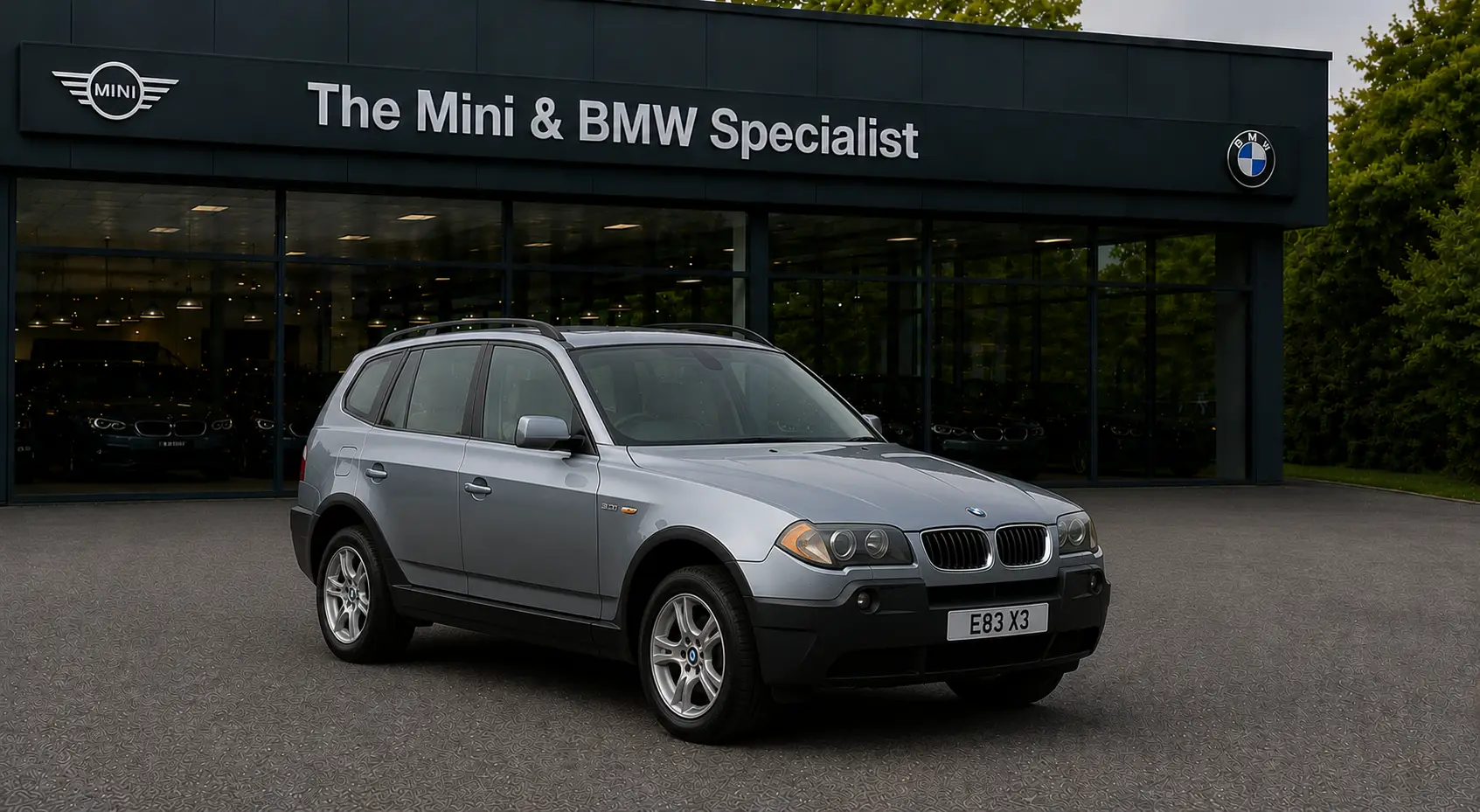
Engines
Service points for this generation
Show details for the Second generation (F25)

Engines
Service points for this generation
Show details for the Third generation (G01)

Engines
Service points for this generation
Show details for the Fourth generation (G45 — current)
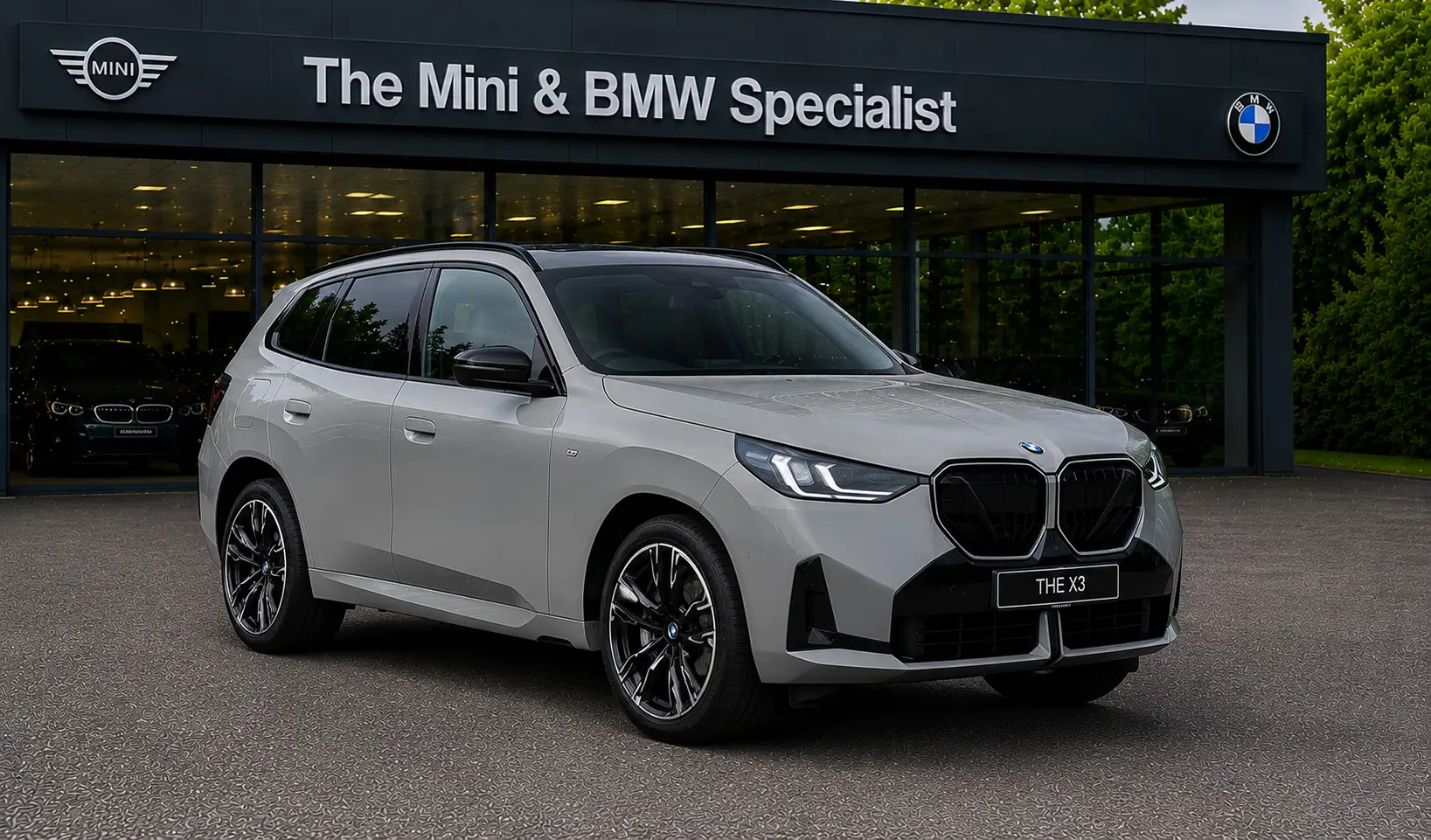
Engines
Service points for this generation
The N20 2.0-litre turbocharged four-cylinder fitted to the F25 X3 xDrive20i and xDrive28i (2011–2017) has a well-documented timing chain wear issue. The chain, guides, and tensioner can wear prematurely — typically symptomatic somewhere between 60,000 and 100,000 miles — and the failure mode is severe: chain jump destroys the engine. This is the single most important pre-purchase consideration on any F25 petrol. The symptom to listen for is a distinctive rattle from the front of the engine, particularly on cold start and most pronounced in the first few seconds before oil pressure builds. Owners often dismiss this as a normal cold-start noise, but on the N20 it is not. We treat any N20 with a cold-start rattle as urgent and recommend immediate diagnostic inspection. Preventive chain, guide, and tensioner replacement is a substantial job but materially cheaper than engine replacement after a chain jump. Service history showing the work already done is a strong positive on any used F25 N20 — and a complete absence of any reference to it on a high-mileage car is a flag to investigate properly. Yes — the N47 2.0-litre diesel fitted to the late E83 X3 (2007–2010, xDrive20d and xDrive18d) and the pre-LCI F25 X3 (2010–2014, xDrive20d) has the well-known rear-of-engine timing chain issue that affects this engine across the wider BMW range. The chain runs at the rear of the engine — between the engine and gearbox — which means replacement requires either engine or gearbox removal. Substantial labour cost. The symptom to listen for is a distinctive rattle from the rear of the engine, particularly on cold start. In advanced cases, chain stretch affects cam timing and produces running issues — rough idling, loss of power, fault codes. We diagnose suspected cases with a borescope inspection and recommend replacement before the chain jumps. Many cars have already had the work done at some point; service history is the critical pre-purchase consideration. The post-LCI F25 (2014 onwards) uses the B47 diesel, which substantially addressed the timing chain issue. If long-term ownership cost certainty matters, a late-LCI F25 B47 is a materially more relaxed proposition than the N47 cars it replaced. We're happy to inspect either generation at our Great Bridge, Tipton (DY4 7LH) workshop. The most common cause of a 4WD warning light on the X3 (across the E83, F25, and G01 generations) is failure of the transfer case actuator — the electric servo motor that operates the multi-plate clutch inside the transfer case to vary torque distribution between the front and rear axles. When the actuator fails, the system loses the ability to engage the front axle reliably and the warning light is triggered. Other symptoms include intermittent clunking on take-off, vague handling in wet conditions, and uneven tyre wear on cars driven for extended periods with the fault unaddressed. The good news: the actuator is replaceable as a separate item, substantially cheaper than full transfer case replacement. Most independent BMW workshops with the correct diagnostic tooling can identify whether the fault is the actuator alone or genuine transfer case wear inside the unit. The bad news: some owners discover the fault after it has been ignored long enough for collateral damage to occur, in which case the bill grows. We diagnose 4WD warning faults on a fault-by-fault basis at our Great Bridge, Tipton (DY4 7LH) workshop and quote actuator-only replacement separately from full transfer case work. Honest diagnosis first; quote based on what the car actually needs. Yes — we service the X3 xDrive30e plug-in hybrid in both G01 (2020–2024) and G45 (2024–present) forms. We're fully equipped for hybrid-specific service work including high-voltage system inspection, battery state-of-health assessment, charging system diagnostics, and the ZF 8HP fluid service adapted for the electrified gearbox housing. This work does not need to be referred to a main dealer. The 30e is a sensible used-PHEV proposition for owners with predictable short commutes who can charge at home. The G01 30e offers around 28 miles of WLTP electric-only range from its 12 kWh battery; the G45 30e offers meaningfully more (BMW quotes up to around 56 miles in optimal conditions, with UK figures varying by spec) from a substantially larger pack. Owners using the car as intended — daily charge, predominantly electric short commute, petrol engine for longer trips — see real-world running cost benefits. Owners who never charge and rely on the petrol B48 alone are carrying around battery weight for no benefit. This is a genuinely confusing one because BMW has two "X3-named" products on sale simultaneously, on completely different platforms. They share the X3 name and very little else. The G45 X3 (in UK showrooms from late 2024) is the fourth-generation conventional X3: petrol and diesel engines with 48V mild-hybrid technology, plus the xDrive30e plug-in hybrid. Built on BMW's revised CLAR platform at Plant Spartanburg in South Carolina. The performance flagship is the M50 xDrive with the B58 inline-six — there is no combustion X3 M variant in this generation. This is the X3 for buyers wanting petrol, diesel, or PHEV powertrains. The iX3 (NA5), with UK customer deliveries beginning 7 March 2026, is a completely separate model on BMW's new Neue Klasse platform — the first production Neue Klasse vehicle. Built at the new Plant Debrecen in Hungary. Fully battery-electric only, with sixth-generation BMW eDrive technology, around 500 miles of WLTP range, and 400 kW peak charging. This is the X3 for buyers wanting a battery-electric SUV. We service both. The G45 and the NA5 share the X3 name but no mechanical commonality, so service procedures, parts catalogues, and diagnostic approaches are entirely different between them. iX3 NA5-specific service detail will appear on a dedicated iX3 page as the model establishes itself in the UK fleet. Owners of either are welcome at our Great Bridge, Tipton (DY4 7LH) workshop.