

BMW 4 Series Service Costs
Transparent pricing, OE-quality parts and open, honest advice.
BMW 4 Series Service Costs – Reliable Care Without Main Dealer Prices
Select your BMW model below (or enter your registration) to view fixed service costs using our Service Calculator.
Looking for Trusted BMW 4 Series Servicing?
Use our BMW 4 Series Service Calculator to check fixed pricing, compare service packages, and plan your maintenance confidently.
We service all 4 Series models — from the efficient 418d and 420i to the powerful 430d and high-performance 440i — using only OE-standard parts for performance and warranty protection.
Our prices include parts, labour, and VAT as standard, with no hidden costs.
We always reset the onboard service computer and update digital service records where fitted.
Conveniently located near Birmingham with easy access to the M5 and M6 motorways, we are trusted specialists for petrol, diesel, and performance BMW 4 Series servicing across the West Midlands.
Why Choose Us for Your BMW 4 Series Servicing?
Transparent Pricing
Fixed prices with parts, labour, and VAT included — no hidden costs.
Digital Service Updates
Service computer reset and digital history updated (where fitted).
Genuine OE-Standard Parts
We use OE-spec parts to protect your performance and warranty.
All Models Expertly Serviced
Petrol, diesel, and performance BMW 4 Series models serviced with care.
Convenient Location
Located in Great Bridge, West Midlands (DY4 7LH) — easy access from Birmingham, Wolverhampton, Dudley, M5 and M6.
Trusted by BMW Owners
Proven track record for honest advice, expert service, and lasting customer relationships.
BMW 4 Series Fixed-Price Servicing Guide
Important: The service prices shown below are typical examples. Exact pricing varies by model, engine size, and fuel type. For an exact quote, please select your model using the Service Calculator above.
All services include VAT, parts, labour, service computer reset, and digital service record updates (where fitted). No hidden charges — just clear, honest pricing.
| Service | What’s Included | Price |
|---|---|---|
| Bronze Service | Oil and filter change using BMW spec oil and filter | From £150.00 |
| Silver Service (4 Cylinder) | Oil, filter, and air filter change using BMW spec parts | From £200.00 |
| Gold Service (4 Cylinder) | Oil, filter, air filter, and cabin filter change using BMW spec parts | From £280.00 |
| Platinum Service (4 Cylinder Petrol) | Gold Service plus spark plug replacement | From £425.00 |
| Silver Service (6 Cylinder) | Oil, filter, and air filter change using BMW spec parts | From £260.00 |
| Gold Service (6 Cylinder) | Oil, filter, air filter, and cabin filter change using BMW spec parts | From £325.00 |
| Platinum Service (6 Cylinder Petrol) | Gold Service plus spark plug replacement | From £495.00 |
| Platinum Service (Diesel) | Gold Service plus fuel filter replacement | From £395.00 |
| Brake Fluid Flush | Flush and replacement using high-performance DOT4 brake fluid | £100.00 |
| MOT | Official Ministry of Transport test for vehicles over 3 years old | £50.00 |
| Diagnostic Check | Dealer-level BMW diagnostic scan and technician report | £80.00 |
What’s Included with Your BMW 4 Series Service?
- Fixed-price servicing with genuine or OE-standard parts
- Onboard service computer reset and digital history update (where fitted)
- Brake, steering, suspension, and engine health checks
- Service options tailored for petrol, diesel, and M Sport models
- Full invoice transparency — no hidden charges
Need Help Choosing the Right BMW 4 Series Service?
Use our BMW 4 Series Service Calculator at the top of this page to explore all service options for your car, compare prices, and book online with confidence.
Prefer to talk? Call us on 0330 999 0020 — our team is happy to help with advice and bookings.
Knowing which generation your BMW 4 Series belongs to matters for servicing. Engines, oil specifications, service intervals, and common faults all vary significantly between generations. Use the table below to identify your generation, then explore the details for engine codes, body styles, and service points. The F32 generation was the first BMW 4 Series, created in 2013 when BMW split the 3 Series coupé and convertible body styles out into a separate model family. The mechanical underpinnings, engines, and electrical architecture were shared directly with the F30 3 Series of the same era — the 4 Series effectively was a 3 Series coupé wearing a different badge, with a lower roofline, a wider rear track, and a more aggressive front-end treatment. Three body styles ran across the generation: F32 two-door coupé (launched 2013), F33 convertible with folding metal hardtop (launched 2014), and F36 Gran Coupé four-door fastback (launched 2014). The F36 in particular found a strong UK market — buyers who wanted four doors and a usable boot but preferred the coupé-influenced styling to a conventional saloon. A significant Life Cycle Impulse (LCI) facelift arrived in 2017 — the most visually obvious change was full LED headlights as standard across the range, but the LCI also brought updated infotainment (iDrive 6 with optional touchscreen), revised suspension settings, and the introduction of the B-series modular engines (B48 petrol, B47 diesel) replacing the older N-series units on most variants. Production ended in 2020 when the G22 second-generation 4 Series replaced it. The F32/F33/F36 remains a strong used-car proposition in 2026 — most are now between 5 and 12 years old, out of manufacturer warranty, and forming the bulk of the independent specialist workload. The F82/F83 M4 high-performance variants are covered separately on our M cars page. N20 (2.0 litre four-cylinder turbo) — pre-LCI — fitted to the 420i (135 kW / 184 hp) and 428i (180 kW / 245 hp) until 2016. The N20 carries the timing chain concern familiar from the F30 3 Series — the chain itself and particularly the chain guides can wear prematurely, with failure most commonly reported between 60,000 and 100,000 miles on cars with extended service intervals. Symptoms are typically a rattle on cold start that disappears once the engine warms up. We replace timing chain kits on these engines regularly and recommend shorter-than-CBS oil change intervals to prolong chain life. N55 (3.0 litre inline-six turbo) — pre-LCI — fitted to the 435i (225 kW / 306 hp). The N55 is widely considered one of BMW's best modern petrol engines — strong performance, reasonable fuel economy for a six-cylinder turbo, and a generally good reliability record. Watch for valve cover gasket leaks (common on all N55s after 80,000 miles) and water pump failure around 80,000–100,000 miles. The N55 in the 435i is the connoisseur's choice for an F32 — strong torque, characterful sound, and a more involving drive than the four-cylinder variants. B48 (2.0 litre four-cylinder turbo) — post-LCI — replaced the N20 from 2016 onwards. Fitted to the 420i (135 kW / 184 hp), 430i (185 kW / 252 hp), and other regional variants. The B48 is part of BMW's modular B-series family, designed from the start to address the failure modes of the N20 generation — different chain design, different oil pump architecture, generally more robust. From 2020 onwards (the final year of F32 production), B48-engined cars gained 48V mild-hybrid technology as standard. B58 (3.0 litre inline-six turbo) — post-LCI — replaced the N55 from 2016 onwards in the 440i (240 kW / 326 hp). The B58 is widely regarded as one of the great modern BMW engines — strong performance, strong reliability record, and a smooth power delivery characteristic of BMW's inline-six tradition. The 440i is the most desirable non-M F32 variant on the used market. N47 (2.0 litre four-cylinder common-rail) — pre-LCI — fitted to the 418d (105 kW), 420d (140 kW), and 425d (160 kW) until 2014. The N47 carries the well-known rear-mounted timing chain concern — failure typically requires engine removal to access the chain, making it one of the most expensive routine repairs on any modern BMW. We see N47 timing chain work regularly and can quote on this; we'd strongly recommend any F32 buyer have an N47 car inspected for chain stretch symptoms before purchase. B47 (2.0 litre four-cylinder common-rail) — from 2014 — replaced the N47 in the 418d, 420d, and 425d, and continued through the LCI. Front-mounted timing chain (no N47-style rear-access issue). The B47 has a much better reliability track record than the engine it replaced and is generally considered one of the better modern BMW diesels. N57 (3.0 litre inline-six common-rail) — pre-LCI — fitted to the 430d (190 kW) and 435d (230 kW, twin-turbo). The 435d xDrive in particular was a UK favourite — significant torque (630 Nm), strong real-world fuel economy on motorway runs, and a usable performance/economy compromise. The N57 carries the same general considerations as in the F30 — EGR cooler reliability, swirl flap considerations on early units, and DPF regeneration on cars used for predominantly short journeys. B57 (3.0 litre inline-six common-rail) — post-LCI — replaced the N57 in the 430d and 435d from 2017 onwards. The B57 is the spiritual successor to the legendary M57 and N57 inline-six diesels and shares its architecture with the diesel engines in the G20, G30, and X5 ranges of the same era. The mature used-car generation. Most F32/F33/F36 cars on UK roads today are between 5 and 12 years old, out of manufacturer warranty, and on second or third ownership. The buyer profile is typically the enthusiast or value-conscious used buyer rather than the lease customer — people who chose the 4 Series because they wanted the coupé/convertible/Gran Coupé body style and could afford to run a premium German car independently. Service expectations are pragmatic: fair fixed pricing, honest advice, no upselling. Engine-specific service items. N20 timing chain inspection and replacement remains a high-volume item — we'd estimate one in three pre-LCI 420i/428i cars will need chain work at some point. N47 timing chain on the pre-2014 diesel variants is similar and significantly more expensive due to the rear-mounted chain location. N55 water pump and valve cover gasket replacements are routine on 435i variants past 80,000 miles. Post-LCI B-series engines are much more service-predictable. Body-style-specific items. The F33 convertible's folding metal hardtop is a complex assembly with multiple hydraulic rams, microswitches, and a dedicated control module — when it works, it works beautifully; when something fails, diagnosis and repair are specialist work. The F36 Gran Coupé's frameless doors and tailgate need their seals and alignment checked at every service to avoid water ingress, particularly on cars that have been parked outside long-term. Brake fluid and brake hardware. Brake fluid changes are every two years on all F32 generation variants — DOT 4 LV. Brake pad and disc replacement intervals depend heavily on driving style; M Sport models with larger calipers tend to consume rear pads faster than standard cars due to weight distribution and the more aggressive ABS/DSC calibration. Independent specialist economics. An F32 is the kind of car where the cost differential between BMW main dealer servicing and independent specialist servicing matters most — these are cars where main dealer pricing makes the running cost question difficult, but where careful independent servicing keeps the car affordable for another five or ten years. The M4 (F82/F83) variants are covered separately on our M cars page. The G22 is the current 4 Series — the generation defined visually by the controversial vertical kidney grille, and mechanically by being built on the same CLAR platform as the G20 3 Series, G30 5 Series, and other current BMW models. Production began in 2020 with the G22 coupé, followed by the G23 convertible in 2021 (now with a fabric soft-top rather than the F33's folding hardtop, saving weight and trunk space) and the G26 Gran Coupé in 2021. Mechanically the G22 shares the full B-series modular engine family with the G20 3 Series — B48 four-cylinder petrol, B58 inline-six petrol, B47 four-cylinder diesel, B57 inline-six diesel. The 48V mild-hybrid system fitted across most variants from launch carries over from the late F32 era. Like the G20, the G22 features the standard CLAR-platform infotainment progression: launch-spec iDrive 7 with the BMW Live Cockpit display, replaced from July 2022 by the BMW Curved Display and BMW Operating System 8 / iD 8. The G26 Gran Coupé deserves separate mention because its arrival reshaped the broader 3/4 Series range. BMW chose not to replace the F34 3 Series Gran Turismo when the G20 launched in 2018, instead consolidating the four-door fastback role into the G26 4 Series Gran Coupé. The result is that current 3 Series buyers see saloon and Touring options only, while four-door fastback buyers shop the 4 Series range. The G82/G83 M4 high-performance variants are covered separately on our M cars page. B48 (2.0 litre four-cylinder turbo) — multiple power outputs — the workhorse petrol engine of the G22 range. Fitted to the 420i (135 kW / 184 hp) and 430i (190 kW / 258 hp), plus the 420e plug-in hybrid variant (covered under Hybrid & Electric below). Same engine block as the G20 3 Series of the same era, different turbo and tuning. The B48 is widely regarded as one of the most reliable modern BMW engines, with a well-understood service profile after a decade in production. 48V mild-hybrid technology is standard across the range. B58 (3.0 litre inline-six turbo) — fitted to the M440i (285 kW / 387 hp). The B58 carries over from the late F32 generation with revised tuning. The M440i is the highest-performance non-M G22 variant — strong real-world performance, an inline-six soundtrack that BMW has worked hard to preserve, and the closest analogue to the spirit of the old E92 335i for buyers who don't want or can't justify the full M4. 48V mild-hybrid as standard. B47 (2.0 litre four-cylinder common-rail) — fitted to the 420d (140 kW). UK diesel demand has reduced significantly across the G22's production run compared to the F32 era — buyer preferences have shifted toward petrol and PHEV variants for company-car use, leaving the 420d as a smaller proportion of UK sales. Mechanically the B47 is the same well-proven unit as in the G20 320d, with the same maintenance profile and reliability record. Front-mounted timing chain. 48V mild-hybrid as standard. B57 (3.0 litre inline-six common-rail) — fitted to the M440d (250 kW, twin-turbo, MHEV). UK availability of the M440d has varied across the production run; it remains a niche choice. The B57 carries the same maintenance profile as the equivalent G20 330d/M340d diesel. 420e plug-in hybrid (2021–) — B48 four-cylinder petrol engine combined with an electric motor. The 420e shares its drivetrain architecture with the G20 320e — 150 kW / 204 PS combined, 12 kWh battery (9.6 kWh usable), up to 60 km / 37 mi WLTP electric-only range. The 420e is the lowest-Benefit-in-Kind option in the 4 Series range and has been a strong company-car choice in the UK. Service-relevant points for the 420e plug-in hybrid: the low-temperature cooling loop for the high-voltage battery and power electronics has its coolant level and condition checked at every service. The onboard charger benefits from periodic diagnostic interrogation, particularly on cars used for predominantly home AC charging. The 12V auxiliary battery works harder than on a pure ICE car (powering the BCM whenever the high-voltage system is dormant) and tends to need replacement earlier. We're fully equipped for plug-in hybrid servicing with isolation procedures and HV-rated tooling. The high-voltage battery itself is sealed and warrantied separately by BMW (typically 8 years / 100,000 miles). 48V mild-hybrid (MHEV) — standard on most variants — the 48V belt-driven starter-generator system fitted across most B48/B47/B57/B58 variants from launch provides smoother stop-start operation, brief torque assist during acceleration, and modest fuel-economy improvements. From a service standpoint the MHEV system adds two specific items: the 48V starter-generator belt is a longer-life part than a traditional auxiliary belt but does have a defined replacement interval, and the high-current 48V system requires isolation procedures during any work near the starter-generator or 48V battery. The 12V system runs in parallel as on a conventional car. There is no fully electric (BEV) version of the G22 4 Series — BMW's electric mid-size offering is the i4, which despite the name shares its platform and most of its body with the G26 4 Series Gran Coupé rather than the saloon-bodied G20 3 Series. The current era. Most G22 cars on UK roads today are between 1 and 6 years old. Many are still within manufacturer warranty or on their original lease/PCP contract. The G22 owner profile is mixed — company-car drivers (particularly 420e plug-in hybrid customers benefiting from the favourable Benefit-in-Kind rate), lease customers about to take ownership at end-of-term, and first-time private buyers of nearly-new used cars. Service expectations are conventional and modern: BMW Service Inclusive plans, scheduled service intervals based on Condition Based Service (CBS), and warranty considerations for cars still under cover. We work with all of these scenarios. B-series modular engines — proven track record. The B48, B57, and B58 engines have now been in production for around a decade and have a well-understood reliability profile. There is no equivalent to the N47 / N20 timing chain horror story in the G22 range — these engines were designed from the start to address the failure modes that affected the previous generation. The most common service items at this stage are conventional oil-and-filter changes, brake servicing/replacement, electronic component-level diagnostics, and routine wear items. iDrive transition — July 2022 cars. The mid-cycle move from iDrive 7 / Live Cockpit (pre-July 2022) to the BMW Curved Display / iD 8 system (from July 2022) means service technicians need to be comfortable with both system architectures. Software updates, coding interventions, and diagnostic procedures differ between the two — early-build G22 cars on iDrive 7 can sometimes be updated to newer software builds, but cannot be retrofitted to the Curved Display hardware. Body-style-specific items. The G23 convertible's fabric soft-top is mechanically simpler than the F33 folding hardtop it replaced — fewer hydraulic rams, fewer microswitches, fewer points of failure — but the fabric and seals are wear items and the mechanism needs periodic lubrication and seal-condition inspection. The G26 Gran Coupé's tailgate hinges and frameless door seals follow the same maintenance pattern as the F36 they replaced. The G82/G83 M4 high-performance variants share the G22's underlying platform but use the S58 inline-six engine and are covered separately on our M cars page. Found your model? Get an exact service price in seconds using the Service Calculator at the top of this page, or call us to discuss your specific car. Generations of the BMW 4 Series
Generation
Years
Chassis codes
Body styles
Platform
First generation (F32/F33/F36)
2013–2020
F32 (coupé), F33 (convertible), F36 (Gran Coupé)
2-door coupé (F32), 2-door convertible (F33), 5-door Gran Coupé fastback (F36)
BMW F-platform — rear-wheel drive with optional xDrive all-wheel drive
Second generation (G22/G23/G26)
2020–present
G22 (coupé), G23 (convertible), G26 (Gran Coupé)
2-door coupé (G22), 2-door convertible (G23), 5-door Gran Coupé fastback (G26)
BMW CLAR (Cluster Architecture) — rear-wheel drive with optional xDrive all-wheel drive
Show details for the First generation (F32/F33/F36)
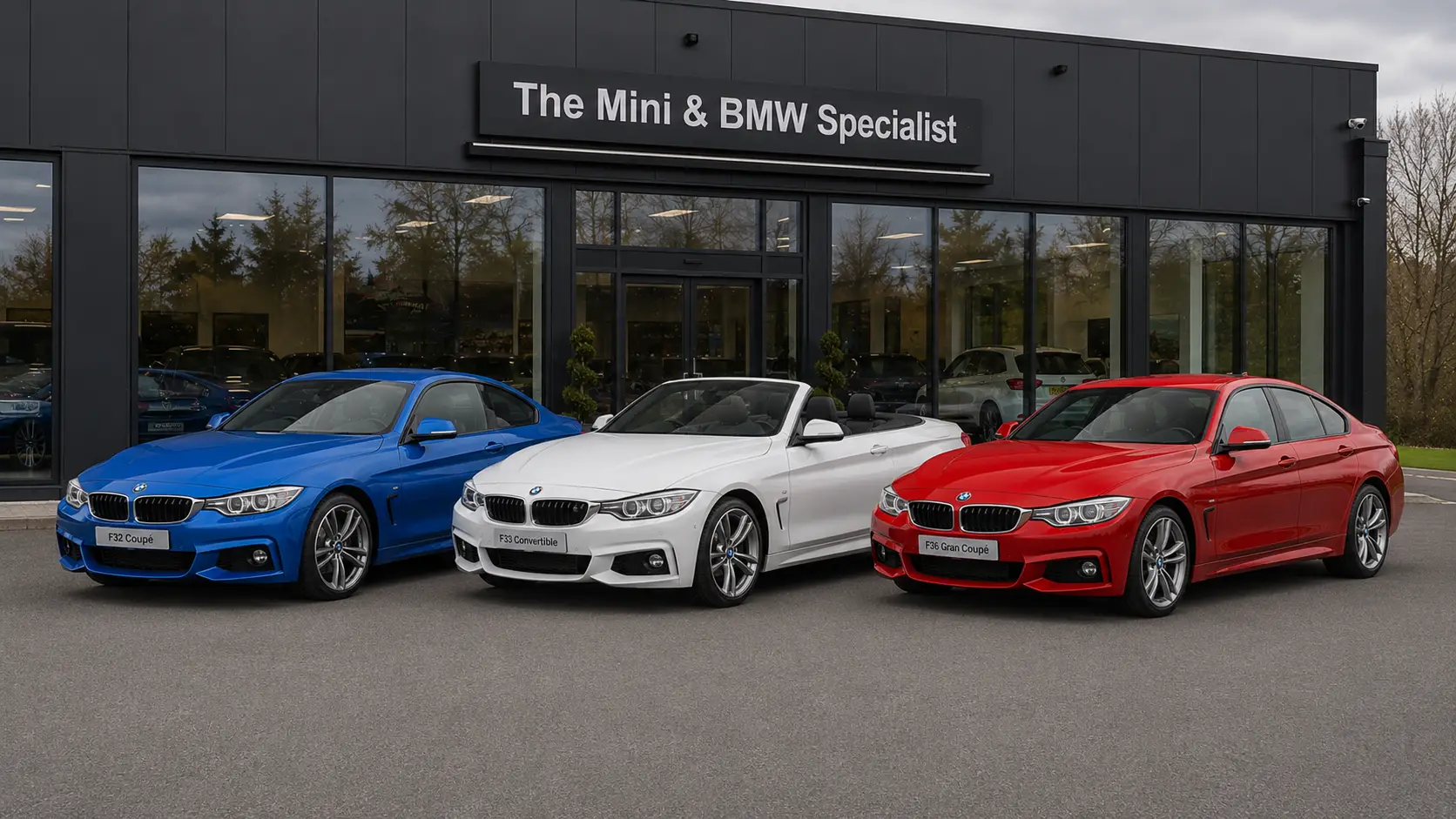
Engines
Service points for this generation
Show details for the Second generation (G22/G23/G26)
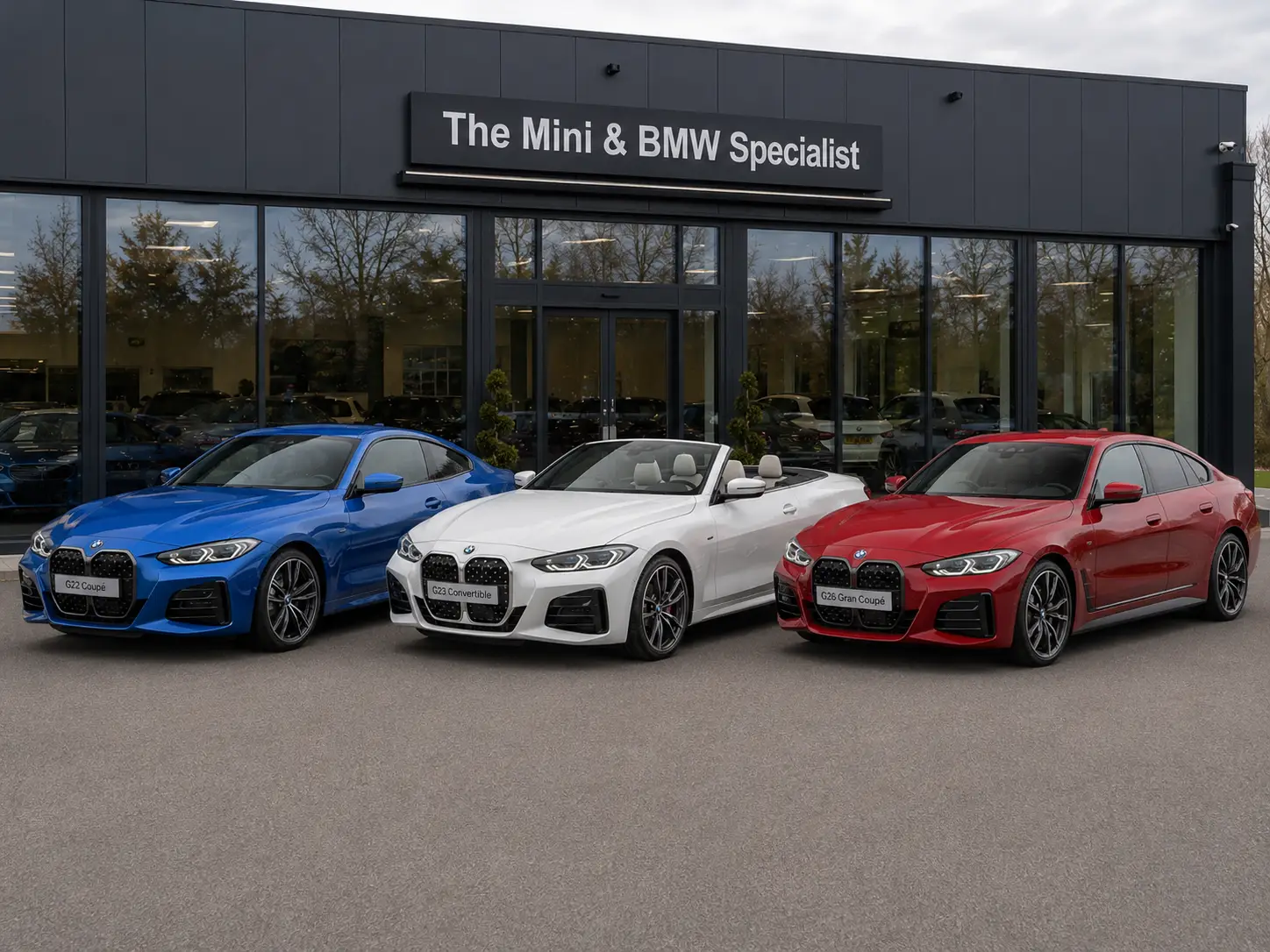
Engines
Service points for this generation
BMW 4 Series Servicing FAQs
- What oil is best for a BMW 4 Series?
- Modern BMW 4 Series petrol engines (N20, N55, B48, B58) require BMW Longlife-01 or Longlife-14 FE specification oil — typically a 0W-20 or 5W-30 fully synthetic, depending on engine and model year. Diesel variants (N47, B47, N57, B57) require BMW Longlife-04, a 5W-30 fully synthetic compatible with the diesel particulate filter. We use the correct BMW-approved specification for your specific engine and year, supplied by Castrol or equivalent OE-standard suppliers, and update your onboard service computer with the oil grade and date.
- How often does a BMW 4 Series need servicing?
- We recommend servicing your BMW 4 Series every 12 months or 12,000 miles, whichever comes first — regardless of what the onboard service computer (CBS) says, since CBS intervals can stretch to 18,000+ miles on light usage and that's too long for modern turbocharged engines. Diesel variants (420d, 425d, 430d, 435d) benefit from shorter intervals if used predominantly on short journeys, due to DPF regeneration and oil dilution. The 420e plug-in hybrid follows the same 12-month interval but has additional checks for the high-voltage cooling system and onboard charger.
- Does a BMW 4 Series service include a brake fluid change?
- Brake fluid changes are separate from a standard service but are recommended every two years on the 4 Series, in line with BMW's published schedule. Brake fluid is hygroscopic — it absorbs moisture over time, which lowers its boiling point and risks vapour lock under hard braking. We offer a fixed-price brake fluid flush using DOT 4 LV (low viscosity) fluid as required by all F32 and G22 generation 4 Series, including models fitted with M Sport brakes. See your model's service options for current pricing.
- Will servicing my BMW 4 Series at an independent garage affect the warranty?
- No — under EU Block Exemption Regulation 461/2010 (retained in UK law post-Brexit), you can have your BMW 4 Series serviced at any independent garage without affecting your manufacturer or extended warranty, provided OE-standard parts are used and the BMW service schedule is followed. We use genuine BMW or OE-standard parts throughout, follow BMW's published service intervals and procedures, and provide a full digital service history that satisfies warranty requirements. Your warranty remains intact.
- How much is a full service on a BMW 4 series?
- BMW 4 Series servicing costs depend on the model, engine, and service type. Interim services start from around £190, full services from around £290, with diesel variants and M Sport models typically £20–£40 higher due to additional consumables. Plug-in hybrid 420e variants sit at the upper end due to HV system checks. The convertible (F33/G23) and Gran Coupé (F36/G26) body styles use the same service pricing as the coupé equivalents. Use our BMW 4 Series Service Calculator at the top of this page for fixed prices on your exact model, or call us on 0330 999 0020 for advice.
- How do you service a BMW 420e plug-in hybrid?
- The 420e shares the B48 petrol engine and largely the same service schedule as the standard petrol 4 Series — 12 months / 12,000 miles, BMW Longlife-01 FE oil, standard filters and consumables. The differences are around the hybrid system: a separate low-temperature cooling loop for the high-voltage battery and power electronics that needs its coolant level and condition checked, an onboard charger that benefits from periodic diagnostic interrogation, and a 12V auxiliary battery that works harder than on a pure ICE car and tends to need replacement earlier. We're set up for plug-in hybrid servicing with isolation procedures and HV-rated tooling. The high-voltage battery itself is sealed and warrantied separately by BMW (typically 8 years / 100,000 miles). The 420e drivetrain is shared with the 320e and 330e in the 3 Series range, so the same service competency applies.