

BMW 8 Series Service Costs
Transparent pricing, OE-quality parts and open, honest advice.
BMW 8 Series Service Costs – Reliable Care Without Main Dealer Prices
Select your BMW model below (or enter your registration) to view fixed service costs using our Service Calculator.
Looking for Premium BMW 8 Series Servicing?
Use our BMW 8 Series Service Calculator to check fixed pricing, compare service packages, and plan your maintenance confidently.
We service all 8 Series models — including the 840i, 840d, M850i and 860i — using only OE-standard parts for performance and warranty protection.
Our prices include parts, labour, and VAT as standard, with no hidden costs.
We always reset the onboard service computer and update digital service records where fitted.
Conveniently located near Birmingham with easy access to the M5 and M6 motorways, we are trusted specialists for petrol, diesel, and hybrid BMW 8 Series Coupé, Convertible, and Gran Coupé models across the West Midlands.
Why Choose Us for Your BMW 8 Series Servicing?
Transparent Pricing
Fixed prices with parts, labour, and VAT included — no hidden costs.
Digital Service Updates
Service computer reset and digital history updated (where fitted).
Genuine OE-Standard Parts
We use OE-spec parts to protect your performance and warranty.
All Models Expertly Serviced
Coupé, Convertible, and Gran Coupé petrol, diesel, and hybrid models serviced with care.
Convenient Location
Located in Great Bridge, West Midlands (DY4 7LH) — easy access from Birmingham, Wolverhampton, Dudley, M5 and M6.
Trusted by BMW Owners
Proven track record for honest advice, expert service, and lasting customer relationships.
BMW 8 Series Fixed-Price Servicing Guide
Important: The service prices shown below are typical examples. Exact pricing varies by model, engine size, and fuel type. For an exact quote, please select your model using the Service Calculator above.
All services include VAT, parts, labour, service computer reset, and digital service record updates (where fitted). No hidden charges — just clear, honest pricing.
| Service | What’s Included | Price |
|---|---|---|
| Bronze Service | Oil and filter change using BMW spec oil and filter | From £250.00 |
| Silver Service (6 Cylinder) | Oil, filter, and air filter change using BMW spec parts | From £299.00 |
| Gold Service (6 Cylinder) | Oil, filter, air filter, and cabin filter change using BMW spec parts | From £350.00 |
| Platinum Service (6 Cylinder Petrol) | Gold Service plus spark plug replacement | From £500.00 |
| Platinum Service (Diesel) | Gold Service plus fuel filter replacement | From £395.00 |
| Brake Fluid Flush | Flush and replacement using high-performance DOT4 brake fluid | £100.00 |
| MOT | Official Ministry of Transport test for vehicles over 3 years old | £50.00 |
| Diagnostic Check | Dealer-level BMW diagnostic scan and technician report | £80.00 |
What’s Included with Your BMW 8 Series Service?
- Fixed-price servicing with genuine or OE-standard parts
- Onboard service computer reset and digital history update (where fitted)
- Brake, steering, suspension, and engine health checks
- Service options tailored for petrol, diesel, hybrid, and M Sport models
- Full invoice transparency — no hidden charges
Need Help Choosing the Right BMW 8 Series Service?
Use our BMW 8 Series Service Calculator at the top of this page to explore all service options for your car, compare prices, and book online with confidence.
Prefer to talk? Call us on 0330 999 0020 — our team is happy to help with advice and bookings.
Knowing which generation your BMW 8 Series belongs to matters for servicing. Engines, oil specifications, service intervals, and common faults all vary significantly between generations. Use the table below to identify your generation, then explore the details for engine codes, body styles, and service points. The E31 was BMW's flagship grand tourer from 1990 to 1999, replacing the E24 6 Series as the company's top-tier coupé — though positioned substantially higher in price, performance, and ambition. Debuting at the 1989 Frankfurt Motor Show, the E31 introduced several firsts: it was the first road car to offer a V12 engine mated to a six-speed manual gearbox, one of the first production cars with electronic drive-by-wire throttle, and among BMW's earliest models to use a multi-link rear axle. The design, penned by Klaus Kapitza in 1986, was aerodynamically advanced for its era and aged remarkably well. Available exclusively as a two-door coupé, the E31 offered V8 and V12 powertrains spanning 286 hp to 380 hp, with transmission choices including four-speed automatic, five-speed automatic, and six-speed manual depending on model and market. Despite critical acclaim, sales never matched expectations — the E31 arrived during a global economic downturn and competed in a narrow market segment. Approximately 31,000 units were produced across a nine-year run. Today, the E31 is increasingly recognised as one of BMW's most significant grand tourers and a rewarding ownership proposition for enthusiasts willing to invest in specialist care. The E31 offered two V8 and three V12 petrol engines across its production run. The 840Ci (1993–1999) featured the M60B40 4.0-litre V8 producing 286 hp and 400 Nm (1993–1996), replaced by the revised M62B44 4.4-litre V8 with 286 hp and 420 Nm (1996–1999) — the M62 bringing lighter Alusil block construction, revised valve timing, and improved low-end torque. The 850i (1990–1994) launched with the M70B50 5.0-litre V12 producing 300 hp and 450 Nm, paired with either a six-speed manual or four-speed automatic. The 850Ci (1994–1999) received the upgraded M73B54 5.4-litre V12 with 326 hp and 490 Nm, mated to a five-speed automatic — smoother, more refined, and better suited to relaxed grand touring. At the top of the range, the homologation-special 850CSi (1992–1996) deployed the S70B56 5.6-litre V12 producing 380 hp and 550 Nm with a six-speed manual gearbox, stiffer suspension, and revised aerodynamics — the most powerful road-going BMW of its era and a genuinely rare collector's item (only 1,510 built). All E31 engines used Bosch Motronic engine management and required premium fuel; the V12 variants featured twin ECUs (one per bank) adding complexity but also redundancy. Diesel variants were not offered during the E31's production run. The grand-tourer positioning and V8/V12 powertrain strategy meant diesel power was never considered for this model. BMW's diesel programme for coupés did not begin until the much later 6 Series (E63) generation. E31 ownership rewards patience, specialist knowledge, and preventive maintenance. The V8 models (M60B40 and M62B44) are the more accessible entry point: engine bays accommodate the smaller block reasonably well, parts availability is good, and the engines are robust when properly maintained — though the M60's Nikasil bore lining can suffer sulphur damage from low-quality fuel, making engine history critical on pre-1996 examples. The M62B44 (1996+) resolved the Nikasil issue with Alusil block construction and is generally the more reliable V8 choice. V12 models demand significantly more commitment: the M70 and M73 engines fill the bay completely, making spark-plug access, cooling-hose replacement, and ancillary work labour-intensive. Twin ECUs (one per cylinder bank) add diagnostic complexity — both must be scanned when fault-finding. Cooling-system maintenance is critical on all variants; thermostat failures, water-pump wear, and radiator deterioration are common on high-mileage examples and must be addressed promptly to avoid overheating damage. The E31's pop-up headlight mechanism, while iconic, requires periodic lubrication and motor inspection. Automatic transmissions (ZF 4HP24 and 5HP30) are generally reliable but benefit from fluid and filter changes every 60,000 miles. The six-speed manual (Getrag 420G on V8, 560G on V12) is durable but can develop notchy selection with age. Suspension bushes, particularly rear subframe mounts, wear over time and significantly affect handling. Electrical systems are 1990s-era analogue/early-digital — simpler than modern BMWs but ageing wiring looms and relay boards can produce intermittent faults. The E31 is a specialist car that rewards investment in quality diagnosis and preventive maintenance; rushed or inexperienced work risks expensive consequential damage. The G15 marked the return of the 8 Series nameplate after a 19-year hiatus, replacing the outgoing F06/F12/F13 6 Series as BMW's flagship grand tourer. Unveiled at the 2018 24 Hours of Le Mans and produced at Dingolfing from late 2018, the second generation expanded the range to three body styles: two-door coupé (G15), two-door convertible (G14), and the four-door Gran Coupé (G16) — the latter offering improved rear-passenger space and positioning the 8 Series as a sportier alternative to the 5 Series saloon. Built on BMW's modular CLAR platform with Carbon Core technology integrating carbon fibre into the chassis, the G15 offered a blend of athletic handling and luxury refinement that the E31 never quite achieved commercially. Engine options spanned from the 320 hp 840d diesel through to the 625 hp M8 Competition, with the high-performance M8 variants (F91/F92/F93) arriving in 2019 powered by the S63 twin-turbo V8. The Alpina B8 Gran Coupé joined the lineup as a luxury-focused alternative to the M8. Production is scheduled to conclude in early 2026, with no direct successor announced — marking the potential end of the 8 Series line for a second time. The 840d xDrive (2018–2026) employed the B57D30 3.0-litre twin-turbo inline-six diesel producing 320 hp and 680 Nm — exceptional low-end torque making it the most relaxed long-distance cruiser in the range. Paired with xDrive all-wheel drive and the eight-speed ZF automatic, the 840d delivered 0–62 mph in 4.9 seconds whilst returning 40+ mpg on a motorway run — a compelling proposition for high-mileage grand touring. Later production examples incorporated 48-volt mild-hybrid technology (MHEV) with an 8 kW electric boost motor, improving start-stop refinement and adding electric assistance during low-speed manoeuvres. The B57 diesel is mechanically robust and long-lived, sharing its architecture with the proven units in the 5 Series and 7 Series — many examples exceed 150,000 miles with proper maintenance, quality fuel, and prompt DPF regeneration cycles. The 840d represents the pragmatic choice within the 8 Series range: genuine grand-touring ability with substantially lower running costs than the V8 petrol variants. The G15 did not offer a dedicated plug-in hybrid or fully electric variant. Later production models incorporated 48-volt mild-hybrid (MHEV) technology across the range, providing improved start-stop refinement, belt-alternator-starter electric boost, and minor fuel-economy gains — but without pure-electric driving capability or external charging. BMW's electrification strategy for the grand-tourer segment focused on the i4 and iX platforms rather than the 8 Series. The absence of a plug-in hybrid option reflects the 8 Series' positioning as a driver-focused performance car rather than an efficiency-oriented model. G15 ownership is more accessible than the E31 but still demands specialist knowledge, particularly on M8 and V8 variants. The B58 inline-six (840i) is BMW's most refined modern engine — robust, efficient, and straightforward to service with excellent parts availability; single-turbo architecture simplifies diagnostics compared to twin-turbo alternatives. The N63 V8 (M850i) is powerful and smooth but requires meticulous cooling-system maintenance; earlier N63 variants earned a mixed reliability reputation, though the TU (technical update) revision fitted to the 8 Series addressed most known issues including hot-vee oil leaks, injector failures, and turbocharger oil-feed problems. The S63 V8 (M8/M8 Competition) demands specialist M-car knowledge: higher thermal loads, track-oriented oil specifications, and performance brake wear patterns all require experienced diagnosis. The B57 diesel is mechanically excellent and long-lived; DPF health monitoring, AdBlue replenishment, and quality fuel are the primary service considerations. The eight-speed ZF 8HP transmission is robust across all variants but benefits from fluid and filter changes every 60,000 miles — despite BMW's sealed-for-life marketing. CLAR platform electronics are sophisticated: iDrive 7.0, adaptive LED headlights, adaptive suspension (where fitted), and xDrive calibration all benefit from specialist diagnostic equipment. Carbon Core chassis components are durable but collision repairs are substantially more expensive than conventional steel structures — bodywork damage assessment requires specialist knowledge. Brake wear is accelerated on M8 models driven hard; carbon-ceramic brake options reduce wear but are expensive to replace. The G15 rewards preventive maintenance and specialist service — rushed or generic workshop care risks expensive consequential damage on what is fundamentally a high-performance, technology-dense platform. Found your model? Get an exact service price in seconds using the Service Calculator at the top of this page, or call us to discuss your specific car.Generations of the BMW 8 Series
Generation
Years
Chassis codes
Body styles
Platform
First generation (E31)
1990–1999
E31
2-door coupé
BMW E31 platform (1990–1999)
Second generation (G14/G15/G16)
2018–2026
G14, G15, G16, F91, F92, F93
2-door coupé (G15), 2-door convertible (G14), 4-door Gran Coupé (G16)
BMW CLAR platform (2018–2026)
Show details for the First generation (E31)
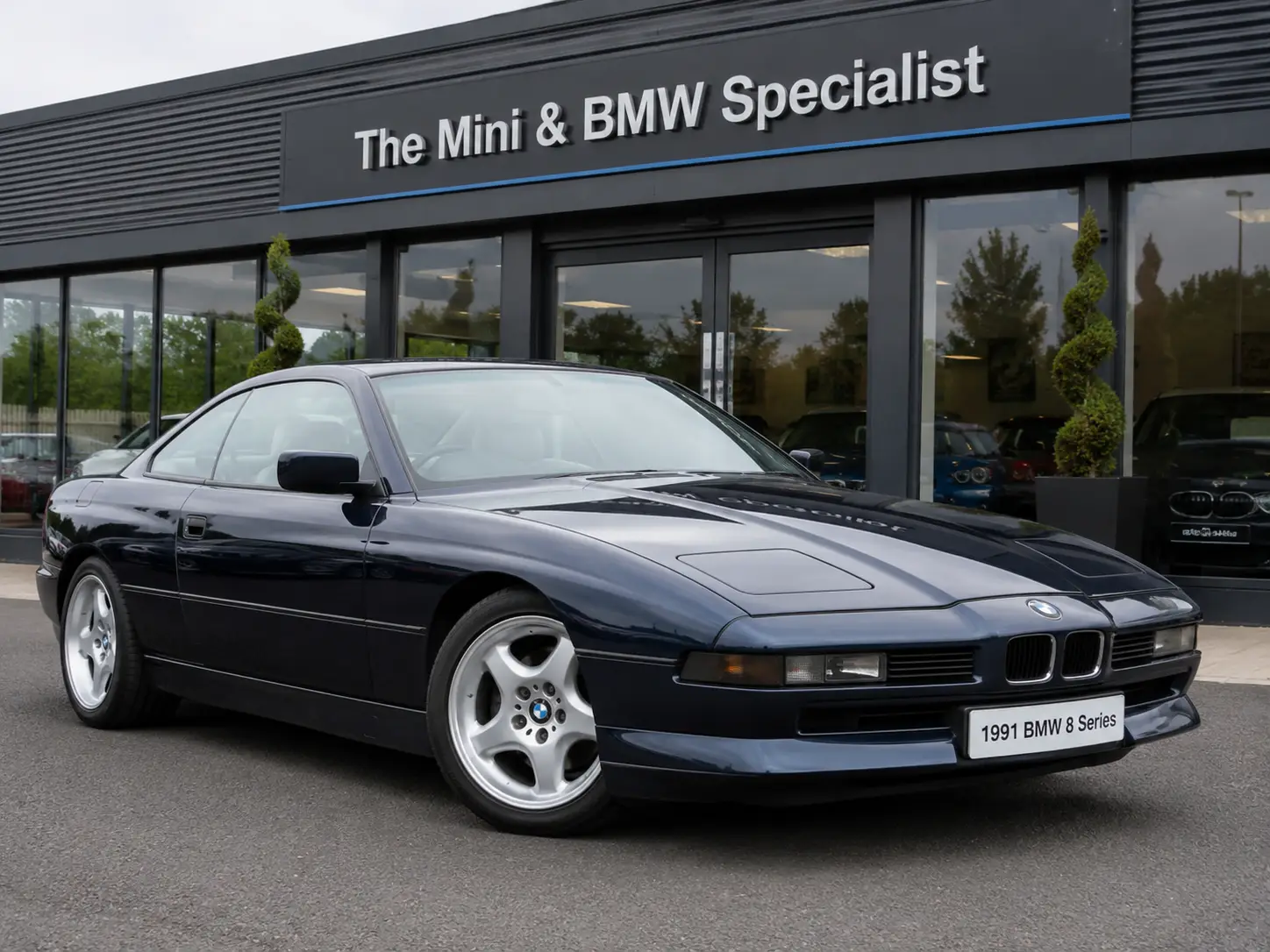
Engines
Service points for this generation
Show details for the Second generation (G14/G15/G16)
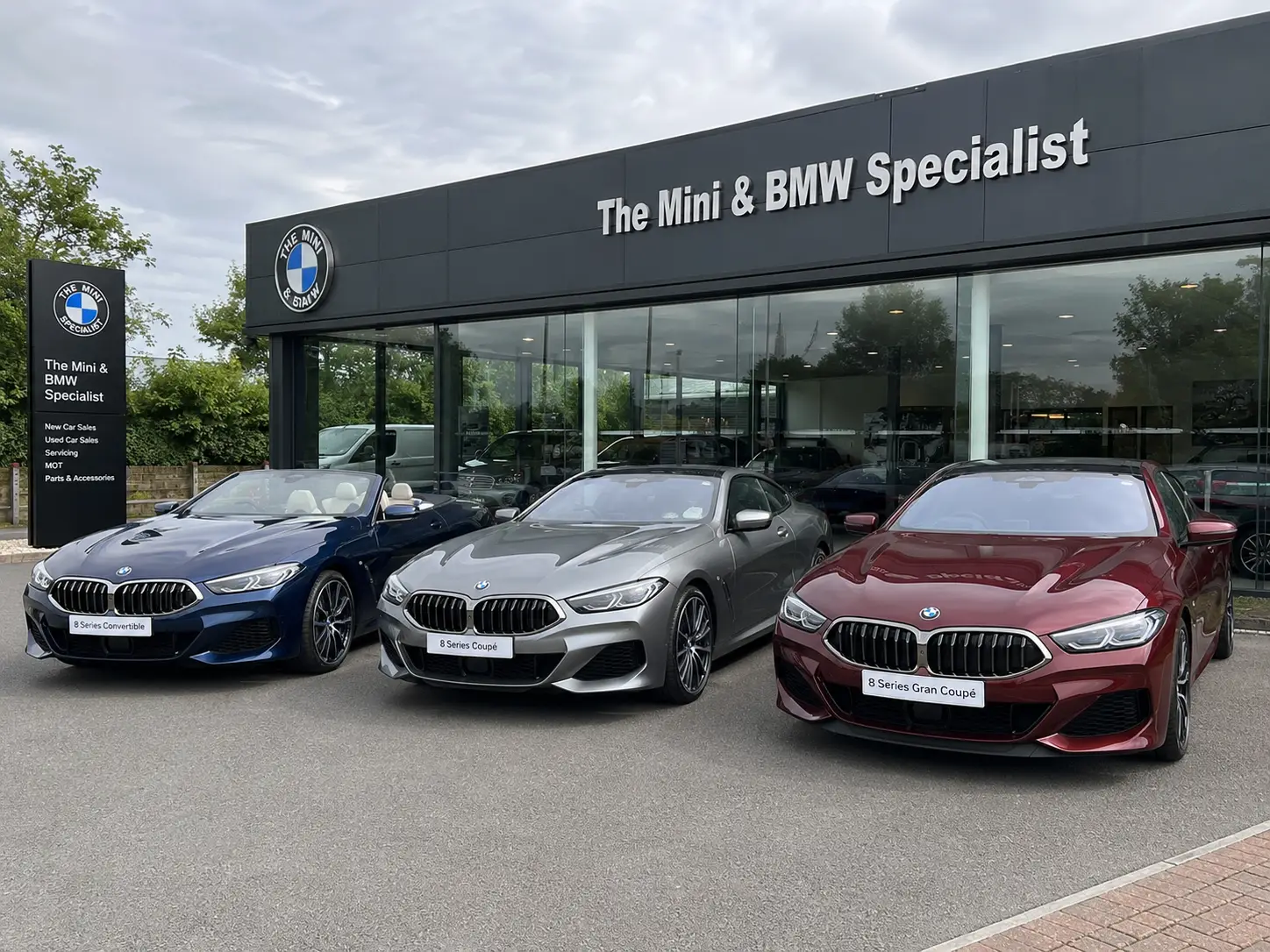
Engines
Service points for this generation
A full service on a BMW 8 Series typically costs £250–£550 at an independent specialist, depending on engine type and model year. The 840i (B58 inline-six) sits at the lower end; the M850i and M8 (N63/S63 V8) cost more due to higher oil capacity, additional filters, and labour-intensive access. Diesel 840d models fall in the mid-range, with DPF inspection included as standard. We use genuine BMW or OE-standard parts and follow BMW's service schedules to the letter. Every service includes full diagnostic scanning via BMW-specific equipment, fluid checks, brake inspection, and digital service history update where fitted. View 8 Series service options and book online. No. Under EU Block Exemption Regulation, retained in UK law, you can have your BMW 8 Series serviced by any qualified independent garage without affecting the manufacturer's warranty — provided the garage uses parts of equivalent quality and follows BMW's service schedule. We use genuine BMW or OE-standard parts (often supplied by the same manufacturers that supply BMW directly), follow BMW's service schedules to the letter, and update your digital service history where fitted. Your warranty stays fully intact, typically at 30–50% less than main dealer prices. View 8 Series service options and book online. BMW recommends servicing the 8 Series every 24 months or 15,000 miles, whichever comes first, based on the Condition Based Servicing (CBS) system. The vehicle monitors oil condition, brake wear, and filter life in real time and will display a service notification on the iDrive screen when maintenance is due. However, we recommend annual servicing regardless of mileage — particularly for V8 models (M850i, M8) where cooling-system health and oil condition are critical to long-term reliability. Diesel 840d models benefit from regular DPF health checks alongside standard servicing. View 8 Series service options and book online. The correct oil specification depends on engine type. The 840i (B58 petrol) requires fully synthetic 5W-30 meeting BMW Longlife-04 (LL-04). The M850i and M8 (N63/S63 V8) also require LL-04, though some M8 Competition owners opt for BMW M-approved 0W-40 under track or high-performance use. The 840d diesel requires 5W-30 meeting BMW Longlife-04 with low-SAPS formulation to protect the diesel particulate filter. Using the wrong specification can trigger early service warnings via oil condition sensing, and non-approved oils risk accelerated wear on timing chains and turbocharger bearings. Every service we carry out uses the correct specification oil for your engine code, supplied through our trade account with BMW-approved manufacturers. View 8 Series service options and book online. Running costs vary significantly by engine. The 840i (B58 inline-six) is the most affordable to maintain — reliable, straightforward to service, and sharing its engine with the 3 Series and 5 Series, so parts are competitively priced. The 840d diesel offers excellent fuel economy (40+ mpg) and low servicing costs, making it the most economical 8 Series for high-mileage use. V8 models (M850i, M8) cost more due to higher oil capacity, twin-turbo complexity, and performance brake wear — but are no more expensive than equivalent Mercedes-AMG or Porsche alternatives. The key to controlling costs is regular specialist servicing. Skipping services on a V8 8 Series risks cooling-system failures, turbocharger damage, and transmission wear that can cost thousands. An independent specialist typically charges 30–50% less than a main dealer for identical work. View 8 Series service options and book online.