

BMW 6 Series Service Costs
Transparent pricing, OE-quality parts and open, honest advice.
BMW 6 Series Service Costs – Reliable Care Without Main Dealer Prices
Select your BMW model below (or enter your registration) to view fixed service costs using our Service Calculator.
Looking for Premium BMW 6 Series Servicing?
Use our BMW 6 Series Service Calculator to check fixed pricing, compare service packages, and plan your maintenance confidently.
We service all BMW 6 Series models — including the 640d, 640i, 650i, 630d and 640e plug-in hybrid — using OE-standard parts to ensure performance, reliability, and warranty protection.
A BMW 6 Series service typically costs between £230 and £495 depending on engine type, service level, and mileage. Our prices include parts, labour, and VAT — no hidden extras. We always reset the onboard service computer and update digital service records where supported.
As an independent BMW specialist, our servicing costs are often 30–40% lower than main dealer prices — without compromising on quality. Conveniently based near Birmingham with easy access to the M5 and M6, we’re trusted by BMW 6 Series owners across the West Midlands.
Why Choose Us for Your BMW 6 Series Servicing?
Transparent Pricing
Fixed prices with parts, labour, and VAT included — no hidden costs.
Digital Service Updates
Service computer reset and digital history updated (where fitted).
Genuine OE-Standard Parts
We use BMW-spec parts to protect your performance and warranty.
All Models Expertly Serviced
Gran Coupé, Convertible, GT, petrol, diesel and hybrid variants serviced with care.
Convenient Location
Located in Great Bridge, West Midlands (DY4 7LH) — easy access from Birmingham, Wolverhampton, Dudley, M5 and M6.
Trusted by BMW Owners
Proven track record for honest advice, expert service, and lasting customer relationships.
BMW 6 Series Fixed-Price Servicing Guide
Important: The service prices shown below are typical examples. Exact pricing varies by model, engine size, and fuel type. For an exact quote, please select your model using the Service Calculator above.
All services include VAT, parts, labour, service computer reset, and digital service record updates (where fitted). No hidden charges — just clear, honest pricing.
| Service | What’s Included | Price |
|---|---|---|
| Bronze Service | Oil and filter change using BMW spec oil and filter | From £198.00 |
| Silver Service (6 Cylinder) | Oil, filter, and air filter change using BMW spec parts | From £260.00 |
| Gold Service (6 Cylinder) | Oil, filter, air filter, and cabin filter change using BMW spec parts | From £325.00 |
| Platinum Service (6 Cylinder Petrol) | Gold Service plus spark plug replacement | From £500.00 |
| Platinum Service (Diesel) | Gold Service plus fuel filter replacement | From £395.00 |
| Brake Fluid Flush | Flush and replacement using high-performance DOT4 brake fluid | £100.00 |
| MOT | Official Ministry of Transport test for vehicles over 3 years old | £50.00 |
| Diagnostic Check | Dealer-level BMW diagnostic scan and technician report | £80.00 |
What’s Included with Your BMW 6 Series Service?
- Fixed-price servicing with genuine or OE-standard parts
- Service computer reset and digital record update (where fitted)
- Brake, suspension, steering and engine checks
- Tailored options for petrol, diesel, and hybrid models
- Full invoice transparency — no hidden charges
Need Help Choosing the Right BMW 6 Series Service?
Use our BMW 6 Series Service Calculator at the top of this page to compare all options for your car. Prefer to talk? Call us on 0330 999 0020 — we’re here to help.
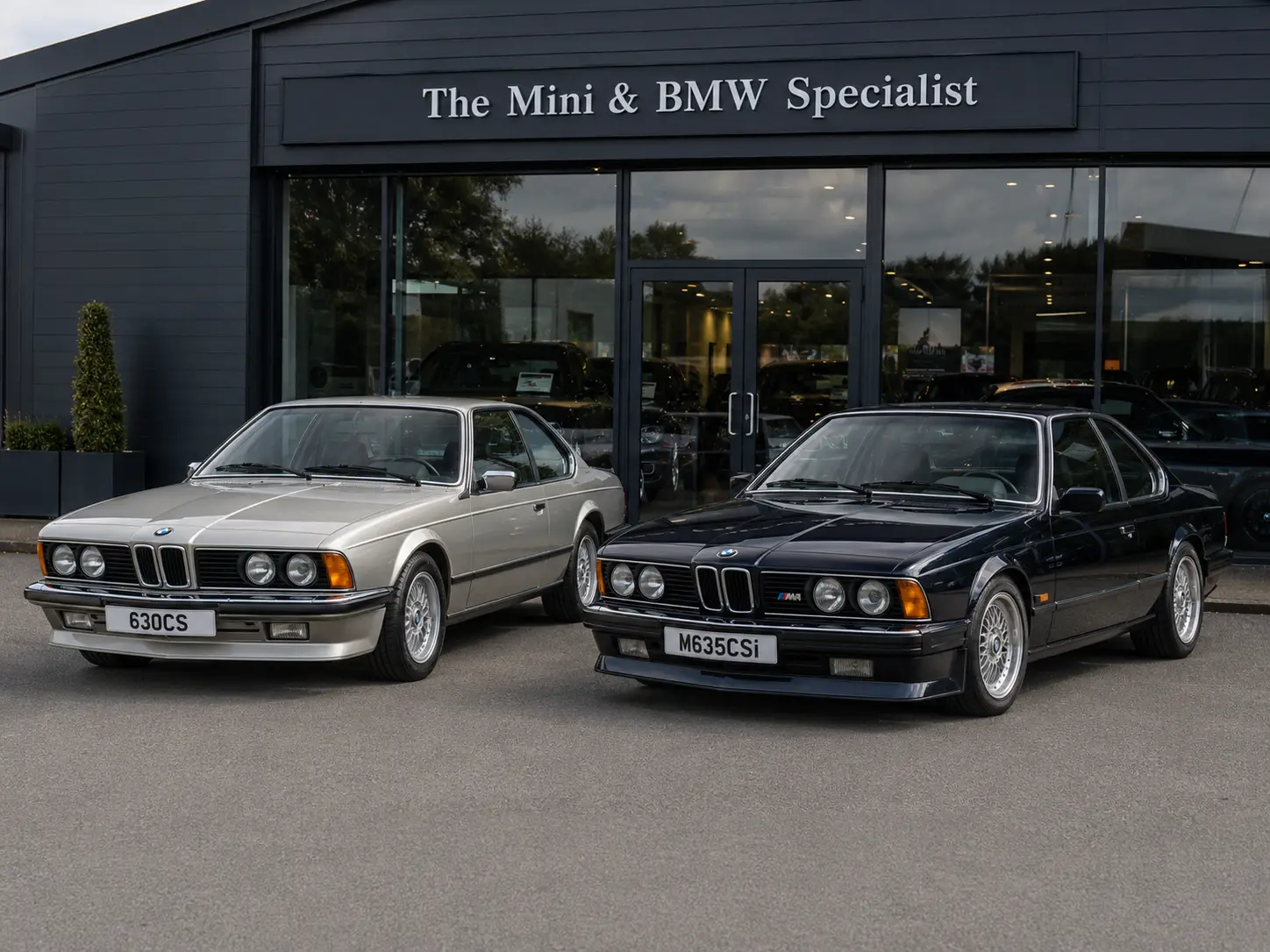
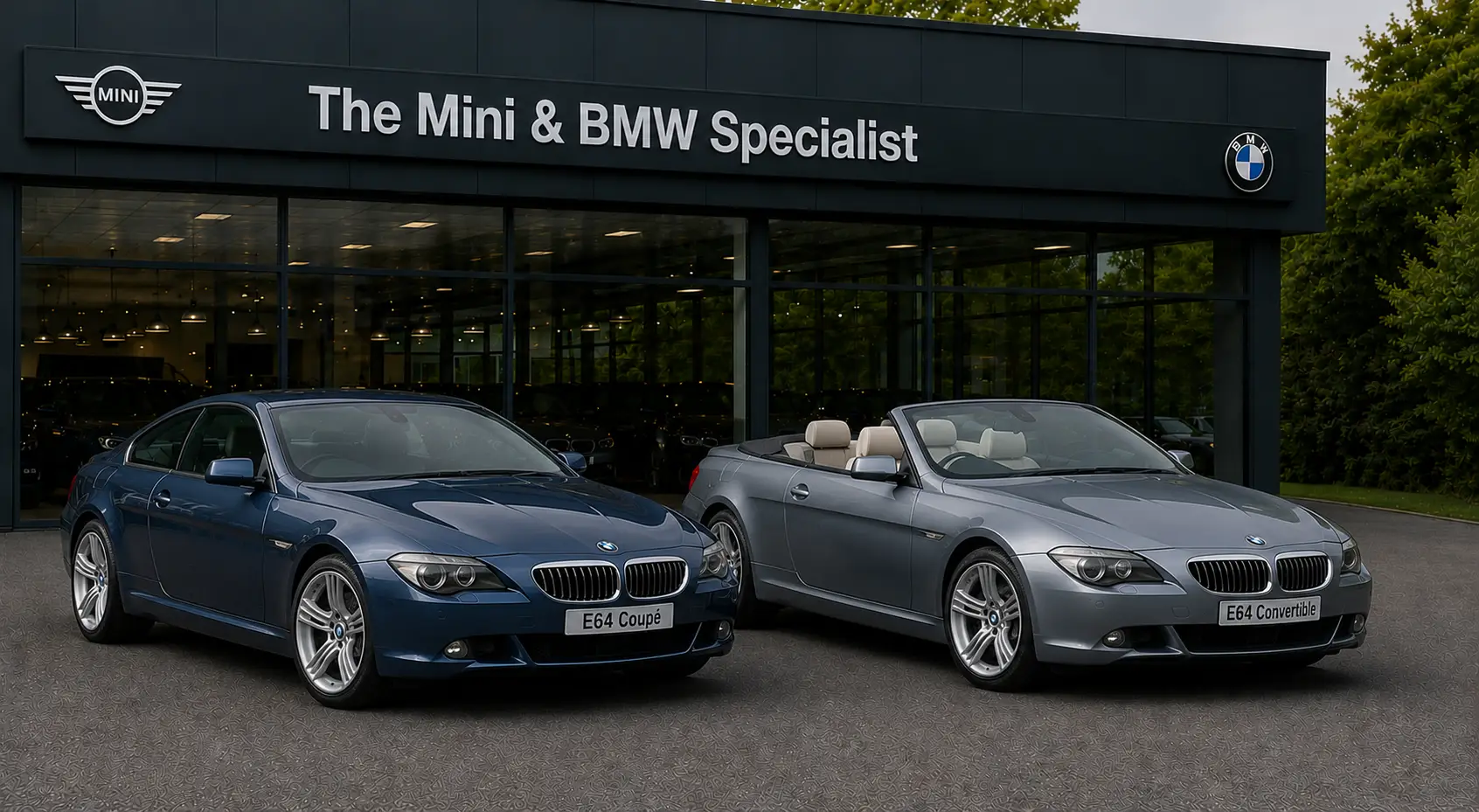
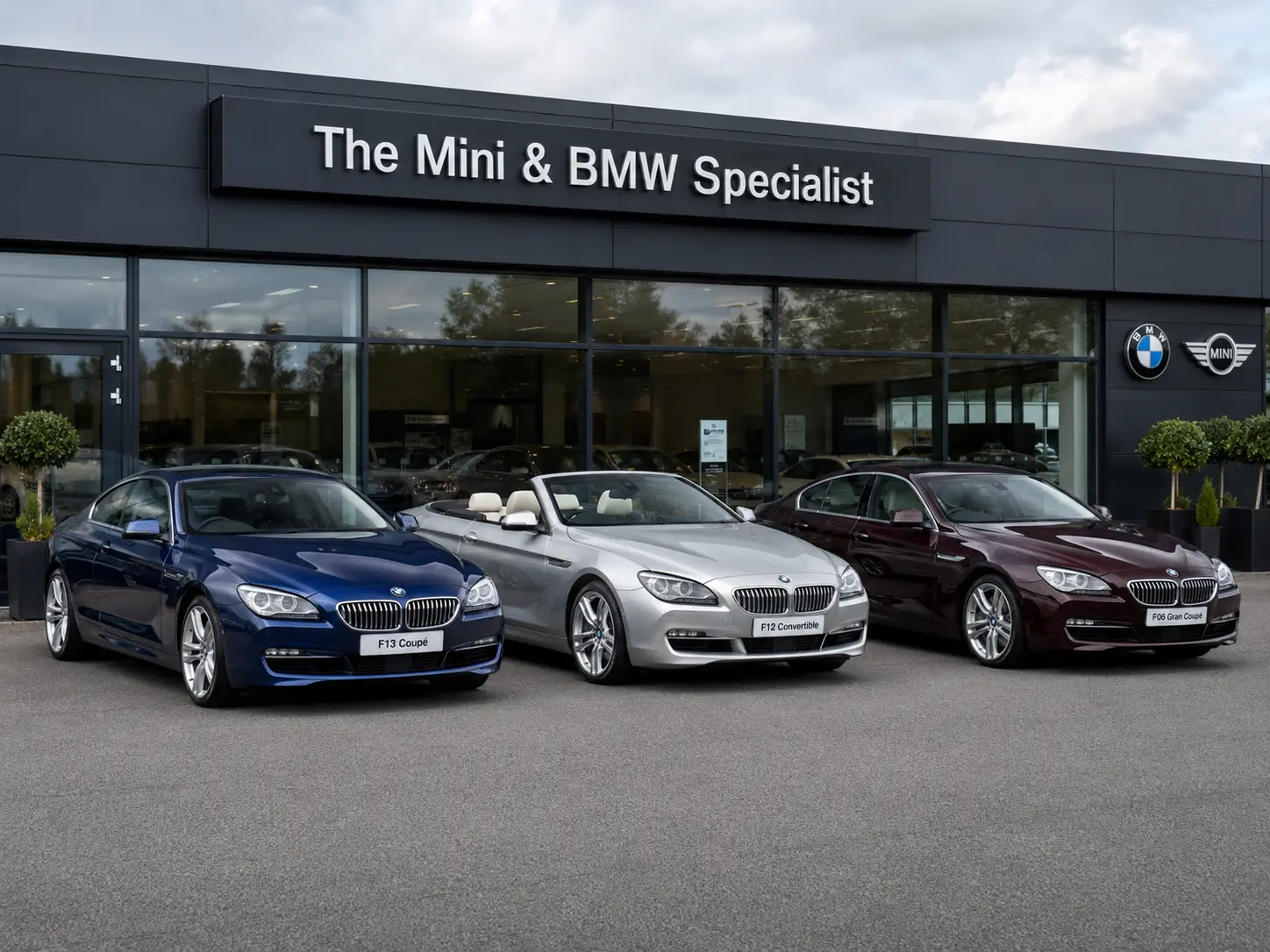
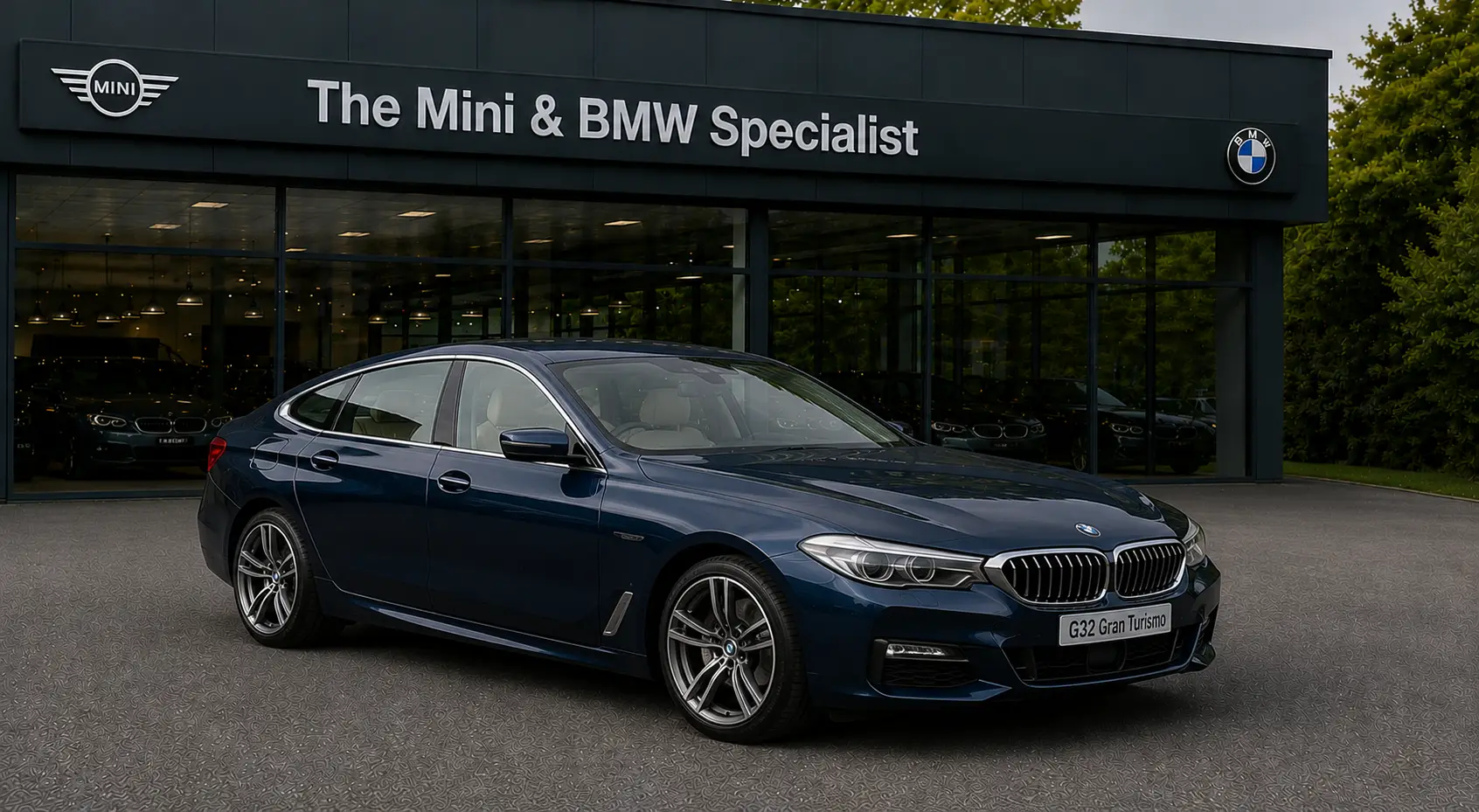
Knowing which generation your BMW 6 Series belongs to matters for servicing. Engines, oil specifications, service intervals, and common faults all vary significantly between generations. Use the table below to identify your generation, then explore the details for engine codes, body styles, and service points. The E24 is the original BMW 6 Series, in production from March 1976 to April 1989 — a 13-year run that established the 6 Series identity as a large, fast, comfortable grand tourer rather than a sports car. It replaced the E9 3.0 CS coupé and was BMW's flagship coupé throughout the late 1970s and the entire 1980s, sitting above the 5 Series saloon and below the 7 Series saloon in the range. The E24 was built on the E12 5 Series platform from launch and switched to the E28 5 Series platform in 1982 (the major mid-life update commonly referred to as the "E24/2" or "facelift" by enthusiasts). The bodywork is bespoke to the 6 Series — long bonnet, frameless windows, low roofline, and the distinctive Hofmeister kink rear pillar treatment. All E24s were 2-door coupés; no convertible, no saloon, no estate body styles were ever produced. The engine range is petrol only — no diesel was ever offered. Across the production run BMW fitted a series of large-displacement inline-six engines: the M30 in 2.8, 3.0, 3.3, and 3.5 litre forms, plus the four-valve-per-cylinder M88 (and its later S38 variant) reserved for the high-performance M635CSi flagship. The M635CSi (1983–1989) is the most significant E24 variant — the original M6. It used the M88/3 DOHC inline-six (286 hp in European tune, derived from the M88 engine first developed for the M1 supercar) and was BMW Motorsport's grand tourer of the 1980s, sitting alongside the E28 M5 in the early Motorsport-developed road car lineage. North American markets received a detuned version badged simply "M6" with the S38 engine, reflecting different emissions requirements. The M635CSi and US M6 are covered separately on our M cars page. BMW produced approximately 86,000 E24s across the 13-year run — a low volume even by 1980s standards, reflecting the 6 Series's premium positioning. The 6 Series line was discontinued in April 1989 and replaced in the BMW range by the E31 8 Series, which took on the GT/flagship coupé role from 1989 to 1999. The 6 Series name lay dormant for 14 years before being revived as the E63/E64 in 2003. By 2026 the E24 is a classic car — every example is at least 37 years old, the youngest being 36. Values for clean, well-documented cars have risen significantly over the past decade, with mint-condition M635CSi examples now regularly making £60,000–£100,000+ at auction. Independent specialist work on the E24 is now classic-car restoration and maintenance rather than routine modern servicing, with parts sourcing, corrosion management, and original-specification fluids and components being the defining concerns. M30 (2.8 litre inline-six SOHC) — 628CSi — the entry-level E24 from 1979 onwards (UK market). Mechanical fuel injection on earlier cars, Bosch L-Jetronic on later examples. Same M30 architecture as the contemporary E12 528i, E28 528i, and E23 728i. The M30 is one of BMW's most respected long-lived inline-six designs and runs reliably to very high mileages with appropriate maintenance. M30 (3.0 litre inline-six SOHC) — 630CS, 630CSi — early E24 (1976–1979). The 630CSi was the first E24 sold in the United States, with Bosch L-Jetronic fuel injection. UK 630CS used a Solex 4A1 carburettor. M30 (3.2 litre inline-six SOHC) — 633CSi — mid-range E24 from launch. Bosch L-Jetronic fuel injection. One of the volume E24 variants in UK and European markets through the late 1970s and early 1980s. M30 (3.3 litre inline-six SOHC) — 633CSi (later) — minor displacement variant fitted to some markets and production runs. Mechanically very similar to the 3.2 M30. M30 (3.5 litre inline-six SOHC) — 635CSi — the most common E24 variant in UK markets through the 1980s, in production from 1978 to the end of E24 production. Bosch L-Jetronic and later Motronic engine management. The 635CSi was the high-performance non-M6 variant and is the E24 most commonly seen in the UK classic-car community today. M90 (3.5 litre inline-six SOHC) — early 635CSi — fitted to early 635CSi production (1978–1980). Mechanically similar to the M30 but with revised intake and cam timing for higher output. Replaced by the standard M30B35 in 1980. M88/3 and S38 (3.5 litre inline-six DOHC, 24-valve) — M635CSi (and US-market M6) — covered in detail on our M cars page. The M88/3 was the four-valve-per-cylinder Motorsport-developed engine first seen in the M1 supercar; the S38 was its US-market emissions-compliant evolution. The M635CSi was the only DOHC E24. No diesel variant was ever offered in the E24 range. BMW did not produce a diesel-powered 6 Series at any point in the E24's 13-year production run. The 6 Series was positioned as a petrol-only grand tourer, and BMW's diesel engines of the era (the M21 524td from 1983) were reserved for the saloon ranges. The classic-car profile. By 2026 the E24 is a classic car in every meaningful sense — every example is at least 37 years old, the youngest having left the factory in spring 1989. Service work on the E24 is fundamentally different from work on a modern BMW: this is restoration and preservation work, not routine fixed-price servicing. The Service Calculator at the top of this page does not apply to the E24 — pricing on classic-era cars is always quoted individually based on condition, scope, and parts availability. M30 inline-six servicing. The M30 is one of BMW's most respected long-lived engine designs and, given regular oil changes with appropriate-specification oil and correct cooling system maintenance, will run reliably to 200,000+ miles. Service items follow classic-era patterns: contact-breaker ignition on early cars (replaced by electronic ignition from approximately 1980), valve clearance adjustment at defined intervals (the M30 has shim-and-bucket valve actuation), timing chain inspection (the M30 uses a single-row timing chain that benefits from periodic inspection at high mileage), and the well-known M30 thermostat housing weeping concern that requires periodic attention. Cooling system. The single most common cause of major M30 engine damage is cooling system neglect. The water pump, thermostat housing, radiator, and hoses on a 35–45 year old car are all wear items. We recommend complete cooling system inspection and refresh on any newly-acquired E24, including replacement of the original mechanical fan clutch which becomes unreliable with age. Carburettor and fuel injection. Early E24s with Solex 4A1 carburettors require specialist setup and tuning. Bosch L-Jetronic fuel injection (mid-period E24) is relatively simple, well-documented, and reliable provided the fuel pressure regulator, cold-start valve, and air mass meter are in good order. Motronic-equipped late E24s benefit from modern diagnostic equipment for fault identification. Suspension and steering. The E24 uses a MacPherson strut front and semi-trailing arm rear suspension layout shared with the contemporary 5 Series. Bushings, ball joints, and dampers are universal wear items at this age. The recirculating-ball steering box (not a rack) is robust but requires periodic adjustment of the play, and the steering column flexible coupling ("rag joint") is a known wear item that affects steering feel significantly when worn. Corrosion. The E24 is from the era before BMW's improved galvanised body construction (which began with the E32 7 Series and E34 5 Series in the late 1980s). Common rust areas include the front jacking points, sills, rear wheel arches, boot floor, spare wheel well, and around the rear screen seal. Corrosion assessment is the single most important factor in valuing an E24 — a mechanically tired car can be restored, but rotten structure is a much larger project. We can carry out detailed corrosion assessments and quote on welding repairs and panel replacement where required. Brakes. The E24 has 4-wheel disc brakes throughout its production run. Brake fluid is hygroscopic and should be replaced every 2 years regardless of usage — particularly important on classic cars that may sit for extended periods. Calipers, master cylinders, and flexible hoses all benefit from inspection and refurbishment as part of any major service. Parts availability. Mechanical parts for the M30 and standard E24 running gear remain reasonably available through specialist suppliers — the M30 is a long-production engine and many components are shared with the contemporary 5 Series and 7 Series. Trim, glass, and body-specific parts are increasingly difficult to source and may require specialist breakers, the BMW Classic parts catalogue (limited availability), or fabrication. M635CSi-specific parts are particularly scarce and expensive. M635CSi servicing. The M635CSi with the M88/3 DOHC engine is a different service proposition from the standard E24 — closer to E28 M5 servicing in complexity and parts requirements. The M88/3 has six individual throttle bodies, more complex valve actuation, and significantly higher service costs than the M30. M635CSi-specific service work is covered in more detail on our M cars page. Documentation and originality. For classic E24 owners considering eventual sale, original tooling, factory service records, original handbook and wallet, original keys, and matching numbers documentation all contribute meaningfully to value. We provide detailed service invoices with parts specifications that support the car's documented history. The E63 (coupé) and E64 (convertible) are the second-generation BMW 6 Series, in production from 2003 to 2010. They revived the 6 Series nameplate after a 14-year hiatus following the end of E24 production in 1989 — a gap that saw the GT/flagship coupé role pass to the E31 8 Series (1989–1999) and then sit vacant from 1999 to 2003. The E63 was based on the BMW Z9 concept car (1999), penned under design chief Chris Bangle. The production E63 retained much of the Z9's bold styling language — the controversial "Bangle Butt" boot treatment, the aggressively flame-surfaced flanks, and the divisive front-end with quad headlights split by a prominent central bonnet crease. Press reception at launch was polarised; in hindsight the E63 is widely regarded as one of the most distinctive BMW coupés of the 2000s, and values have firmed up significantly since 2020 as the design has aged into its own. The E63 coupé launched in 2003 and was joined by the E64 convertible in 2004. The E64 used a fabric soft-top rather than the folding metal hardtops popular among contemporaries (the Mercedes-Benz SL R230, the Lexus SC, the Volvo C70) — a deliberate choice by BMW to keep weight down and preserve the boot space and rear seating space that a hardtop mechanism would have eliminated. All E63s and E64s were rear-wheel drive; xDrive was not offered on the second-generation 6 Series. The drivetrain range covers all the major petrol engines of the E60 5 Series era plus one diesel. Petrol variants spanned the N52 inline-six (630i), the N62 V8 (645Ci and 650i), and the S85 V10 (M6). Diesel was limited to the M57 3.0-litre twin-turbo inline-six in the 635d, introduced in 2007. Transmission options were unusually broad: 6-speed manual on most variants, ZF 6-speed automatic, and the 7-speed SMG III single-clutch automated manual on the M6. The M6 (E63 coupé and E64 convertible, 2005–2010) is the most significant variant. It used the S85 5.0-litre naturally-aspirated V10 — the only V10 BMW road-car engine — shared with the E60 M5 saloon. The S85 produced 507 hp at 7,750 rpm and revved to 8,250 rpm, with design philosophy inherited from BMW's contemporary Formula 1 engine programme. The M6 paired the S85 with the 7-speed SMG III gearbox (a manual conversion was offered as a no-cost option in the US market but not in Europe). The M6 is covered separately on our M cars page. The E63/E64 was replaced by the F12/F13 in 2011. By 2026 the E63/E64 is a future-classic — the youngest examples are 16 years old, the oldest 23. Standard variants (630i, 645Ci, 650i, 635d) are well within independent specialist scope and remain affordable to run; the M6 has appreciated significantly and is now a specialist car in its own right with substantial maintenance considerations. N52 (3.0 litre inline-six) — 630i — fitted to the 630i from 2005 onwards. The N52 produced 258 hp and was the volume petrol variant in UK and European markets. Same N52 architecture as the contemporary E60 530i and E90 330i. The N52 has a well-understood reliability profile and is one of the more straightforward E63/E64 variants to service. N62 (4.4 litre V8) — 645Ci — the original V8 variant from launch in 2003. The N62 produced 333 hp and was the volume V8 in the early E63 range. Same N62B44 architecture as the contemporary E60 545i, E65 745i, and E53 X5 4.4i. N62TU (4.8 litre V8) — 650i — facelift V8 variant from 2005 onwards. The N62TU (Technical Update) produced 367 hp and replaced the 645Ci in most markets. Same N62B48 architecture as the contemporary E60 550i and E70 X5 4.8i. S85 (5.0 litre V10) — M6 — covered in detail on our M cars page. The S85 was the only V10 ever fitted to a BMW road car, naturally aspirated, revving to 8,250 rpm, producing 507 hp. The S85 was shared with the E60 M5 saloon and is one of the most celebrated BMW engines of the 21st century, though it requires specialist knowledge and significant maintenance investment to keep healthy at high mileage. The honest position on N62 V8 ownership. The N62 (645Ci and 650i) and N62TU (650i) are excellent engines when properly maintained, but they have known service items that should be priced into any ownership decision: the valve stem seals, alternator bracket gasket, coolant transfer pipe (a substantial job requiring engine-out access on some variants), and various oil leak points all need attention at higher mileages. M57 (3.0 litre inline-six twin-turbo) — 635d — introduced to the E63/E64 range in 2007 as the 635d. The M57N2 produced 286 hp and 580 Nm of torque — remarkable figures for a diesel grand tourer of the era. Same M57N2 twin-turbo architecture as the contemporary E60 535d and E70 X5 3.0sd. The 635d offered V8-equivalent real-world performance with diesel running costs, making it a particularly attractive specification for high-mileage UK buyers. M57 service considerations. The M57 is widely regarded as one of BMW's most durable diesel engines and runs reliably to 250,000+ miles when properly maintained. Service items follow the established M57 pattern: swirl flaps (the inlet manifold swirl flaps are a known failure point and many UK 635d owners have had them removed or upgraded), EGR cooler, glow plugs, and the usual modern diesel particulate filter regeneration considerations. The twin-turbo system itself is robust but the smaller of the two turbochargers does wear more rapidly than the larger one. The modern-classic profile. By 2026 the E63/E64 is approaching modern-classic status — the youngest examples are 16 years old, the oldest 23. Most cars on UK roads are in the hands of enthusiast owners rather than original purchasers. Service work is more involved than equivalent E60 5 Series work due to the additional complexity of the coupé/convertible bodywork, the iDrive 2.0 / CCC (Car Communication Computer) infotainment system that is approaching end-of-life support from BMW, and the higher rate of low-mileage and low-usage cars that bring specific service profiles. iDrive 2.0 / CCC infotainment. The E63/E64 was an early iDrive car (iDrive 2.0 / CCC). The optical fibre MOST bus that connects the iDrive components, satellite navigation, and audio system can develop reliability issues with age — connector contamination, fibre damage, and module failures are all known concerns. We can diagnose CCC faults and intervene at module level, but some component replacements require BMW's coding tools and are best handled in partnership with our dealer network contacts when warranty-period coding is required. N62 V8 service items (645Ci, 650i). The N62 family has several well-documented service items that significantly affect ownership cost projections: valve stem seal failure (causing characteristic blue-smoke-on-startup) is a substantial job involving cylinder head removal; the alternator bracket gasket is a smaller but persistent oil leak source; the coolant transfer pipe between the cylinder heads runs through the engine valley and replacement requires intake manifold removal or in worst cases engine-out access. None of these is catastrophic in isolation, but cumulatively they need pricing into ownership budgets. We provide honest pre-purchase inspection reports and detailed quotes on any work identified. M57 diesel service items (635d). The M57N2 twin-turbo diesel is robust but has the same swirl-flap concern as other M57-equipped BMWs of the era. Many UK 635d cars have already had the swirl flaps deleted or replaced with upgraded items; cars that have not had this work done benefit from proactive intervention before flap failure can cause catastrophic engine damage. The EGR cooler is also a known wear item that can leak coolant into the inlet system. Convertible (E64) specific concerns. The E64 fabric soft-top is robust and well-engineered but is now 16–23 years old on every example. Hydraulic ram failure, fabric wear (particularly at the rear corners and along the rear window seam), and electrical actuator faults are all in-scope service items. The complete roof mechanism is serviceable, and individual rams, motors, and fabric panels can be replaced — but the work is specialist and time-intensive. We can assess condition and quote on individual interventions. SMG III gearbox (M6). The 7-speed SMG III single-clutch automated manual fitted to the M6 has a polarising reputation. Properly maintained — with fluid changes at defined intervals, the pump and accumulator in good order, and the clutch pack within wear limits — it works as designed. Neglected, it becomes one of the more expensive components on an M6 to put right. The SMG III is covered in more detail on our M cars page. Suspension and steering. The E63/E64 uses front double-wishbone and rear multi-link suspension shared with the E60 5 Series. Front lower control arms, ball joints, and bushings are wear items past approximately 80,000 miles. The hydraulic power steering (the E63/E64 used hydraulic, not electric, power steering throughout) is reliable but the pump, lines, and rack are all serviceable items at higher mileages. Brakes. The E63/E64 uses substantial brake hardware appropriate to a 2-tonne grand tourer. Front discs are 348mm on 650i and 374mm on M6; rear discs scale similarly. M Sport and M6 variants benefit from upgraded calipers and pad compounds. Brake fluid is hygroscopic and should be replaced every 2 years regardless of mileage. Tyres and wheels. Standard E63/E64 wheels range from 17-inch to 19-inch; M6 uses 19-inch standard wheels. Run-flat tyres were standard on most UK cars. We can advise on alternative non-run-flat options where customers prefer ride comfort over the puncture-resistance of run-flats. Parts availability. Mechanical parts for standard E63/E64 variants remain reasonably well-supported through BMW's current parts catalogue and the aftermarket. N62 V8 service parts are widely available. M6-specific parts (SMG III components, S85-specific items) are increasingly expensive and lead times can be extended — sourcing these often requires specialist channels and patience. The M6 is a different proposition entirely. The E63/E64 M6 with the S85 V10 and SMG III gearbox is closer to a specialist racing car than a grand tourer in service terms — rod bearings, throttle actuators, VANOS units, and the SMG III pump and accumulator all require periodic specialist attention. The S85 demands frequent oil changes (we recommend 5,000-mile intervals on enthusiast-driven M6s, not BMW's longer Condition Based Service intervals) and specific oil specifications. Full M6 service profile is covered on our M cars page. The F12 (coupé), F13 (convertible), and F06 (Gran Coupé) are the third-generation BMW 6 Series, in production from 2011 to 2018. The F06 Gran Coupé arrived in 2012 — the first four-door 6 Series in the model's history, sitting on a stretched wheelbase and measuring just over 5,000 mm in overall length. The third generation was the broadest 6 Series line BMW has ever produced and the last 6 Series in the traditional grand tourer role before the line was discontinued. The exterior design was led by Nader Faghihzadeh, with the interior under Christian Bauer. The styling marked a deliberate move away from the controversial E63's flame-surfaced design language — cleaner surfaces, a more conventional rear treatment, longer bonnet, and a more horizontal stance. Press reception was significantly warmer than the E63's, and the F12/F13/F06 is widely regarded as one of the most resolved BMW grand tourer designs of the modern era. The F12 coupé launched in 2011, joined by the F13 convertible in 2011 and the F06 Gran Coupé in 2012. As with the previous generation, the convertible used a fabric soft-top rather than a folding metal hardtop — a continuation of BMW's stated preference for fabric on grand tourer convertibles to preserve boot space and rear seating. xDrive all-wheel drive became available for the first time on the 6 Series in this generation, fitted to selected 640i, 650i, and 640d variants in markets including the UK. The drivetrain range covered petrol and diesel variants. Petrol options were the N55 single-turbo inline-six (640i), the N63 twin-turbo V8 (650i), and the S63TU twin-turbo V8 (M6). Diesel was the N57 3.0-litre twin-turbo inline-six (640d). All variants used ZF's 8-speed automatic gearbox as the volume transmission (the M6 used a 7-speed dual-clutch DCT). Manual transmission was not offered in UK or European markets. The 640d (N57 twin-turbo diesel) deserves specific mention. It produced 313 hp and 630 Nm of torque — figures that translate to 0–62 mph in approximately 5.5 seconds, broadly comparable to the petrol 640i but with substantially more mid-range torque (the 640i N55 produces approximately 450 Nm). For high-mileage UK grand tourer buyers, the 640d was a particularly compelling specification, offering V8-equivalent real-world performance with significantly lower running costs. The M6 (F12 coupé, F13 convertible, and F06 Gran Coupé, 2012–2018) is covered separately on our M cars page. It used the S63TU 4.4-litre twin-turbo V8 (560 hp standard, 600 hp in Competition spec) paired with the 7-speed DCT. The F06 M6 Gran Coupé was the first-ever four-door M6 and remains a relatively rare specification. BMW discontinued the F12/F13/F06 in 2018. The grand tourer coupé and convertible role passed to the G15 8 Series (launched 2018), and the Gran Coupé role passed to the G16 8 Series Gran Coupé (launched 2019). The 6 Series name continued only as the G32 6 Series Gran Turismo — a separate large 5-door fastback that replaced the F07 5 Series GT and that itself was discontinued in 2024 without a successor. By 2026 the F12/F13/F06 occupies the modern-used market space: youngest examples are 8 years old, oldest 15. Standard variants remain well within independent specialist scope and represent significant value for buyers seeking a genuine grand tourer at modern-used prices. N55 (3.0 litre inline-six single-turbo) — 640i — the volume petrol variant in UK and European markets. The N55 produced 320 hp and 450 Nm of torque, paired with the ZF 8-speed automatic. Same N55 architecture as the contemporary F30 335i, F10 535i, F25 X3 35i, and many other early-2010s BMW models. The N55 is one of BMW's more reliable modern turbocharged inline-sixes, though it has known service items including the water pump, valve cover gasket, and oil filter housing gasket. Available with xDrive in selected markets. N63 (4.4 litre V8 twin-turbo) — 650i — the V8 variant from launch in 2011. The N63 (and later N63TU) produced 407 hp in standard 650i tune and 450 hp in later N63TU specification. Same N63 architecture as the contemporary F10 550i, F01 750i, F15 X5 50i, and others. The N63 family has well-documented service items that affect ownership cost projections — see the service points section below. Available with xDrive in most markets. S63TU (4.4 litre V8 twin-turbo) — M6 — covered in detail on our M cars page. The S63TU was the M-developed evolution of the N63 with significantly upgraded internals, twin-scroll turbochargers, and a higher-pressure oil system. 560 hp in standard M6 tune, 600 hp in M6 Competition Package specification. Paired with the 7-speed M DCT dual-clutch gearbox. The honest position on N63 V8 ownership (650i). The N63 family — including the variant fitted to the 650i — is an excellent engine when properly maintained, but it has well-known service items that prospective buyers should factor into ownership cost projections: valve stem seal failure (causing blue smoke on startup), the so-called "customer care package" service items that BMW themselves identified and partially funded under extended warranty arrangements at the time (valve stem seals, mass air flow sensors, crankcase ventilation system, low-pressure fuel sensor, vacuum pump, battery), the timing chain guides (early N63 production), and various oil leak points. We're happy to provide pre-purchase inspections on 650i cars and quote honestly on the work likely to be needed in the first two to three years of ownership. N57 (3.0 litre inline-six twin-turbo) — 640d — the diesel variant from launch in 2011. The N57 produced 313 hp and 630 Nm of torque, paired with the ZF 8-speed automatic. Same N57 architecture as the contemporary F10 535d, F01 740d, F25 X3 30d, F15 X5 30d, F26 X4 30d, and many other early-2010s BMW diesel models. Available with xDrive (640d xDrive) in selected markets. The N57 is widely regarded as one of BMW's most durable diesel engines of the modern era and is the recommended high-mileage specification for the third-generation 6 Series. N57 service considerations. The N57 has a well-understood service profile and runs reliably to 200,000+ miles when properly maintained. Service items follow the established N57 pattern: timing chain (which on the N57 is at the rear of the engine — a significant job if it fails but the chain itself is more robust than the earlier M57 design), EGR cooler, DPF regeneration management, AdBlue system on later post-2014 cars, swirl flaps (improved over the M57 design but still a wear item), and the usual modern diesel particulate filter and EGR considerations. The 640d remains one of our most-recommended modern-used 6 Series specifications. The modern-used profile. By 2026 the F12/F13/F06 occupies the modern-used market space — youngest examples are 8 years old, oldest 15. Standard variants are within full modern-servicing scope, including diagnostic work, software interventions, and component-level interventions. The Service Calculator at the top of this page applies to standard F12/F13/F06 variants (640i, 640d, 650i); the M6 is a different proposition and is covered separately on our M cars page. N55 petrol service items (640i). The N55 is generally well-regarded for reliability but has known service items at higher mileages: water pump and thermostat housing (the electric water pump is a known wear item, typically at 80,000–120,000 miles), valve cover and gasket, oil filter housing gasket, charge pipe (an aftermarket upgrade to metal is common for high-performance use), and various sensor failures. Carbon build-up on the intake valves (a characteristic of direct-injection engines without port injection) responds well to walnut-shell blasting at appropriate service intervals. N63 V8 service items (650i). The N63 in the 650i has the well-documented service profile noted above. The "customer care package" service items identified by BMW themselves — valve stem seals, mass air flow sensors, crankcase ventilation, low-pressure fuel sensor, vacuum pump, and battery — should be assumed needed on any high-mileage example unless documented as already addressed. Coolant transfer pipe replacement is a substantial job on the N63 family. We provide detailed pre-purchase inspections and honest quotes on any work identified. N57 diesel service items (640d). The N57 is one of the more durable modern BMW diesels but service items include timing chain (rear-mounted on the N57, less prone to failure than the M57 but more expensive to address if it does fail), EGR cooler, DPF management, AdBlue system on post-2014 cars, glow plugs, and the swirl flaps (improved over the M57 design but still a wear item). The 640d is the recommended high-mileage specification. ZF 8-speed automatic gearbox. All standard F12/F13/F06 variants use the ZF 8HP 8-speed automatic, one of the most respected automatic transmissions of the modern era. BMW's official position is that the ZF 8HP is filled for life and requires no fluid change. Our position, based on practitioner experience and broader industry consensus, is that gearbox fluid and filter changes at approximately 60,000-mile intervals significantly extend gearbox life and reduce the incidence of mechatronic and torque converter failures. We can carry out this work using OEM-specification fluid and filter parts. Convertible (F13) specific concerns. The F13 fabric soft-top is well-engineered and more reliable than the E64 mechanism it replaced. Common service items at 10+ years of age include hydraulic ram seals, fabric wear (particularly at folding points and the rear window seam), and electrical actuator faults. The complete roof mechanism remains serviceable and individual components can be replaced. The F13 also has the convertible-specific torsional bracing under the floor that benefits from inspection at higher mileages for corrosion. Gran Coupé (F06) specific notes. The F06 Gran Coupé is mechanically identical to the F12 coupé from the front bulkhead forwards and uses a stretched wheelbase to provide the rear-door opening. There are no Gran Coupé-specific reliability concerns beyond those shared with the F12. The F06 was the first four-door 6 Series ever made and remains the only fastback four-door BMW grand tourer of the F-platform era (the role passed to the G16 8 Series Gran Coupé from 2019). Air suspension (rear, optional and standard on some variants). Self-levelling rear air suspension was fitted as standard to many F12/F13/F06 variants and is a known service item at higher mileages. Air strut failure typically presents as the rear sitting low when the car is parked overnight, followed by audible compressor activity on startup. Rear air struts can be replaced individually and the compressor is also a serviceable item. We can diagnose and quote on air suspension faults. Suspension and steering. Front double-wishbone and rear multi-link suspension shared with the F10 5 Series. Front lower control arms, ball joints, and bushings are wear items past approximately 70,000–100,000 miles. The F12/F13/F06 was one of BMW's first models with electric power steering (EPS) — generally reliable but the steering column module and rack-mounted EPS motor are both serviceable items if faults develop. Brakes. Substantial brake hardware appropriate to a 2-tonne grand tourer. Front discs are 348 mm on 640i/640d, 374 mm on 650i, and significantly larger on the M6. M Sport variants benefit from upgraded calipers and pad compounds. Brake fluid is hygroscopic and should be replaced every 2 years regardless of mileage. Tyres and wheels. Standard F12/F13/F06 wheels range from 18-inch to 20-inch; M Sport variants typically run 19-inch or 20-inch. Run-flat tyres were standard on most UK cars. We can advise on alternative non-run-flat options where customers prefer ride comfort over the puncture-resistance of run-flats. Parts availability. Mechanical parts for standard F12/F13/F06 variants remain well-supported through BMW's current parts catalogue and the aftermarket. N55, N57, and N63 service parts are widely available and competitively priced. M6-specific parts (S63TU components, DCT-specific items) remain available but at significantly higher prices than equivalent standard 6 Series parts. The M6 is a different proposition. The F12/F13/F06 M6 with the S63TU twin-turbo V8 and 7-speed DCT requires specialist knowledge and is covered separately on our M cars page. Service profile includes specific oil specifications, DCT fluid intervals, twin-turbo charge system maintenance, and the higher-stress N63-derived V8 architecture. We service the F12/F13/F06 M6 as part of our broader M cars practice. The G32 is the fourth-generation BMW 6 Series, in production from 2017 to 2023, and marketed throughout its production life as the 6 Series Gran Turismo. It is a significant editorial departure from the previous three generations of 6 Series: rather than a grand tourer coupé and convertible, the G32 is a single-body-style 5-door fastback hatchback with a raised roofline, extended wheelbase, and a focus on rear passenger space and luggage capacity rather than driving dynamics or grand tourer styling. The G32 is most accurately understood as a direct successor to the F07 5 Series Gran Turismo (2009–2017) rather than to the F12/F13/F06 grand tourer 6 Series. In 2017 BMW renumbered the second-generation 5 Series GT into the 6 Series range — partly to differentiate it more clearly from the standard 5 Series saloon and Touring, and partly to reposition the GT body style at a higher price point. The mechanical, platformly, and dimensional relationship of the G32 is to the G30 5 Series, not to the discontinued F12/F13/F06 grand tourer line. Body style is 5-door fastback only — no coupé, no convertible, no traditional saloon variant was ever produced. The G32's defining design feature is its raised roofline and large rear hatchback, providing significantly more rear headroom and luggage capacity than the equivalent G30 5 Series Touring. The styling is more restrained than the F-generation 6 Series and is widely regarded as the G32's main commercial weakness — it lacks the visual drama of the grand tourer it nominally succeeded. The engine range is narrower than any previous 6 Series generation: turbocharged 4-cylinder petrol (630i in some markets), turbocharged 6-cylinder petrol (640i and 640i xDrive), and turbocharged 6-cylinder diesel (630d and 640d xDrive). No V8 was ever offered. No M variant was ever produced — the G32 is the only 6 Series generation without a corresponding M model. No plug-in hybrid was offered, although 48V mild-hybrid technology was added from the 2020 LCI (Life Cycle Impulse) facelift onwards on selected variants. The G32 underwent its LCI facelift in 2020, with revised styling, updated infotainment to BMW's iDrive 7.0 system, and the addition of 48V mild-hybrid technology to selected variants. The mild-hybrid system improved fuel economy and added a small amount of electric assist during acceleration, but the G32 was never offered as a true plug-in hybrid or as a fully electric variant. BMW discontinued the G32 in 2023 without a direct successor. The 6 Series name has, as of 2026, no current production vehicle wearing it — the 6 Series line is dormant. The fastback role the G32 occupied was, to the extent it continues at all in the modern BMW range, partially absorbed by the G16 8 Series Gran Coupé (a more traditional 4-door coupé), but the unique tall-roof 5-door fastback positioning of the G32 has not been replaced. By 2026 the G32 is a modern used car — youngest examples are 3 years old, oldest 9. All G32 variants are within full modern-servicing scope, though the model's low production volume and limited UK retail presence (the G32 sold primarily into executive lease fleets and Continental European markets rather than UK retail) means independent specialist familiarity with the model is more limited than for higher-volume BMW models. We service the G32 as part of our broader BMW practice and the Service Calculator at the top of this page applies to standard G32 variants. B48 (2.0 litre four-cylinder turbocharged) — 630i — entry-level G32 in selected markets (less common in the UK, where the 640i was the volume petrol variant). The B48 produced 252 hp and was the same modular four-cylinder unit fitted across the contemporary 3 Series, 5 Series, X3, X4, and many other BMW models of the era. Available with rear-wheel drive in most markets. B58 (3.0 litre inline-six turbocharged) — 640i, 640i xDrive — the volume petrol variant in UK and European markets. The B58 produced 340 hp and paired with the ZF 8-speed automatic. Same B58 architecture as the contemporary G20 M340i, G30 540i, G05 X5 40i, and Toyota GR Supra (which uses a BMW-supplied B58). The B58 is widely regarded as one of BMW's most reliable modern turbocharged petrol engines and is the recommended high-performance specification for the G32. Available with xDrive on the 640i xDrive variant. No V8 was ever offered in the G32 range. Unlike all three previous 6 Series generations (E24 with M88/3, E63/E64 with N62 V8, F12/F13/F06 with N63 V8), the G32 was never available with a V8 engine. The B58 inline-six was the top petrol specification throughout production. No M variant was ever produced. The G32 is the only 6 Series generation without a corresponding M model — there was no G32 M6, no Competition variant, no M Performance variant. The lack of an M-developed flagship reflects the G32's positioning as a comfortable executive transport rather than a grand tourer or performance car. B57 (3.0 litre inline-six twin-turbo) — 630d, 640d xDrive — the volume diesel variants in UK and European markets. The B57 produced 265 hp in the 630d (single-turbo specification) and 320 hp in the 640d xDrive (twin-turbo specification), paired with the ZF 8-speed automatic. Same B57 architecture as the contemporary G30 530d/540d, G05 X5 30d/40d, G11 730d/740d, and many other late-2010s BMW diesel models. The 630d and 640d xDrive were the most-recommended high-mileage G32 specifications. B57 service considerations. The B57 follows the established modern BMW diesel service profile: timing chain (improved over the earlier N57 design and generally reliable in service), EGR cooler, DPF management and regeneration, AdBlue system (mandatory throughout G32 production), glow plugs, and the swirl flaps (further refined from the M57 and N57 designs and significantly less troublesome on the B57). The B57 is widely regarded as the most reliable modern BMW diesel engine and is well-suited to high-mileage executive use. 48V mild-hybrid (from 2020 LCI facelift onwards, selected variants). Following the G32's 2020 LCI facelift, BMW introduced 48V mild-hybrid technology to selected G32 variants — the 640i, 640i xDrive, and some diesel variants. The mild-hybrid system uses a 48V belt-driven starter-generator to provide small amounts of electric assist during acceleration, coast-down energy recovery, and engine-off coasting at higher speeds. It is not a true hybrid and provides no electric-only driving capability. No plug-in hybrid variant was ever offered in the G32 range. Despite BMW introducing plug-in hybrid variants extensively across the rest of the late-2010s range (the G20 330e, G30 530e, G05 X5 xDrive45e, and others), no plug-in hybrid 6 Series was ever produced. No fully electric variant was ever offered in the G32 range. The 6 Series name has never been used on a BMW i electric vehicle. The closest equivalent in the current BMW range to the G32's executive-fastback positioning is the i5 (G60 5 Series fully electric), but the i5 is a saloon body style rather than the G32's fastback. The modern-used profile. By 2026 the G32 occupies the modern-used market space — youngest examples are 3 years old, oldest 9. All G32 variants are within full modern-servicing scope, including diagnostic work, software interventions, OTA update verification, and component-level interventions. The Service Calculator at the top of this page applies to all G32 variants. The independent specialist context for the G32. The G32 sold in low volumes in the UK retail market — the majority of UK G32 sales went to executive lease and corporate fleets rather than to private buyers. As a result, independent specialist familiarity with the G32 is more limited than with higher-volume BMW models such as the 3 Series or 5 Series. We service the G32 as part of our broader BMW practice and have the diagnostic equipment, parts channels, and CLAR-platform familiarity needed to support G32 owners — but we'd encourage G32 owners to make contact in advance of significant service work so we can confirm parts availability and any model-specific considerations. B48 petrol service items (630i). The B48 has a well-understood service profile across BMW's modular four-cylinder range. Service items include oil filter housing gasket, vanos solenoids, charge pipe (high-performance use), and the usual modern direct-injection considerations around intake valve carbon build-up. Generally reliable and well-supported by the parts aftermarket. B58 petrol service items (640i, 640i xDrive). The B58 is one of BMW's most reliable modern turbocharged inline-sixes and has fewer service concerns than the N55 it replaced. Service items include oil filter housing gasket (an evolution of the N55 design but improved), water pump (electric, typical wear at 100,000+ miles), and the usual direct-injection intake valve carbon considerations. The B58 has a generous service interval profile and benefits from oil changes at approximately 10,000-mile intervals using BMW LL-04 specification oil. B57 diesel service items (630d, 640d xDrive). The B57 is widely regarded as the most reliable modern BMW diesel and service items are well-understood: timing chain (significantly improved over the N47/N57 designs and generally trouble-free in service), EGR cooler, DPF management with regeneration scheduling, AdBlue tank level management and SCR catalyst monitoring, glow plugs at higher mileages. The B57 is well-suited to high-mileage executive use and is the recommended specification for buyers covering more than 15,000 miles per year. 48V mild-hybrid system (post-2020 LCI variants). The 48V mild-hybrid system on later G32s uses a belt-driven starter-generator (BSG) in place of the conventional alternator and starter motor. The BSG itself is generally reliable, but the 48V battery (typically located in the boot floor or under-bonnet depending on variant) is a serviceable item and the 48V-to-12V DC-DC converter is a known service consideration. Mild-hybrid faults present as warning lights and degraded start-stop functionality; we have the diagnostic equipment to identify and address these. ZF 8-speed automatic gearbox. All G32 variants use the ZF 8HP 8-speed automatic. As with other BMW models using this gearbox, BMW's official position is that the fluid is filled for life and requires no change; our practitioner position is that fluid and filter changes at approximately 60,000-mile intervals significantly extend gearbox life. We can carry out this work using OEM-specification fluid and filter parts. iDrive 6.0 (pre-LCI) and iDrive 7.0 (post-LCI) infotainment. Pre-2020 G32 cars use iDrive 6.0; post-2020 LCI cars use iDrive 7.0. Both systems remain supported by BMW for software updates as of 2026. We can carry out diagnostic work on the infotainment system and identify faults at module level; some interventions require BMW's coding tools. Air suspension (rear, standard on most variants). Self-levelling rear air suspension is standard on most G32 variants — a continuation of the F07 5 Series GT's design philosophy of prioritising ride comfort and load-carrying capacity. Air strut wear typically presents as the rear sitting low overnight with audible compressor activity on startup. Rear air struts can be replaced individually and the compressor is also a serviceable item. Suspension and steering. CLAR-platform front and rear suspension shared with the G30 5 Series. Front lower control arms, ball joints, and bushings follow the established G-generation wear pattern. Electric power steering is standard and generally reliable. Brakes. Substantial brake hardware appropriate to a 2-tonne executive fastback. Standard discs front and rear, with M Sport variants getting upgraded calipers and pad compounds. Brake fluid is hygroscopic and should be replaced every 2 years regardless of mileage. Tyres and wheels. Standard G32 wheels range from 18-inch to 20-inch, with M Sport variants typically running 19-inch or 20-inch. Run-flat tyres were standard on most UK cars. We can advise on alternative non-run-flat options where customers prefer ride comfort. Parts availability. Mechanical parts for the G32 remain well-supported through BMW's current parts catalogue and the aftermarket. B48, B57, and B58 service parts are widely available and competitively priced — these are high-volume modular engines used across most of the modern BMW range. G32-specific body and trim parts are less widely available in the aftermarket due to the model's low UK volume; lead times on some G32-specific parts can be longer than for higher-volume models such as the 3 Series or 5 Series. No M variant means no specialist M cars page treatment. Unlike the previous three 6 Series generations, the G32 has no M variant and therefore no cross-reference to our M cars page. All G32 service work is within standard BMW practice and the Service Calculator at the top of this page applies throughout the G32 range. Found your model? Get an exact service price in seconds using the Service Calculator at the top of this page, or call us to discuss your specific car.Generations of the BMW 6 Series
Generation
Years
Chassis codes
Body styles
Platform
First generation (E24)
1976–1989
2-door coupé (grand tourer)
2-door coupé (grand tourer)
BMW E12 5 Series platform (1976–1982) and BMW E28 5 Series platform (1982–1989), with bespoke 6 Series long-bonnet, low-roofline coupé bodywork — rear-wheel drive, longitudinal engine
Second generation (E63/E64)
2003–2010
Second generation (E63/E64)
2-door coupé (E63), 2-door convertible (E64, fabric soft-top)
BMW E60 5 Series platform, shared underpinnings with the contemporary 5 Series saloon and Touring — rear-wheel drive throughout (xDrive was not offered on the E63/E64)
Third generation (F12/F13/F06)
2011–2018
F12 (coupé), F13 (convertible), F06 (Gran Coupé)
2-door coupé (F12), 2-door convertible (F13, fabric soft-top), 4-door fastback / Gran Coupé (F06)
BMW F10 5 Series platform, shared underpinnings with the contemporary 5 Series saloon and Touring — rear-wheel drive and xDrive both offered (xDrive available on 640i, 650i, M6 from facelift onwards in selected markets, and 640d xDrive)
Fourth generation (G32 Gran Turismo)
2017–2023
G32
5-door fastback (Gran Turismo)
BMW CLAR platform, shared underpinnings with the contemporary G30 5 Series and G11 7 Series — rear-wheel drive standard, with xDrive all-wheel drive optional on selected variants
Show details for the First generation (E24)
Engines
Service points for this generation
Show details for the Second generation (E63/E64)
Engines
Service points for this generation
Show details for the Third generation (F12/F13/F06)
Engines
Service points for this generation
Show details for the Fourth generation (G32 Gran Turismo)
Engines
Service points for this generation
The 650i designation covers two distinct V8 engines across two generations of 6 Series, and both have well-documented ownership cost realities you should price into any purchase decision. The E63/E64 650i (2005–2010) uses the N62 V8, and the F12/F13/F06 650i (2011–2018) uses the N63 twin-turbo V8 — different engines, different failure profiles, both expensive to put right when they go wrong. The N62 is prone to valve stem seal degradation (blue smoke on start-up after sitting), alternator bracket gasket leaks, and coolant transfer pipe failure deep in the valley of the engine — that last job is labour-heavy and often deferred until it becomes urgent. The N63 was the subject of BMW's "Customer Care Package" for early units: high oil consumption, timing chain wear, fuel injector failures, battery vent issues, and turbo coolant line problems were common enough that BMW themselves intervened. Later N63TU variants improved on this, but pre-purchase scrutiny of service history is non-negotiable. If V8 character isn't the priority, the 640d with the N57 diesel six is the more rational long-term ownership proposition across both generations — comparable performance, materially lower running costs, and a far gentler fault profile. Yes — we service every M6 variant: the E63/E64 M6 (2005–2010) with the S85 5.0-litre V10, and the F12/F13/F06 M6 (2012–2018) with the S63TU twin-turbo V8. Both are specialist propositions rather than routine servicing jobs, and the cost base reflects that. The S85 V10 shares its rod bearing concern with the S65 in the E9x M3 — preventive replacement at a sensible interval is far cheaper than the consequences of leaving it. SMG III gearbox health, throttle actuators, and VANOS solenoids are the other watchpoints. The S63TU in the F-series M6 inherited the broader N63 family's appetite for oil and timing chain attention, but in higher-state-of-tune form — service history and a careful pre-purchase inspection matter more than mileage alone. Full detail on M car servicing — engine-by-engine, generation-by-generation — is on our M cars page. For any M6 inspection, diagnostic, or scheduled service, contact us in Great Bridge, Tipton (DY4 7LH). The 640d is, in our view, the most rational ownership proposition in the modern 6 Series range. The N57 3.0-litre twin-turbo straight-six diesel is a well-understood engine — long-legged, materially cheaper to fuel than the petrol V8 alternatives, and free of the costlier failure modes that affect the N62 and N63 V8s. That said, "reliable" doesn't mean maintenance-free. Watch for swirl flap wear, EGR cooler issues, and timing chain attention on higher-mileage examples. Adblue system health on later units, DPF condition for cars that have lived a short-journey life, and the usual ZF 8HP gearbox fluid service every 60–80,000 miles all apply. None of these are deal-breakers — they're predictable, scheduled items rather than expensive surprises. Service history matters more than mileage. A 640d with consistent records at 120,000 miles is a better buy than a poorly-documented example at 60,000. Book a pre-purchase inspection at our workshop in Great Bridge, Tipton (DY4 7LH). Yes — we service the E24 6 Series (1976–1989), including the M635CSi flagship. These are classic cars now rather than modern vehicles, and we approach them accordingly: preservation and sympathetic restoration rather than the scheduled-service model that applies to F-prefix cars and later. Our Service Calculator doesn't apply to the E24 — every job is quoted individually after inspection. The dominant variables in E24 ownership economics are corrosion (front and rear arches, sills, boot floor, suspension pickup points) and cooling system condition; both have a far greater bearing on long-term value than the mechanical condition of the engine itself. The M30 six-cylinder is robust and well-supported, but the chassis around it needs honest assessment. The M635CSi with its M88/3 (and later S38) engine is a specialist proposition — see our M cars page for engine-specific detail. For any E24 inspection, recommissioning, or scheduled mechanical work, contact us in Great Bridge, Tipton (DY4 7LH). Yes — we service the G32 6 Series Gran Turismo (2017–2023). We'll be straightforward: the G32 sold in low retail volumes in the UK compared with the 5 Series Touring that sat alongside it, so we don't see them in the numbers we see other models. That doesn't affect our capability to service them — it just means most G32 owners reaching us are doing so deliberately, not by accident. Mechanically the G32 shares its underpinnings with the G30/G31 5 Series and uses the same B48, B57 and B58 modular engines, with 48V mild-hybrid added at the 2020 LCI. Servicing logic is therefore identical to the equivalent 5 Series — ZF 8HP fluid changes, B58 cooling system attention, B57 diesel injector and EGR maintenance, and software updates via dealer-grade diagnostics. The Service Calculator applies in the normal way. Book in via our Great Bridge, Tipton (DY4 7LH) workshop.