

BMW 5 Series Service Costs
Transparent pricing, OE-quality parts and open, honest advice.
BMW 5 Series Service Costs – Reliable Care Without Main Dealer Prices
Select your BMW model below (or enter your registration) to view fixed service costs using our Service Calculator.
Looking for Trusted BMW 5 Series Servicing?
Use our BMW 5 Series Service Calculator to check fixed pricing, compare service packages, and plan your maintenance confidently.
We service all 5 Series models — from the 518d and 520i to the powerful 550i, M550i, and hybrid 530e — using only OE-standard parts for performance and warranty protection.
Our prices include parts, labour, and VAT as standard, with no hidden costs.
We always reset the onboard service computer and update digital service records where fitted.
Conveniently located near Birmingham with easy access to the M5 and M6 motorways, we are trusted specialists for petrol, diesel, and hybrid BMW 5 Series servicing across the West Midlands.
Why Choose Us for Your BMW 5 Series Servicing?
Transparent Pricing
Fixed prices with parts, labour, and VAT included — no hidden costs.
Digital Service Updates
Service computer reset and digital history updated (where fitted).
Genuine OE-Standard Parts
We use OE-spec parts to protect your performance and warranty.
All Models Expertly Serviced
Petrol, diesel, and hybrid BMW 5 Series models serviced with care.
Convenient Location
Located in Great Bridge, West Midlands (DY4 7LH) — easy access from Birmingham, Wolverhampton, Dudley, M5 and M6.
Trusted by BMW Owners
Proven track record for honest advice, expert service, and lasting customer relationships.
BMW 5 Series Fixed-Price Servicing Guide
Important: The service prices shown below are typical examples. Exact pricing varies by model, engine size, and fuel type. For an exact quote, please select your model using the Service Calculator above.
All services include VAT, parts, labour, service computer reset, and digital service record updates (where fitted). No hidden charges — just clear, honest pricing.
| Service | What’s Included | Price |
|---|---|---|
| Bronze Service | Oil and filter change using BMW spec oil and filter | from £150.00 |
| Silver Service (4 Cylinder) | Oil, filter, and air filter change using BMW spec parts | From £200.00 |
| Gold Service (4 Cylinder) | Oil, filter, air filter, and cabin filter change using BMW spec parts | From £280.00 |
| Platinum Service (4 Cylinder Petrol) | Gold Service plus spark plug replacement | From £399.00 |
| Silver Service (6 Cylinder) | Oil, filter, and air filter change using BMW spec parts | From £260.00 |
| Gold Service (6 Cylinder) | Oil, filter, air filter, and cabin filter change using BMW spec parts | From £325.00 |
| Platinum Service (6 Cylinder Petrol) | Gold Service plus spark plug replacement | From £500.00 |
| Platinum Service (Diesel) | Gold Service plus fuel filter replacement | From £395.00 |
| Brake Fluid Flush | Flush and replacement using high-performance DOT4 brake fluid | £100.00 |
| MOT | Official Ministry of Transport test for vehicles over 3 years old | £50.00 |
| Diagnostic Check | Dealer-level BMW diagnostic scan and technician report | £80.00 |
What’s Included with Your BMW 5 Series Service?
- Fixed-price servicing with genuine or OE-standard parts
- Onboard service computer reset and digital history update (where fitted)
- Brake, steering, suspension, and engine health checks
- Service options tailored for petrol, diesel, and M Sport models
- Full invoice transparency — no hidden charges
Knowing which generation your BMW 5 Series belongs to matters for servicing. Engines, oil specifications, service intervals, and common faults all vary significantly between generations. Use the table below to identify your generation, then explore the details for engine codes, body styles, and service points. The E12 is the original BMW 5 Series — the car that introduced the nameplate in 1972 as a successor to the BMW New Class mid-size saloon. The "5" in 5 Series denotes BMW's fifth New Class platform; the convention of size-based numerical model names (3, 5, 7) was established with this car and has run ever since. The E12 sat between the smaller 2002 two-door range and the larger E3 saloon, occupying the executive saloon position that the 5 Series has held in BMW's lineup for over fifty years. Production began in 1972 at BMW's Munich plant and continued until 1981 in Europe, with assembly continuing in South Africa until 1984. The body was styled by Paul Bracq and Pietro Frua, drawing on Bertone's 1970 BMW Garmisch 2002ti Geneva show car for its visual cues. The E12 was produced exclusively as a four-door saloon — there was no Touring estate, coupé, or convertible variant in this generation. Manual transmission was standard across the range, with an automatic transmission available on US and Japanese specification cars. The E12 was offered with four-cylinder and six-cylinder petrol engines across its production run, including the high-performance M535i — produced from 1979 onwards and widely regarded as the spiritual predecessor to the M5 model line, although the official M5 nameplate did not appear until the following E28 generation. By 2026 the E12 is a classic car. Surviving cars in the UK are predominantly in the hands of enthusiast owners and BMW Car Club members, often as restored or preserved examples. The service profile is correspondingly different from modern 5 Series work — fewer routine fluid-and-filter services per year, more carburettor and ignition system work, more attention to bodywork preservation and corrosion prevention, and an ongoing need to source obsolete or specialist parts. M10 (1.8–2.0 litre four-cylinder, single overhead camshaft, carburettor) — fitted to the 518 (1.8 litre, 66 kW / 90 hp) and 520 (2.0 litre, 85 kW / 115 hp) variants. The M10 is one of the most enduring BMW four-cylinder engines, with origins stretching back to the New Class of 1962 and a service life that continued in various forms until the 1980s. Twin-carburettor (Solex or Stromberg) on early cars, single carburettor on later UK-specification cars. Robust bottom end, generally tolerant of mileage, but timing chain wear and carburettor tuning are routine attention items on cars surviving to 2026. M30 "Big Six" (2.5–3.5 litre inline-six, single overhead camshaft) — fitted to the 525 (2.5 litre, 107 kW / 145 hp), 528 (2.8 litre, 121 kW / 165 hp), 528i (2.8 litre fuel-injected, 130 kW / 177 hp from 1977), 530 (US-market 3.0 litre), and the M535i (3.5 litre, 160 kW / 218 hp from 1979). The M30 is one of the great BMW engines — produced from 1968 to 1995 across multiple model lines, with a reputation for longevity and strong torque delivery. Early cars used carburettors; from 1977 the 528i introduced Bosch L-Jetronic fuel injection to the E12 range, marking the start of BMW's transition away from carburettors. M535i (3.5 litre M30, fuel-injected) — high-performance variant — produced from 1979 to 1981 with Bosch L-Jetronic fuel injection, a close-ratio Getrag manual gearbox, limited-slip differential, sport seats, BBS alloy wheels, and front and rear spoilers. Widely regarded as the spiritual predecessor to the M5 — though the M5 badge proper did not arrive until the E28 generation that followed. Surviving M535i examples are now significant collectible cars and a different proposition from a routine service standpoint. No diesel engine was offered in the E12 5 Series. BMW's first diesel passenger car engine — the M21 — arrived in the following E28 generation. The classic car generation. By 2026, the E12 is a car of historical and enthusiast interest rather than daily use. Most surviving UK examples are owned by collectors, BMW Car Club members, or long-term enthusiast owners. Service intervals are typically defined by use rather than time — many E12s cover under 2,000 miles a year and may not need a full annual service in the way a modern 5 Series does. However, fluid degradation, fuel system deposits, and rubber component perishing happen regardless of mileage, so a regular condition-based inspection schedule matters more than a mileage-based one. Carburettor and ignition system work. Pre-1977 E12s use carburettors (Solex or Stromberg, depending on variant) and point-and-condenser distributor ignition. These systems need periodic tuning, cleaning, and adjustment in a way modern fuel-injected cars do not. We work with classic BMW fuel and ignition systems and can rebuild, tune, and balance carburettors as needed. Post-1977 528i variants use Bosch L-Jetronic fuel injection, which is a more straightforward system to maintain but has its own age-related considerations around fuel pump pressure, injector seals, and the airflow meter. Corrosion and bodywork. E12s are now over 40 years old and original UK cars have largely either succumbed to rust or been comprehensively restored. We do not undertake bodywork or structural restoration in-house, but we can assess condition and refer to specialist classic BMW restoration partners as appropriate. Routine attention to drain holes, sill cavities, and underbody protection extends the working life of a preserved car significantly. Parts sourcing. Mechanical and consumable parts for the M10 and M30 engines remain reasonably available through BMW Classic, specialist classic BMW parts suppliers, and the second-hand market. Body trim, interior components, and chrome work are more difficult and may require specialist sourcing or refurbishment. We will be transparent about lead times when parts need to be ordered, and can advise on which jobs are economical to do now versus deferred to a future restoration cycle. M535i considerations. The E12 M535i is now a significant collectible and is treated as a restoration-grade car rather than a service-grade car. Work on these vehicles is done with originality preservation in mind — we will discuss parts choices, tuning settings, and any deviation from factory specification with the owner before proceeding. There was no E12 M5 — the M5 model line proper began with the E28 generation. The E28 is the second-generation BMW 5 Series, produced from 1981 to 1988. Although the E28 looks similar to the outgoing E12 at a glance — same general profile, same four-door-saloon-only body style — it was a substantially revised car underneath. The body shell was new, with greater torsional stiffness; the suspension geometry was reworked; the interior was redesigned around an improved dashboard layout; and significant new powertrains arrived during the production run. Visual changes over the E12 included revised headlight assemblies, thicker rubber bumper surrounds with integrated indicators on later cars, and large rectangular taillights replacing the E12's more delicate units. The E28 retained the saloon-only body strategy — there was still no Touring estate variant in this generation; BMW's first 5 Series estate appeared in the following E34. The E28 introduced two firsts of lasting significance. The M21 six-cylinder diesel — BMW's first passenger-car diesel engine — arrived in 1983 in both naturally aspirated (524d) and turbocharged (524td) forms, beginning the long history of inline-six BMW diesels that continues to today's B57. And in 1984 the original M5 launched, using the S38 six-cylinder developed from the M88 unit in the M1 supercar. At launch the European-specification E28 M5 was the fastest production saloon in the world. The Alpina relationship with BMW was particularly close during the E28 era. Alpina's B7 S Turbo, B9, and B10 conversions of the E28 were factory-equivalent quality and are now significant collectible cars in their own right. The E28 M5 high-performance variant is covered separately on our M cars page. By 2026 the E28 is a classic. Surviving UK cars are predominantly in enthusiast ownership, with the M5, M535i, and Alpina derivatives commanding the highest interest and the most careful restoration work. The standard 520i, 525e, and 528i variants remain on the road in smaller numbers as preserved or restored examples. M10 (1.8 litre four-cylinder) — fitted to the 518 and 518i (the latter with Bosch L-Jetronic fuel injection from 1984). The M10 carries over from the E12 generation, with the fuel-injected 518i being the volume entry-level petrol variant in the UK. Same robust bottom end and timing-chain considerations as the E12 application. M20 (2.0–2.7 litre inline-six "Small Six") — fitted to the 520i (2.0 litre, 92 kW / 125 hp), 525e (2.7 litre economy-tuned, 90 kW / 122 hp), and 525i (2.5 litre, 125 kW / 170 hp from the late-model facelift). The M20 was BMW's smaller inline-six, distinct from the M30 "Big Six". Notable service item: the M20 uses a timing belt rather than a timing chain — replacement every 60,000 miles is critical, and belt failure causes catastrophic engine damage on this interference-design engine. Many E28 M20 cars in 2026 have unknown timing belt history; we will not run an M20 without confirming or replacing the belt as a first action. M30 "Big Six" (2.8–3.5 litre inline-six) — fitted to the 528i (2.8 litre, 135 kW / 184 hp), 533i (US market 3.2 litre), and 535i (3.5 litre, 160 kW / 218 hp). Same M30 family as fitted to the E12 528i with revised tuning and Bosch Motronic engine management on later cars (replacing the earlier L-Jetronic). The M30 retains its reputation as one of BMW's most enduring inline-six engines — robust, torquey, and long-lived with proper maintenance. Timing chain rather than belt, so the M20-style belt failure issue does not apply. M535i (3.5 litre M30) — high-performance variant — produced from 1984 to 1988, the E28-era M535i is a different car from the E12 M535i that preceded it. The E28 M535i uses the same M30 3.5 litre engine as the 535i but with M-Technic suspension, Recaro sport seats, a comprehensive aerodynamic package (front spoiler, side skirts, rear spoiler), BBS cross-spoke alloy wheels, and a limited-slip differential. The M535i ran alongside the M5 itself — the M535i offered the M-Technic look and chassis without the M5's S38 engine, at a lower price point. S38 (3.5 litre inline-six) — M5 — the engine that launched the M5 nameplate. The S38 is covered in detail on our M cars page along with the rest of the M5 history. M21 (2.4 litre inline-six common-rail) — BMW's first passenger-car diesel — fitted to the 524d (naturally aspirated, 63 kW / 86 hp from 1985) and 524td (turbocharged, 85 kW / 115 hp from 1983). The 524td was historically significant as the first turbocharged diesel in the BMW range and the foundation of the inline-six diesel tradition that continues through the M51, M57, N57, and B57 engines to today. The M21 itself has aged better than many contemporary diesels — robust mechanical injection (Bosch in-line pump), no DPF or modern emissions hardware to fail, no DMF concerns — but parts availability for the specific Bosch injection components requires specialist sourcing in 2026. By UK market expectations, the 524d and 524td were not high-volume sellers — diesel was still a fringe choice in the executive segment in the early 1980s — so survival numbers in the UK are low. The M21 is more commonly encountered today in mainland European E28s than in UK-market cars. The classic-car generation. The E28 is now over 35 years old at the youngest. UK cars in 2026 are predominantly in enthusiast ownership — collectors, BMW Car Club members, long-term keepers — with annual mileage typically well below 5,000 miles. Service intervals are condition-based rather than mileage-based: fluids, fuel-system condition, ignition timing, and rubber components degrade with time regardless of mileage, and a regular annual condition inspection matters more than chasing a CBS interval. M20 timing belt — the critical service item. The M20-engined cars (520i, 525e, 525i) use a timing belt with a 60,000-mile or six-year replacement interval. The M20 is an interference engine, so belt failure causes immediate valve-to-piston contact and major engine damage. Many E28 M20 cars now have unknown belt history. We will not return a customer's M20 E28 to service without confirming or replacing the belt and tensioner as a first action. This is a job we do regularly on E30 3 Series cars (same engine) and the technique is identical. Bosch Motronic and L-Jetronic fuel injection. Most fuel-injected E28 petrol variants use either Bosch L-Jetronic (early cars) or Bosch Motronic (later cars and higher-power variants). Both are mature, repairable systems — fuel pumps, airflow meters, injectors, and the relay packs are the typical wear items, all of which are reasonably available through specialist classic BMW parts suppliers. The Motronic ECUs themselves remain reliable. Carburettored variants (early base-spec cars) need periodic tuning and balancing, which we can do. Corrosion. The E28 was no more rust-resistant than its contemporaries and original-paint UK cars in 2026 are uncommon. Sills, wheel arches, jacking points, boot floor, and the area around the rear windscreen are the documented problem zones. We assess condition at every service and can refer to specialist classic BMW bodywork partners as needed; we do not undertake structural restoration in-house. Parts sourcing. Mechanical and consumable parts for the M10, M20, M30, and M21 engines remain reasonably available through BMW Classic, specialist suppliers, and the second-hand market. Body trim, interior parts, chrome work, and electrical components are more difficult and may require longer lead times. We will be transparent about parts availability before starting work and can advise on which jobs are economical now versus deferred to a future restoration cycle. Alpina considerations. Genuine Alpina E28 conversions (B7 S Turbo, B9, B10) are significant collectible cars and are treated as restoration-grade work rather than routine service. Originality preservation, correct period parts, and documentation of work matter. We will discuss any deviation from factory or Alpina specification with the owner before proceeding. M5 and M535i. The E28 M5 is the foundation of the M5 model line and is covered separately on our M cars page. The E28-era M535i (1984–1988) is handled within standard 535i servicing with attention to the M-Technic suspension components, the limited-slip differential, and BBS wheel condition. The M535i is a different car from the E12-era M535i that preceded it. The E34 is the third-generation BMW 5 Series, produced from 1988 to 1996. Where the E28 was a careful evolution of the E12, the E34 was a substantial step forward — a stiffer body shell, more aerodynamic styling, a longer wheelbase, and a meaningful jump in interior space and refinement. It drew heavily on the contemporary E32 7 Series in body construction and electrical architecture, and the result was a car that comfortably outclassed its predecessor in every measurable way. Three significant firsts arrived with the E34 generation. The Touring estate body style — the first 5 Series estate ever — launched in 1991 and quickly became a staple of the UK fleet and family-car market. V8 engines returned to the 5 Series for the first time since the M30-only E28 era, with the new M60 V8 fitted to the 530i V8 and 540i variants from 1992. And all-wheel drive arrived in the 525iX from 1991, BMW's first attempt at xDrive in the 5 Series segment (the system was very different from modern xDrive — a viscous-coupling-based mechanical system rather than the electronically managed unit fitted to current cars). The E34 also brought significant safety advances: driver airbag standard from 1992 (passenger airbag soon after), four-wheel anti-lock brakes across the range, and ASC (automatic stability control) or ASC+T (with traction control) on higher-specification variants from the mid-production run. The body structure itself was substantially more rigid than the E28 and Intellichoice rated the E34 as best-in-class for reliability in 1991. It remains widely regarded as one of the most reliable BMWs ever made. By 2026 the E34 occupies an unusual position. It is old enough to be a classic — the youngest cars are 30 years old — but reliable and tough enough that a meaningful number are still in light regular use rather than purely collector ownership. The 525i M50/M50TU and 525tds variants in particular are still seen as daily-driver-grade cars by experienced owners. M5, V8, and Touring variants tend toward collector ownership; volume saloons with M20/M50/M51 engines are more mixed. The E34 M5 high-performance variant (S38B36 from 1988, S38B38 from 1995) is covered separately on our M cars page. M20 (2.0–2.5 litre inline-six "Small Six") — early E34 — fitted to the 520i (2.0 litre, 95 kW / 129 hp) and 525i (2.5 litre, 125 kW / 170 hp) until 1990. Same M20 family as fitted to the E28, with the same critical timing belt service consideration — 60,000-mile or six-year replacement on an interference engine. The M20 was phased out in 1990 in favour of the M50, so M20-engined E34s are the early-production cars only. M50 and M50TU (2.0–2.5 litre inline-six) — 1990 onwards — replaced the M20 in the 520i (110 kW / 150 hp) and 525i (141 kW / 192 hp). The M50 was a major redesign: double overhead camshafts, four valves per cylinder, and — critically — a timing chain rather than a timing belt. The M50TU (Technical Update, from 1992) added single-VANOS variable valve timing on the intake camshaft. The M50 family is widely regarded as one of BMW's best engines of the period; the timing chain replaces the M20's belt-failure concern, the cooling system is more capable, and the engine itself is long-lived with proper maintenance. The M50TU's VANOS unit becomes the principal service item as the engine ages — symptoms of VANOS wear include rough idle, reduced low-end torque, and a characteristic rattle on cold start. M30 "Big Six" (3.0–3.5 litre inline-six) — early E34 — fitted to the 530i (3.0 litre) and 535i (3.5 litre) until 1992. Final appearance of the M30 in the 5 Series — phased out in favour of the M60 V8 from 1992. Same M30 service profile as the E28 application. M60 V8 (3.0–4.0 litre) — 1992 onwards — fitted to the 530i V8 (3.0 litre, 160 kW / 218 hp) and 540i (4.0 litre, 210 kW / 286 hp). The M60 was BMW's return to V8 power in the 5 Series and a significant engineering programme — alloy block, alloy heads, four valves per cylinder, electronic throttle. However, the M60 carries the well-documented Nikasil bore-lining concern: early-production blocks (pre-1996, varying by market) used Nikasil cylinder liners that were attacked by the sulphur content in pre-low-sulphur petrol. Symptoms are loss of compression, particularly on cars used for short journeys on early-1990s fuel. By 2026, most surviving M60-engined cars have either been replaced with later Alusil-lined blocks, run on appropriate fuel for their entire UK service life, or have known compression histories. We will check compression before quoting on M60 work and advise honestly on engine condition. 525iX (all-wheel drive) — the 525iX (1991–1995) uses the M50 or M50TU engine with a viscous-coupling-based all-wheel drive system. The 525iX is mechanically distinct from rear-wheel-drive 525i variants: a different front subframe, a different gearbox tunnel, a transfer case, front driveshafts, and a different front suspension geometry. Parts availability for the 525iX-specific components is more difficult than for standard E34s and we will be transparent about lead times. S38 (3.5–3.8 litre inline-six) — M5 — the M5 engines (S38B36 1988–1995, S38B38 1995–1996) are covered in detail on our M cars page along with the rest of the M5 history. M21 (2.4 litre inline-six turbo-diesel) — early E34 — fitted to the 524td until 1991. Carries over from the late E28 application. By 1991 the M21 was an old design and was replaced by the considerably more modern M51 family. M51 (2.5 litre inline-six turbo-diesel) — 1991 onwards — fitted to the 525tds (2.5 litre turbocharged, 105 kW / 143 hp). The 525tds is one of the most significant diesels in BMW's history: a genuinely capable executive diesel that combined acceptable performance with real-world fuel economy in the high-30s mpg. The M51 founded the modern reputation of BMW diesels in the UK market — by the time the E39 arrived in 1995 with the updated M51 and later M57 engines, the BMW diesel was an established choice rather than a fringe one. Service considerations for the M51: it uses a timing chain (not a belt), which is reliable but the lower tensioner and guide rails wear over high mileage and benefit from inspection. The Bosch VP44 rotary injection pump fitted to mid-production cars is a known wear item — failure is gradual and signalled by rough running and reduced power, and we can diagnose pump condition without committing to a full replacement. The turbocharger itself is reliable, but oil-feed line condition on older cars is worth checking. The 525tds is the diesel E34 most commonly encountered today; the older 524td survives in much smaller numbers. The transitional generation. The E34 sits at an interesting point in BMW's history — old enough to be classic-era, but engineered well enough that careful examples remain genuinely usable as light daily drivers. Surviving UK cars in 2026 split roughly into three groups: collector-grade cars (M5, V8s, low-mileage Tourings, original-spec 525iX); enthusiast daily drivers (typically 525i M50/M50TU saloons and Tourings, and 525tds); and slowly diminishing numbers of standard saloons in working use. Service expectations vary correspondingly. M50/M50TU VANOS — the principal age-related service item. The single-VANOS unit fitted to M50TU-engined cars (from 1992) is the standard service-point on this generation. Symptoms of VANOS solenoid wear or seal failure include rough idle, reduced low-end torque, and a characteristic cold-start rattle. The VANOS unit can be rebuilt or replaced; both are jobs we do regularly on E34 and E36 cars (same engine). Cost is meaningful but predictable. M60 Nikasil — diagnostic before work. If a customer brings an early M60-engined E34 (530i V8 or 540i pre-1996) for significant work, we will check cylinder compression and request the service history before committing to any major engine work. Nikasil-affected blocks have measurably reduced compression on the affected cylinders; later Alusil-lined replacement blocks are unaffected. This is editorial honesty rather than upselling — there is no point in spending money on an engine with compression problems that won't improve. 525iX considerations. The viscous-coupling-based all-wheel drive system is mechanically distinct from modern xDrive. The transfer case, front driveshafts, and viscous coupling itself are wear items that benefit from inspection. Front suspension geometry differs from standard E34s. We can service the 525iX but parts availability for the AWD-specific components is more limited than for standard cars; we are transparent about lead times. Cooling system. The E34's plastic radiator end-tanks, expansion bottle, and water-pump impeller are all known to fail with age. Failure is rarely sudden — typical symptoms are slow coolant loss, slight overpressure, or a hairline crack in a plastic component. The cooling system is best treated as a service-replace-on-time item rather than waiting for failure: on a car of this age, the cost of a precautionary replacement is much lower than the cost of a head-gasket repair after an overheat. Suspension bushes and mounts. By 2026 every original rubber suspension bush, engine mount, gearbox mount, and subframe mount on an E34 will be at or past its design life. We assess these at every service and can quote on replacement in priority order — typically front lower control arm bushes, rear trailing arm bushes, and engine mounts are the first to need attention. Polyurethane replacements are available but change the driving character; for owners who want to preserve the original E34 feel, we recommend OE-equivalent rubber components. Touring-specific items. The E34 Touring's rear hydropneumatic self-levelling suspension (fitted to most Touring variants) has its own service considerations — the rear shock absorbers are unique to the Touring, the levelling valve and hydraulic lines are wear items, and the system is more expensive to service than the standard saloon's rear suspension. The Touring's split tailgate (a feature carried over to later 5 Series Tourings) needs its hinges, seals, and electrical contacts checked periodically. Parts and rust. Mechanical parts for the M50, M51, and M60 engines remain reasonably available. Body trim, interior plastics, and chrome work are increasingly difficult. Rust on UK E34s typically appears around the rear arches, sills, jacking points, and the area below the rear window — we assess at every service and refer to specialist bodywork partners as needed. We do not undertake structural restoration in-house. M5. The E34 M5 (S38B36 1988–1995, S38B38 1995–1996) is the second-generation M5 and one of the most respected M cars ever made. It is covered in detail on our M cars page. The E39 is the fourth-generation BMW 5 Series, produced from 1995 to 2004 (Touring through to 2004; saloon production ended in 2003). It is widely regarded as the benchmark 5 Series — the generation against which every subsequent 5 Series has been measured, and in the view of many BMW enthusiasts the high-water mark of the model line. Consumer Reports famously awarded the 2001 530i its highest-ever car rating, and the contemporary motoring press consistently rated the E39 as the best executive saloon of its era. The E39 drew heavily on the contemporary E38 7 Series for its body construction and electronic architecture. The wheelbase grew by 68 mm and overall length by 55 mm over the E34, producing a more spacious cabin and a more composed ride. The body shell was substantially stiffer than the E34 it replaced, and the suspension geometry was reworked — multi-link rear suspension and a sophisticated front MacPherson strut arrangement that delivered the chassis composure the E39 became famous for. Two significant points in the production run shape what you'll see on UK roads today. The first is the 1998 introduction of the M52TU and M62TU engines with double-VANOS variable valve timing, replacing the earlier M52 and M62 units. The second is the September 2000 facelift, which brought updated front and rear lighting (the "angel eye" halo headlight rings became standard), revised interior trim, and the introduction of the new M54 inline-six engines (replacing the M52TU) — a more refined and slightly more powerful set of engines that took the E39 through to the end of production. The E39 retained the saloon and Touring estate body strategy from the E34. There was no coupé or convertible variant — those body styles had been spun out into the E36/E46 3 Series ranges by this point. All-wheel drive was not offered on the E39 in any form (the 525iX-style mechanical AWD did not return until the E60 generation's xDrive in the mid-2000s). By 2026 the E39 sits at an unusual point. Early M52-engined cars and the V8 540i variants are increasingly collector-grade — values are climbing and surviving examples tend to be in careful enthusiast ownership. Late M54-engined cars (525i, 528i, 530i from 2000 onwards) are still encountered as light daily drivers by experienced owners, particularly Tourings and well-specified Sport variants. The E39 M5 (S62 V8) is one of the most respected M cars ever made and is covered separately on our M cars page. M52 (2.0–2.8 litre inline-six) — early E39, 1995–1998 — fitted to the 520i (2.0 litre, 110 kW / 150 hp), 523i (2.5 litre, 125 kW / 170 hp), and 528i (2.8 litre, 142 kW / 193 hp). The M52 carries over from the late E36 3 Series with revised tuning. Aluminium block (replacing the iron block of the M50), single-VANOS variable valve timing on the intake camshaft, and Bosch Motronic engine management. The cooling system is the principal age-related concern — plastic radiator end-tanks, the expansion bottle, the thermostat housing, and the water pump impeller are all known to fail with age and are best treated as service-replace-on-time items. M52TU (2.0–2.8 litre inline-six) — mid-cycle, 1998–2000 — replaced the M52 with the addition of double-VANOS variable valve timing on both intake and exhaust camshafts. Power outputs were similar to the M52 but with improved low-end torque and slightly better refinement. Same cooling-system considerations as the M52, plus the double-VANOS unit itself becomes a service item as the engine ages. M54 (2.2–3.0 litre inline-six) — post-facelift, 2000–2003 — replaced the M52TU in the 520i (2.2 litre, 125 kW / 170 hp), 525i (2.5 litre, 141 kW / 192 hp), and 530i (3.0 litre, 170 kW / 231 hp). The M54 is widely regarded as one of the great BMW inline-sixes — refined, torquey, and long-lived with proper maintenance. The 530i in particular is the variant most often cited when E39 enthusiasts talk about "the best ever 5 Series" — smooth power delivery, the Consumer Reports record, and a service profile that's well understood after twenty-plus years. Service considerations for the M54: same cooling-system replace-on-time approach as the M52/M52TU; the double-VANOS unit can be rebuilt as it ages; the DISA intake manifold valve becomes a known service item past 100,000 miles (failure can cause the plastic flap to break off and pass through the engine, with catastrophic results — we replace DISA valves as a priority on any high-mileage M54). The crankcase ventilation system (CCV) is a known wear item — failure causes oil consumption and rough running, and the CCV hose set is a routine service-replace job on cars over 150,000 miles. M62 V8 (3.5–4.4 litre) — early E39, 1995–1998 — fitted to the 535i (3.5 litre, 173 kW / 235 hp) and 540i (4.4 litre, 210 kW / 286 hp). The M62 was a development of the earlier M60 with corrected Nikasil concerns — UK-market M62 blocks from 1996 onwards used Alusil cylinder liners and are not affected by the M60's bore-wear issue. The M62 itself is a reliable V8 with a few known service items: the timing chain guides wear over very high mileage and benefit from inspection past 150,000 miles, and the cooling system shares the same plastic-component age concerns as the inline-sixes. M62TU V8 (3.5–4.4 litre) — 1998–2003 — added VANOS variable valve timing to the M62 architecture, with revised tuning and slightly increased power outputs. Same general reliability profile as the M62, plus the VANOS units (one per bank on a V8) become age-related service items. S62 V8 (5.0 litre) — M5 — the engine fitted to the E39 M5 is covered in detail on our M cars page along with the rest of the M5 history. M51 (2.5 litre inline-six turbo-diesel) — early E39, 1995–1998 — fitted to the 525tds (105 kW / 143 hp). Carries over from the late E34 application with detail refinements. The 525tds remained the volume diesel choice in the UK through the late 1990s, building on the reputation the M51 had established in the E34. Same service considerations as the E34 application — timing chain reliable but lower tensioner worth inspecting at high mileage, Bosch VP44 injection pump a known wear item, turbocharger generally reliable. M57 (2.5–3.0 litre inline-six common-rail) — 1998 onwards — fitted to the 525d (2.5 litre common-rail, 120 kW / 163 hp from 2000) and 530d (2.9–3.0 litre, 135 kW / 184 hp from 1998, 160 kW / 218 hp from 2002). The M57 was a major step forward over the M51 — common-rail direct injection replacing the M51's rotary-pump system, significantly improved refinement, better fuel economy, and substantially more torque. The 530d in particular became a UK fleet favourite and is widely regarded as one of the great executive diesels of its era. Service considerations for the M57: timing chain rather than belt, generally reliable; the swirl flaps in the intake manifold are a well-known concern on early M57 units — the plastic flaps can break off and pass into the engine with catastrophic results, and most knowledgeable M57 owners have had the swirl flaps removed or blanked off as a precautionary measure (a job we do regularly). The EGR cooler and intake manifold benefit from periodic inspection and cleaning past 100,000 miles. The turbocharger itself is robust. DPF was not fitted to E39-era diesels, simplifying the maintenance picture compared to later cars. The benchmark-generation profile. The E39 holds a particular position in BMW enthusiast culture — widely regarded as the high-water mark of the 5 Series and supported by a strong specialist community. UK cars in 2026 split into three broad groups: collector-grade cars (M5, V8 variants, low-mileage saloons with full history); enthusiast daily drivers (predominantly M54-engined 525i and 530i saloons and Tourings from the 2000–2003 period); and continuing-use Tourings and diesel saloons that remain practical second cars or family runabouts. We see all three patterns regularly. Cooling system — replace before failure. The single most consistent service-points lesson on the E39 is the cooling system. Plastic radiator end-tanks, the expansion bottle, the thermostat housing, hoses, the water pump impeller, and the auxiliary fan are all known to fail with age and have failed across the entire fleet over the past two decades. By 2026, every E39 should have had a comprehensive cooling-system overhaul at some point in its life; if a car comes in with original cooling components and unknown history, we recommend a precautionary replacement programme as a priority. The cost of doing this proactively is much lower than the cost of head-gasket repair after an overheat. VANOS — single and double. Single-VANOS units (M52, M62) and double-VANOS units (M52TU, M54, M62TU) all wear with age. Symptoms include rough idle, reduced low-end torque, and a characteristic cold-start rattle. VANOS rebuild kits are available and we do these jobs regularly. Cost is meaningful but predictable, and the difference in driving feel after a VANOS rebuild on a worn engine is significant. M54 DISA valve and CCV. Two specific M54 service items worth flagging. The DISA intake manifold valve fails by the plastic flap detaching — if it passes into the engine, the consequences are severe. We recommend precautionary DISA replacement on any M54 over 100,000 miles. The crankcase ventilation system (CCV) is a routine service item past 150,000 miles — failure causes oil consumption, rough running at idle, and oil contamination of the inlet manifold. The CCV hose set is a defined kit and a manageable service job. M57 swirl flaps. The 525d and 530d (M57 common-rail diesels) have well-documented swirl flap failure concerns. The plastic flaps in the intake manifold can break off and pass into the engine. Most knowledgeable diesel-E39 owners have had the swirl flaps either removed entirely (with the linkage rod replaced by a blanking plate) or replaced with metal aftermarket flaps. We can do either intervention; for high-mileage cars where the swirl flaps haven't been addressed, we'll recommend it as a priority. Front suspension wear. The E39's front suspension uses thrust arm bushes ("control arm bushes") that wear with age and produce the characteristic E39 front-end shimmy at motorway speeds. Replacement is straightforward and significantly improves the driving feel. Lemforder or Meyle HD bushes are the usual specialist-trade choice; we use OE-equivalent or known-good aftermarket parts depending on the customer's preference and the car's intended use. Touring-specific items. The E39 Touring continues the E34's hydropneumatic self-levelling rear suspension on most variants — different rear shock absorbers, a levelling valve, and hydraulic lines that are all wear items. The Touring's split tailgate carries over from the E34 with the same hinge and electrical-contact considerations. The Touring's rear window mechanism (the upper glass section opens independently) is a known wear item and benefits from periodic regulator and motor inspection. iDrive — NOT fitted to the E39. Worth a note for clarity: iDrive was introduced on the E65 7 Series in 2001 and the E60 5 Series in 2003. The E39 predates iDrive entirely — the dashboard, climate controls, and infotainment are conventional buttons and dials. This is a significant point in the E39's appeal to drivers who prefer physical controls over screen-based interfaces. Parts and rust. Mechanical parts for the M52, M54, M57, M62, and M62TU engines remain very well supported through BMW Classic, specialist suppliers, and the aftermarket. Body trim and interior parts are increasingly difficult for some specifications. Rust on UK E39s typically appears at the front jacking points, rear arches, sills, and around the boot floor — we assess condition at every service and refer to specialist bodywork partners as needed. M5. The E39 M5 (S62 V8) is the third-generation M5 and is widely regarded as one of the greatest M cars ever made. It is covered in detail on our M cars page. The E60 is the fifth-generation BMW 5 Series, produced from 2003 to 2010, with the E61 Touring estate variant introduced in 2004. It is the generation in which BMW made its most significant technological and stylistic break from the previous 5 Series tradition — controversial at launch and the subject of significant motoring-press criticism, but ultimately the best-selling 5 Series in BMW's history. Styling was led by the late Davide Arcangeli under Chris Bangle's design directorship, and the resulting car divided opinion sharply. The "flame surfacing" body treatment, the angular front-end, and the Bangle-era rear-end styling were unlike any previous BMW. Two decades on, the E60 has aged into a recognisable period-specific look rather than a controversial one, and the build quality and engineering depth underneath have aged considerably better than the styling debate suggested. The E60 introduced several lasting technological firsts to the 5 Series. The iDrive infotainment interface — first seen on the 2001 E65 7 Series — arrived in the 5 Series with the E60. Electric power steering replaced the hydraulic system used previously. xDrive all-wheel drive returned to the 5 Series for the first time since the E34 525iX, now in a much more sophisticated electronically controlled form. And the 2007 535i became the first 5 Series ever to use a turbocharged petrol engine — the twin-turbo N54 inline-six that would go on to define an era of BMW petrol power. A significant Life Cycle Impulse (LCI) facelift arrived in 2007, bringing updated front and rear lighting, revised interior trim, the new N-series turbocharged petrol engines (replacing the older naturally aspirated N52 and M54-derived units), the updated M57N2 diesel engines, and the second-generation iDrive system. The pre-LCI (2003–2007) and post-LCI (2007–2010) cars are meaningfully different propositions — the post-LCI cars are generally considered the more refined and reliable choice on the used market. By 2026 the E60 sits firmly in the post-warranty independent-specialist territory. The customer base splits into three groups: enthusiast keepers (typically 530i, 535i, and 530d Touring variants); budget-conscious buyers looking for a lot of executive car for modest money (volume 520i and 520d cars); and continuing-use Tourings serving as family or trade workhorses. The E60 M5 (S85 V10) is one of the most celebrated and most demanding M cars ever made — extraordinary engine, significant service costs — and is covered separately on our M cars page. N52 (2.5–3.0 litre inline-six, naturally aspirated) — fitted to the 523i, 525i, 528i, and 530i across the production run. The N52 replaced the M54 from 2005, with magnesium-alloy block construction (significantly lighter than the M54's aluminium block), Valvetronic variable valve lift on the intake side, and double-VANOS variable valve timing. The N52 is widely regarded as one of the great BMW inline-sixes — refined, characterful, and reliable when properly maintained. Key service items: the Valvetronic eccentric shaft sensor can fail with age, the electric water pump (a feature new on the N52) has a defined service life and is best replaced proactively past 80,000 miles, and the crankcase ventilation system needs attention past 100,000 miles. Oil consumption on high-mileage N52s is common and not necessarily indicative of major engine problems. N53 (3.0 litre inline-six, naturally aspirated, direct injection) — European markets, 2007 onwards — fitted to the 525i (post-LCI) and 530i (post-LCI) in European markets where the cleaner direct-injection emissions were beneficial. The N53 replaces the port-injection N52 with high-pressure direct injection (HPI) but retains the same general architecture. The high-pressure fuel pump is a known wear item — symptoms of pump failure include rough running, misfire codes, and reduced power. The injectors themselves can carbon up over time and benefit from cleaning past 80,000 miles. UK-market E60s with the N53 are less common than N52-engined cars but do exist. M54 (2.2–3.0 litre inline-six, naturally aspirated) — early E60, 2003–2005 — fitted to the 520i, 525i, and 530i until the N52 replaced it in 2005. Same M54 engine as fitted to the late E39 530i, with the same service profile — DISA valve replacement past 100,000 miles, CCV servicing past 150,000 miles, cooling system as a precautionary replace-on-time item. N54 (3.0 litre inline-six, twin-turbo) — 535i, post-LCI, 2007 onwards — the first turbocharged petrol engine in the 5 Series, fitted to the 535i and 535xi from 2007. 225 kW / 306 hp from a twin-turbo arrangement (one turbo per three cylinders). The N54 is a complicated and demanding engine to service properly: high-pressure fuel pump failure is well-documented (BMW issued a recall extending the pump warranty), the carbon build-up on intake valves from direct injection requires periodic walnut-blasting to maintain performance, the wastegate rattles on the twin turbos can develop into expensive turbo replacements, and the charge pipe and intercooler hoses are known weak points under boost. Performance and the engine's character remain strong, but the running costs of a high-mileage N54 are a genuine consideration for any used buyer. N62 V8 (4.0–4.8 litre) — early E60, 2003–2007 — fitted to the 540i, 545i, and 550i. The N62 is a more sophisticated V8 than the M62 that preceded it — Valvetronic across both banks, double-VANOS, electric water pump. It is also notably more demanding to maintain. The valve stem seals are a well-known failure point — symptoms include blue smoke on overrun and oil consumption — and replacement is significant work due to the V8 packaging. Alternator and starter motor accessibility is poor. Coolant pipe failures (the "cooling pipe of doom" running through the engine valley) require partial top-end stripdown to replace. Honest assessment: the N62-engined E60s are now an enthusiast-only proposition — fixable but never inexpensive. We are transparent about likely cost before starting work on these cars. N63 V8 (4.4 litre, twin-turbo) — 550i, post-LCI, 2008 onwards — replaced the N62 in the 550i and 550xi from 2008. Twin-turbo direct-injection V8 with the turbos mounted in the "hot V" valley between the cylinder banks. The N63 has a long-running reputation for early-life problems — coolant transfer line failure, valve stem seal premature wear, and timing chain stretch on early units — most of which were addressed by service campaigns and a "Customer Care Package" overhaul programme. By 2026, surviving N63 cars have usually had the major issues addressed; we can verify history and condition before quoting on work. xDrive variants — xDrive all-wheel drive returned to the 5 Series with the E60. Available on selected variants (525xi, 530xi, 535xi, 550xi). The xDrive system on the E60 is electronically controlled — different from the viscous-coupling E34 525iX system — with a default torque split biased to the rear and the capacity to send up to 100% of torque to either axle. Specific xDrive service items include the front driveshaft, the transfer case (and its actuator motor, which is a known wear item), and the front differential. S85 V10 — M5 — the V10 engine fitted to the E60 M5 is covered in detail on our M cars page. M47 (2.0 litre four-cylinder common-rail) — early E60, 2003–2007 — fitted to the 520d (120 kW / 163 hp) until 2007. The M47 carries the well-known rear-mounted timing chain concern shared with the contemporary E46 320d — failure typically requires engine removal to access the chain, making it one of the most expensive routine repairs on any BMW diesel of this era. We see M47 timing chain work regularly. Any 520d buyer should have the timing chain condition assessed before purchase. N47 (2.0 litre four-cylinder common-rail) — post-LCI, 2007 onwards — replaced the M47 in the 520d from 2007. The N47 unfortunately repeats the rear-mounted timing chain architecture of the M47 — the same access difficulty applies, and the N47 chain wear rate has if anything been documented as more aggressive than the M47. By 2026 most N47 520d cars on UK roads have either had the timing chain done already or are running on luck. We replace N47 timing chains regularly and the work is well-understood, but the cost is meaningful. M57 and M57N2 (2.5–3.0 litre inline-six common-rail) — fitted to the 525d, 530d, and 535d across the production run. The M57 in the early E60 is the same architecture as the late E39 530d with revised tuning; the M57N2 from 2007 brought updated emissions hardware, piezoelectric injectors, and (on the 535d) twin-turbocharging producing 210 kW / 286 hp. The 530d and 535d are genuinely capable executive diesels and remain enthusiast favourites today. Service considerations: swirl flaps in the intake manifold remain a concern on M57 units (same plastic-failure issue as the E39), and most knowledgeable diesel-E60 owners have had them addressed; the EGR cooler and intake manifold benefit from periodic cleaning past 100,000 miles; DPFs were fitted from approximately 2005 onwards on UK-market cars, introducing the standard short-journey DPF clogging concerns; on the 535d, twin-turbocharger maintenance becomes a high-stakes service area — turbo failure is rare with good oil servicing but expensive when it happens. The post-warranty independent-specialist generation. By 2026, the youngest E60 is 16 years old and the oldest is 23. All are well out of any factory warranty. UK cars split into three rough groups: enthusiast-kept saloons and Tourings (typically 530i, 535i, 530d) with good history and a willing owner; budget-buyer cars (volume 520i, 520d, 525d) bought cheaply on the used market and serviced as needed; and continuing-use Tourings serving as family second cars or trade vehicles. Service expectations and budgets vary significantly between these groups, and we try to read each owner's situation honestly. iDrive — first-generation and second-generation. Pre-LCI (2003–2007) cars use the original iDrive system with the limited-button controller and the early-generation Central Information Display. Post-LCI (2007–2010) cars use the updated iDrive 2 system with the controller layout that became standard for years afterwards. Both systems can be diagnosed and serviced; module faults are not uncommon on high-mileage cars, and the early CCC (Car Communication Computer) units in pre-LCI cars are a known failure point. We can usually diagnose iDrive faults without major dismantling. Pre-LCI vs post-LCI engine selection matters. If a customer is shopping for a used E60, the pre-LCI vs post-LCI distinction is often the most important factor. Post-LCI N52 and N53 petrol engines and the N63 V8 are more sophisticated but well-supported; the M47 diesel was replaced by the N47 in 2007 with similar timing-chain issues either way; the M57N2 diesel from 2007 is the better choice over the earlier M57. We're happy to advise on pre-purchase considerations for any specific variant. Electric power steering. The E60 replaced the previous generations' hydraulic power steering with an electric system. The advantage is reduced complexity and no power steering fluid to leak or service. The disadvantage is that the electric steering rack itself is the wear item, and failure (rare but not unheard of) is expensive. Symptoms include intermittent loss of assistance, noise from the rack, or warning messages on the dashboard. Suspension and bushes. By 2026 every original rubber suspension component on an E60 will be at or past its design life. We assess at every service. The front lower control arm bushes ("wishbone bushes") are the most common first-replacement item; the rear trailing arm bushes are second. Engine mounts and gearbox mounts have predictable wear patterns. The Touring E61 adds the rear self-levelling air suspension (fitted to most Touring variants) as a known wear area — the air bags, compressor, and ride-height sensors are all serviceable items. N52 and N53 specifics. N52: Valvetronic eccentric shaft sensor (known failure), electric water pump (proactive replacement past 80,000 miles), CCV system (past 150,000 miles), oil consumption common but not necessarily catastrophic. N53: high-pressure fuel pump (known failure mode, BMW had a goodwill programme historically), injector carbon-cleaning past 80,000 miles, NOx sensor failures common. N54 service intensity. If a customer brings an N54-engined 535i for service, we will be transparent about the service profile this engine demands: high-pressure fuel pump history check, walnut-blasting of intake valves at 60,000-80,000 mile intervals, wastegate condition, charge pipe and intercooler hose condition. The N54 is a brilliant engine but it is not a "service and forget" engine. Owners who understand this and budget accordingly enjoy them; owners who don't can find them expensive. N62 V8 honest pricing. The N62-engined cars (540i, 545i, 550i pre-LCI) are now genuinely budget enthusiast cars in the UK — purchase prices are low because running costs are not. We will not start major work on an N62 without an honest discussion about the likely cost ceiling. Valve stem seals, cooling pipe ("of doom"), alternator access, and starter motor access are all expensive jobs on this engine packaging. M47/N47 timing chain — diesel. Both the M47 and N47 four-cylinder diesels fitted to the 520d share the well-documented rear-mounted timing chain architecture. By 2026 a high-mileage 520d that has not had the timing chain replaced is running on luck. We replace these chains regularly and the work is straightforward to quote on. If a customer is buying a used 520d, we strongly recommend the chain assessment as a pre-purchase priority. xDrive specifics. E60 xDrive variants need attention to the transfer case (the actuator motor is a known wear item — failure mode is the system defaulting to two-wheel drive with a warning light), the front differential, and the front driveshafts. xDrive parts availability is reasonable but more expensive than equivalent two-wheel-drive components. Cooling system — every variant. Across every engine in the E60 range, the cooling system is the single highest-risk service area at this age. Electric water pumps on the N52/N53/N63/N62 have defined service lives. Plastic thermostat housings, expansion bottles, radiators, and hose joints all fail with age. We treat the cooling system as a precautionary-replace-on-time area on every E60 we see; the cost of doing this work proactively is significantly lower than the cost of head-gasket repair after a coolant loss event. E61 Touring rear suspension. The E61 Touring uses rear air suspension as standard on most variants (compared to the E60 saloon's conventional coil-spring rear). The air suspension components — bags, compressor, ride-height sensors, control module — are all known wear items past 100,000 miles. Symptoms of failure include the car sagging at the rear when parked, intermittent suspension warning messages, and audible compressor cycling. Replacement air bags are available and the work is straightforward. Parts. Mechanical and consumable parts for the N52, M57, N47, and M47 engines remain very well supported through BMW Classic, specialist suppliers, and the aftermarket. N62, N63, N53, and N54 parts are reasonably available but more expensive. Body trim and interior components are increasingly difficult for some specifications. M5. The E60 M5 (S85 V10) is the fourth-generation M5 — the only V10-powered M car ever made, and one of the most demanding to service. It is covered in detail on our M cars page. The F10/F11/F07 is the sixth-generation BMW 5 Series, produced from 2010 to 2017. The platform is based on the F01 7 Series of the same era, bringing significant suspension and structural advances over the E60 it replaced — front dual-ball-joint short-long-arm (SLA) suspension replacing the previous MacPherson strut arrangement, multilink rear suspension, and a substantially stiffer body shell. Stylistically the F10 marked a deliberate retreat from the Bangle-era controversy of the E60. The body lines were more conservative, the centre console was angled toward the driver in the traditional BMW manner, and the interior was generally more conventional than the E60's. Press reception was mixed at launch — some reviewers welcomed the return to classical BMW design, others criticised the F10 as too bland and conservative, with too close a visual resemblance to the contemporary E90 3 Series. Twelve years on, the F10 has settled into a recognisable BMW look that's neither divisive nor dated. The F10 range introduced three body styles. The F10 saloon launched in 2010 and was the volume seller. The F11 Touring estate followed in 2011 and quickly became the default Touring choice for UK fleet, family, and trade buyers. The F07 Gran Turismo — a five-door fastback with a raised roofline and a higher driving position — launched in 2010 as a more crossover-influenced alternative, but never achieved volume sales and was discontinued in 2017 without a direct successor. The four-door fastback role in BMW's lineup was subsequently absorbed by the G26 4 Series Gran Coupé from 2021. A significant Life Cycle Impulse (LCI) facelift arrived in 2013, bringing updated lighting (full LED headlights as an option, revised tail lights), interior refinements (iDrive 4.2 with revised menus and graphics), and the introduction of the B-series modular engines on selected variants — notably the B47 four-cylinder diesel replacing the older N47 in the 518d and 520d from 2014. Pre-LCI (2010–2013) and post-LCI (2013–2017) cars are meaningfully different, with the post-LCI cars generally considered the more refined and reliable choice on the used market. The F10 also marked BMW's first production hybrid 5 Series — the ActiveHybrid 5, launched in 2011, combining the N55 inline-six petrol engine with an electric motor and a small lithium-ion battery. The ActiveHybrid 5 was a low-volume variant aimed primarily at the US, China, and Japan markets and is rare on UK roads. The F10 M5 (F10 chassis, 2011–2016) introduced forced induction to the M5 line for the first time — the S63 twin-turbo V8 producing 412 kW / 560 hp (later 423 kW / 575 hp in the Competition variant). It is covered separately on our M cars page, alongside the equivalent M535d/M550d diesel performance variants where appropriate. N20 (2.0 litre four-cylinder turbo) — 520i, 528i — the volume four-cylinder petrol engine of the F10 range. Fitted to the 520i (135 kW / 184 hp) and 528i (180 kW / 245 hp). The N20 carries the well-known timing chain concern familiar from the F30 3 Series and F32 4 Series — the chain itself and particularly the chain guides can wear prematurely, with failure most commonly reported between 60,000 and 100,000 miles on cars with extended service intervals. Symptoms are typically a rattle on cold start. We replace N20 timing chain kits regularly and recommend shorter-than-CBS oil change intervals to prolong chain life. N52 (3.0 litre inline-six, naturally aspirated) — early F10, 2010–2011 — fitted to the 523i and 530i in the early production run, before being replaced by the turbocharged N53 and N55 units. Same N52 engine as fitted to the late E60, with the same service profile — Valvetronic eccentric shaft sensor, electric water pump, CCV system maintenance. N53 (3.0 litre inline-six, naturally aspirated, direct injection) — European markets, early F10 — fitted to the 528i and 530i in European markets before the move to turbocharged units. Same N53 service profile as the late E60 — high-pressure fuel pump as a known wear item, injector carbon-cleaning past 80,000 miles, NOx sensor failures common. N55 (3.0 litre inline-six, single-turbo) — 535i, 535i xDrive — replaced the twin-turbo N54 in the 535i from 2011, with a single twin-scroll turbocharger replacing the N54's dual-turbo arrangement. The N55 is widely regarded as significantly more reliable than the N54 it replaced — same general performance envelope but without the high-pressure fuel pump warranty programmes, walnut-blasting requirement, or wastegate concerns. Service items: valve cover gasket leaks past 80,000 miles, water pump replacement past 100,000 miles, and the CCV system as a routine service item. N63 V8 (4.4 litre, twin-turbo) — 550i — fitted to the 550i and 550i xDrive throughout the production run. The N63 carries over from the late E60 generation with significant revisions to address the early-life concerns of that earlier application. Service campaigns and the "Customer Care Package" overhaul programme addressed valve stem seal premature wear, coolant transfer line failure, and timing chain stretch on early units. By 2026, surviving N63 cars have usually had the major issues addressed; we can verify history and condition before quoting on work. The 550i is now a budget enthusiast V8 in the UK used market — purchase prices are low because running costs are not. B48 (2.0 litre four-cylinder turbo) — late F10 facelift cars — replaced the N20 on selected variants from late 2015/2016 onwards. Part of the B-series modular engine family — designed from the start to address the N20's timing chain failure modes. Limited UK availability on the F10 generation as the B48 became more widespread on the following G30. N55 hybrid (ActiveHybrid 5) — 2011–2016 — the ActiveHybrid 5 combines the N55 petrol engine with an electric motor integrated into the eight-speed automatic transmission, plus a small lithium-ion battery mounted in the boot. The system was capable of low-speed electric-only operation and provided modest fuel-economy improvements on long journeys. The ActiveHybrid 5 is a low-volume variant on UK roads. Service considerations include the high-voltage battery (separate cooling loop, periodic condition diagnostics), the hybrid-specific transmission, and the conventional 12V auxiliary battery which works harder than on a standard N55 car. S63 V8 (4.4 litre, twin-turbo) — M5 — the engine fitted to the F10 M5 (2011–2016) is covered in detail on our M cars page. N47 (2.0 litre four-cylinder common-rail) — 518d, 520d, 525d (early F10) — fitted to the 518d (105 kW), 520d (135 kW / 184 hp), and 525d (160 kW / 218 hp, twin-turbo variant) until replaced by the B47 from 2014. The N47 carries the well-documented rear-mounted timing chain concern — failure typically requires engine removal to access the chain, making it one of the most expensive routine repairs on any BMW diesel. By 2026, every N47-engined F10 should have had the timing chain done already or is running on luck. We replace N47 chains regularly and the work is straightforward to quote on. B47 (2.0 litre four-cylinder common-rail) — 518d, 520d, 525d from 2014 — replaced the N47 in the four-cylinder diesel range. Front-mounted timing chain (no N47-style rear-access issue) and generally considered a much more service-predictable engine than the N47. The B47 has a strong reliability track record over a decade of production and continues in the G20 3 Series and G30/G31 5 Series ranges. N57 (3.0 litre inline-six common-rail) — 530d, 535d, M550d — the volume executive-diesel engine of the F10 range. Fitted to the 530d (180 kW / 245 hp, single-turbo) and 535d (230 kW / 313 hp, twin-turbo). The M550d xDrive variant (from 2012) used a quad-turbocharged version of the N57 — three turbos sequentially staged plus an additional small turbo — producing 280 kW / 381 hp and the highest specific output of any production diesel engine at its launch. The M550d is mechanically remarkable and covered in detail on our M cars page where appropriate. Service considerations for the N57: timing chain reliable, swirl flaps in the intake manifold a known concern (same plastic-failure issue as the E60 M57 — most knowledgeable owners have had them removed or blanked off), EGR cooler and intake manifold benefit from periodic cleaning past 100,000 miles, DPF regeneration considerations standard for short-journey use, twin-turbo (535d) and quad-turbo (M550d) variants have more complex turbo plumbing and correspondingly higher repair costs if turbo failure occurs. ActiveHybrid 5 (2011–2016) — BMW's first production hybrid 5 Series, combining the N55 inline-six petrol engine with an electric motor and a small lithium-ion battery. The ActiveHybrid 5 was a "mild" parallel hybrid by current standards — capable of low-speed electric-only operation and offering modest fuel-economy improvements on long journeys, but not a plug-in hybrid. It was aimed primarily at the US, China, and Japan markets and is rare on UK roads. Service considerations: the high-voltage battery is sealed and warrantied separately (typically 8 years / 100,000 miles when new), with periodic condition diagnostics through the BMW diagnostic system; the hybrid-specific transmission includes an integrated electric motor and has its own service requirements; the 12V auxiliary battery works harder than on a conventional N55 car and tends to need earlier replacement. We're equipped for hybrid servicing with isolation procedures and HV-rated tooling. There was no plug-in hybrid (PHEV) F10 5 Series — the first PHEV 5 Series was the G30 530e of 2017. There was no fully electric F10 — BMW's first fully electric 5 Series is the current G60 i5. The volume used-market generation. By 2026, the F10/F11/F07 is the highest-volume 5 Series on UK roads — most surviving cars are between 8 and 15 years old, well out of manufacturer warranty, and on second or third ownership. The customer base is genuinely mixed: budget executive saloon buyers wanting a lot of car for modest money (typically 520d saloons and Tourings), enthusiast keepers (530d, 535i, 535d, M550d), and continuing trade and family use (Tourings of all engine variants). This is the generation where the customer cares most about transparent fixed pricing and honest advice on what's worth doing versus what can be deferred. Pre-LCI vs post-LCI matters. The 2013 LCI is significant. Post-LCI cars (2013–2017) bring updated lighting, the revised iDrive 4.2, and — critically — the B47 diesel replacing the N47 from 2014. The N47 timing chain issue is the single biggest reason to prefer post-LCI cars on the diesel side. On the petrol side, the N55 had replaced the N54 by the start of F10 production, so the F10 doesn't have the same pre-LCI/post-LCI petrol engine cliff that affected the E60. N47 timing chain. Pre-LCI 518d, 520d, and 525d cars use the N47 with the rear-mounted timing chain. By 2026 every high-mileage N47 should have had the chain done already or be on borrowed time. Symptoms of chain wear include a rattle on cold start, gradually getting worse, then suddenly very loud. Catastrophic failure is engine-replacing rather than chain-replacing. We do N47 chains regularly and the cost is meaningful but predictable. If you're buying a pre-LCI 520d, the chain history is the single most important pre-purchase check. N20 timing chain. The four-cylinder petrol 520i and 528i variants use the N20 with similar timing chain concerns — different architecture from the N47 but the same general concern about chain and chain-guide wear past 60,000–100,000 miles. We replace N20 chain kits regularly. The B48 that replaced the N20 in late F10 production does not have this issue. N63 V8 honest assessment. The 550i is now a budget enthusiast V8 in the UK — purchase prices are low because running costs are not. Service campaigns and the "Customer Care Package" overhaul programme addressed the worst of the early N63's problems, but the engine remains expensive to maintain at the high end. We will not start major N63 work without a clear discussion about the likely cost ceiling. Valve stem seals, coolant transfer lines, and timing chain stretch are all known issues; on a car that has had these addressed under the Care Package, the running costs from that point forward are reasonable. On a car that hasn't, they are not. N57 swirl flaps and DPF. Same M57/N57 swirl flap concern as the E60 — plastic flaps in the intake manifold that can break off and pass into the engine. Most knowledgeable diesel owners have had them removed or replaced with metal aftermarket flaps. DPFs were standard across the F10 diesel range and the usual short-journey regeneration considerations apply. The 535d's twin-turbo and the M550d's quad-turbo arrangements add complexity and cost if turbo failure occurs. Cooling system. The F10 inherits the same cooling-system service profile as the E60 — electric water pumps with defined service lives, plastic thermostat housings, expansion bottles, and radiators all known to fail with age. We treat the cooling system as a precautionary replace-on-time area on any F10 past 80,000 miles. Cost of proactive replacement is significantly lower than the cost of head-gasket repair after a coolant loss event. Suspension and bushes. F10 front dual-ball-joint SLA suspension has different wear patterns from the E60 MacPherson strut arrangement. Front lower control arm bushes are still the most common first-replacement item, but the upper control arm bushes and the ball joints themselves wear differently. Rear multilink bushes follow predictable patterns. Engine mounts and gearbox mounts past 100,000 miles. The F11 Touring's rear self-levelling air suspension (standard on most Touring variants) needs attention to the bags, compressor, and ride-height sensors. F11 Touring air suspension. Standard on most F11 Touring variants. By 2026 the air bags themselves have a defined service life and most high-mileage Tourings will have had at least one bag replaced. The compressor is a known wear item — symptoms include slow ride-height recovery after parking, audible compressor cycling, or suspension warning messages. The ride-height sensors and the suspension control module are reliable but can fail. F07 Gran Turismo specifics. The F07 was discontinued in 2017 without a successor and is the rarest variant of the sixth generation. Mechanically it shares engines, gearboxes, brakes, and the full service schedule with the equivalent F10 saloon — a 530d Gran Turismo uses the same N57 service profile as a 530d saloon. The Gran Turismo-specific items are the tailgate mechanism (similar to the 5 Series Touring split tailgate but with a different upper-glass arrangement) and the rear self-levelling air suspension which was standard on all F07s rather than optional. Parts availability for F07-specific body components is more limited than for F10 saloons. iDrive — pre-LCI and post-LCI. Pre-LCI F10s use the iDrive 3 system carried over from the late E60; post-LCI cars use iDrive 4.2 with revised menus and graphics. Both systems can be serviced and diagnosed; CCC module failures are uncommon on F10 (much less prevalent than on the early E60) but the head unit, controller, and CCC unit are all individually replaceable. Pre-LCI cars typically have smaller displays; post-LCI cars have the larger 10.25-inch display as an option. xDrive variants. F10 xDrive uses the same electronically controlled system architecture as the E60, refined and made more reliable. The transfer case actuator motor remains a known wear item — failure mode is the system defaulting to two-wheel drive with a warning light. Front driveshafts and front differential reliable; service costs marginally higher than two-wheel-drive equivalents. ActiveHybrid 5 considerations. Rare in the UK but does appear occasionally. The high-voltage battery is sealed and serviced via diagnostic interrogation; the hybrid transmission has its own service requirements; the 12V auxiliary battery works harder than on a conventional N55 car. We're equipped for hybrid servicing with isolation procedures. The high-voltage battery itself is typically still warrantied at this age unless service history indicates otherwise. Parts. Mechanical and consumable parts for the N47, B47, N57, N20, N55, and N63 engines remain very well supported. Body trim, interior plastics, and electronic components are widely available. F07-specific body components are more limited but generally available with longer lead times. M5 and M550d. The F10 M5 (S63 twin-turbo V8, 2011–2016) is the fifth-generation M5 and the first to use forced induction. The M550d xDrive (quad-turbo N57 diesel, 2012–2017) is a separate performance category. Both are covered in detail on our M cars page. The G30/G31 is the seventh-generation BMW 5 Series, produced from 2017 to 2023. It moved the 5 Series onto BMW's CLAR (Cluster Architecture) platform — the same modular platform shared with the contemporary G20 3 Series, G01 X3, G11 7 Series, and other modern BMW models. The CLAR move brought a significant weight reduction over the F10 (up to 100 kg lighter on a like-for-like comparison), a stiffer body shell, improved torsional rigidity, and a more refined ride-and-handling balance. Stylistically the G30 was an evolution rather than a revolution from the F10 it replaced — conservative for a new BMW, deliberately so after the press response to the F10's resemblance to the E90 3 Series. The G30 introduced a slightly larger and more sculpted kidney grille, full LED headlights as standard, and a cleaner interior with the BMW Live Cockpit Professional digital instrument display becoming standard from launch on higher trims and from the 2020 facelift on all variants. Three significant points in the production run shape the used market today. First, the launch in 2017 with iDrive 6 and the introduction of the 530e iPerformance plug-in hybrid — BMW's first proper PHEV 5 Series and a strong UK company-car choice. Second, the 2018 introduction of the M550i xDrive (replacing the V8 550i with a more powerful N63B44T3 V8) and the F90 M5 (covered separately). Third, the May 2020 Life Cycle Impulse facelift, which brought the BMW Operating System 7 / iDrive 7 system, 48V mild-hybrid technology across most petrol and diesel variants, revised front and rear styling, and the introduction of the 545e xDrive — a six-cylinder plug-in hybrid with significantly higher combined output than the four-cylinder 530e. The G30 retained the saloon and Touring estate body strategy. A long-wheelbase variant (G38) was produced exclusively for the Chinese market — adding approximately 130 mm to the wheelbase for additional rear legroom — but was not sold in the UK or other RHD markets. There was no coupé, convertible, or Gran Turismo variant in this generation; the F07 Gran Turismo was discontinued without replacement in 2017. By 2026 the G30 sits in two distinct market positions. Early pre-facelift cars (2017–2020) are now coming off lease and PCP contracts in volume, entering the independent specialist market as out-of-warranty used cars. Post-facelift cars (2020–2023) are largely still within manufacturer warranty or on their original lease contracts, with most independent specialist work currently limited to wear-and-tear and pre-purchase inspections. The customer base is mixed — predominantly company-car drivers becoming private owners at end-of-lease, plus continuing fleet and trade use of Tourings. The F90 M5 (S63B44T4 twin-turbo V8 with M xDrive, 2018–2023) is covered separately on our M cars page. B48 (2.0 litre four-cylinder turbo) — multiple power outputs — the volume four-cylinder petrol engine of the G30 range. Fitted to the 520i (135 kW / 184 hp) and 530i (185 kW / 252 hp). The B48 is part of BMW's modular B-series engine family — designed from the start to address the N20's timing chain failure modes. Widely regarded as one of the most reliable modern BMW engines, with a well-understood service profile after a decade in production across multiple BMW model lines. From 2020 onwards (post-LCI), B48-engined cars gained 48V mild-hybrid technology as standard. B58 (3.0 litre inline-six turbo) — 540i, 540i xDrive — fitted to the 540i (250 kW / 340 hp). The B58 is widely regarded as one of the great modern BMW engines — strong performance, strong reliability record, and a smooth power delivery characteristic of BMW's inline-six tradition. Same engine architecture as fitted to the M340i, M440i, X3 M40i, and other modern BMW performance variants. From 2020 onwards, the B58 in the 540i gained 48V mild-hybrid technology as standard. N63B44T3 V8 (4.4 litre, twin-turbo) — M550i xDrive, 2018–2023 — replaced the older 550i designation with a substantial power upgrade and exclusive xDrive availability. 390 kW / 530 hp in standard tune. The N63B44T3 is a heavily revised version of the N63 architecture that addressed the early-life concerns of the original N63 used in the F10 and earlier E60/E70 applications — strengthened internals, revised valve stem seals, updated cooling architecture. The M550i is a strong-performing executive saloon and significantly more usable as a daily driver than the F90 M5 it sits below. B58 hybrid (545e xDrive) — post-LCI, 2020–2023 — a six-cylinder plug-in hybrid combining the B58 with an electric motor in the eight-speed automatic transmission. The 545e xDrive replaced the four-cylinder 530e as the premium plug-in hybrid option from 2020 — 290 kW / 394 hp combined output, significantly stronger performance than the 530e while retaining the favourable Benefit-in-Kind tax position for company-car users. The 545e xDrive uses a 12 kWh battery (9.6 kWh usable) giving up to approximately 56 km / 35 mi WLTP electric-only range. B48 hybrid (530e iPerformance) — 2017–2023 — covered in detail in the Hybrid & Electric section below. S63B44T4 V8 — F90 M5 — the engine fitted to the F90 M5 and M5 Competition is covered in detail on our M cars page. B47 (2.0 litre four-cylinder common-rail) — fitted to the 518d (110 kW / 150 hp) and 520d (140 kW / 190 hp). Front-mounted timing chain. The B47 has a strong reliability track record over a decade of production across the BMW range. The 520d in particular has been the volume diesel choice for UK company-car and fleet buyers throughout the G30's production run, and remains so for the equivalent G60 successor. From 2020 onwards, B47-engined cars gained 48V mild-hybrid technology as standard. B57 (3.0 litre inline-six common-rail) — fitted to the 525d (170 kW / 231 hp, until 2017), 530d (195 kW / 265 hp pre-2020, 210 kW / 286 hp from 2020 with MHEV), and 540d xDrive (235 kW / 320 hp). The B57 is the spiritual successor to the legendary M57 and N57 inline-six diesels and shares its architecture with the diesel engines in the G20, G01 X3, and X5 ranges of the same era. From 2020 onwards, B57-engined cars gained 48V mild-hybrid technology as standard. N57 quad-turbo (M550d xDrive) — 2017–2019 — the M550d xDrive carried over from the late F10 generation for the first two years of G30 production, using the same quad-turbocharged N57 producing 294 kW / 400 hp. Discontinued in 2019 as BMW moved away from the M-Performance diesel category. The M550d is covered in detail on our M cars page where appropriate. 530e iPerformance (2017–2023) — BMW's first proper plug-in hybrid 5 Series, combining the B48 four-cylinder petrol engine with an electric motor integrated into the eight-speed automatic transmission. The 530e was offered in rear-wheel-drive and 530e xDrive all-wheel-drive forms. Combined output started at 185 kW / 252 hp at launch, increased to 215 kW / 292 hp from the 2020 LCI with the introduction of the "XtraBoost" function (providing a temporary 30 kW power increase from the electric motor for up to 10 seconds). Battery capacity also increased over the production run — 9.2 kWh on launch cars (around 40 km WLTP electric range), increasing to 12 kWh (9.6 kWh usable, around 50–55 km WLTP) on post-LCI cars. The 530e has been a strong UK company-car choice throughout its production run — favourable Benefit-in-Kind taxation, useful electric range for daily commutes, and the option of plugging in for cheap home charging while retaining petrol range for longer trips. The car's drivetrain architecture is shared with the contemporary 330e (G20), 320e (G20), 745e (G11/G12), and 745Le (G12) PHEVs. 545e xDrive (post-LCI, 2020–2023) — covered above in the petrol engines section. Combines the B58 inline-six with the same hybrid system architecture as the 530e but with significantly more combined power output (290 kW / 394 hp). The 545e xDrive was BMW's response to the AMG E53 hybrid and a rare example of a six-cylinder PHEV in the executive segment. 48V mild-hybrid (MHEV) — standard on most variants from 2020 onwards — the 2020 Life Cycle Impulse facelift introduced 48V mild-hybrid technology across most B47, B48, B57, and B58 variants. The 48V belt-driven starter-generator system provides smoother stop-start operation, brief torque assist during acceleration, and modest fuel-economy improvements. From a service standpoint the MHEV system adds two specific items: the 48V starter-generator belt is a longer-life part than a traditional auxiliary belt but does have a defined replacement interval, and the high-current 48V system requires isolation procedures during any work near the starter-generator or 48V battery. The 12V system runs in parallel as on a conventional car. The N63B44T3 V8 in the M550i and the S63B44T4 V8 in the F90 M5 are notable as the V8 variants that did NOT receive 48V MHEV treatment. There was no fully electric (BEV) G30 5 Series. BMW's first fully electric 5 Series is the i5 variant of the current G60 generation. The transition-from-warranty generation. By 2026, the G30 is the generation most actively transitioning from manufacturer warranty and BMW Service Inclusive coverage into the independent specialist market. Pre-LCI cars (2017–2020) are now five to nine years old, predominantly out of warranty, and entering second or third ownership. Post-LCI cars (2020–2023) are largely still within warranty or on original lease contracts, with limited but growing independent specialist work. The customer profile is dominated by company-car drivers becoming private owners and continuing-use Tourings and 530e variants. B-series modular engines — proven track record. The B47, B48, B57, and B58 engines fitted across the G30 range have been in production for a decade or more and have a well-understood reliability profile. There is no equivalent to the N47 or N20 timing chain concern in the G30 range — these engines were designed from the start to address the failure modes that affected the F10's older powertrain. The most common service items at this stage are conventional oil-and-filter changes, brake servicing, electronic component-level diagnostics, and routine wear items. Pre-LCI vs post-LCI matters less than in previous generations. The 2020 facelift was significant — iDrive 6 to BMW Operating System 7, addition of 48V MHEV across most variants, revised styling, introduction of the 545e xDrive — but the underlying mechanical and service profile changed less between pre-LCI and post-LCI G30s than in some previous generations. Both pre-LCI and post-LCI cars share the same B-series engine architecture, the same eight-speed automatic transmission, and the same suspension geometry. The main pre-LCI/post-LCI service differences are around the electrical and software architecture (iDrive generation, MHEV system). BMW Operating System 7 / iDrive 7 — post-LCI cars. Post-2020 G30s use the BMW Operating System 7 / iDrive 7 system that runs across the G20, G30, G05 X5, and other contemporary BMW models. Software updates can be applied via BMW's diagnostic system or over-the-air on newer cars. The system is generally reliable; head unit faults are uncommon but the controller and individual modules are diagnosable and replaceable. N63B44T3 V8 in M550i. The N63B44T3 fitted to the M550i is a significantly improved version of the older N63 architecture that addressed the original engine's well-documented early-life concerns. By 2026, M550i variants in independent specialist territory should not be exhibiting the valve-stem-seal, coolant-transfer-line, or timing-chain-stretch concerns that affected earlier N63 applications. We can verify service history and condition before quoting on work. The M550i is significantly more expensive to service than four-cylinder or B58 variants but the cost profile is predictable. 530e and 545e plug-in hybrid servicing. Both the 530e (B48 PHEV) and 545e xDrive (B58 PHEV) share the same general hybrid service profile. The high-voltage battery is sealed and warrantied separately by BMW (typically 8 years / 100,000 miles when new), with periodic condition diagnostics through the BMW diagnostic system. The low-temperature cooling loop for the high-voltage battery and power electronics has its coolant level and condition checked at every service. The onboard charger benefits from periodic diagnostic interrogation, particularly on cars used for predominantly home AC charging. The 12V auxiliary battery works harder than on a conventional ICE car and tends to need earlier replacement. We're fully equipped for plug-in hybrid servicing with isolation procedures and HV-rated tooling. 48V MHEV servicing — post-LCI variants. The 48V belt-driven starter-generator system fitted to most post-2020 G30 variants requires isolation procedures during any work near the starter-generator or 48V battery. The 48V belt itself has a defined replacement interval — longer than a traditional auxiliary belt, but it is a wear item. The 48V battery is separate from the 12V auxiliary battery and is typically located in the boot. The N63B44T3 V8 in the M550i and the S63B44T4 V8 in the F90 M5 are the notable V8 variants that did NOT receive 48V MHEV treatment. Cooling system. The G30 inherits the same cooling-system service profile as previous modern-era 5 Series — electric water pumps with defined service lives, plastic thermostat housings, expansion bottles, and radiators all known to fail with age. Cooling system condition becomes a meaningful service consideration past 80,000 miles, and we treat it as a precautionary replace-on-time area on cars approaching 100,000 miles. The 530e and 545e add the high-voltage battery cooling loop as a separate but related service area. Suspension and bushes. G30 front dual-ball-joint short-long-arm suspension and rear multilink suspension. By 2026 the early pre-LCI cars are reaching the age where original rubber suspension components are starting to wear. Front lower control arm bushes and rear trailing arm bushes are the most common first-replacement items. Engine and gearbox mounts predictable past 100,000 miles. The G31 Touring's rear air suspension (standard on most Touring variants) needs attention to the bags, compressor, and ride-height sensors past 80,000 miles. G31 Touring air suspension. Same general profile as the F11 Touring it replaces — air bags, compressor, ride-height sensors, and control module all known wear items past 100,000 miles. Replacement parts are available and the work is straightforward. Symptoms of air suspension issues include the car sagging at the rear when parked, slow recovery to set ride height, audible compressor cycling, or suspension warning messages. xDrive variants. G30 xDrive uses the latest-generation electronically controlled xDrive system. Transfer case actuator motor remains a known wear item but failure rate appears lower than on E60 and F10 generations — design has been refined over multiple iterations. Front driveshafts, front differential reliable; service costs marginally higher than two-wheel-drive equivalents. Tyres and wheels. G30s — particularly M Sport variants with run-flat tyres on 19-inch or 20-inch wheels — go through tyres more quickly than older 5 Series generations due to weight, performance, and the firmer M Sport setup. Run-flat tyre considerations apply (no spare wheel fitted as standard, run-flat-only or fitted with a mobility kit). We can assess condition and recommend on tyre choice, including alternatives to run-flats where the customer prefers a softer ride. Parts. The G30 is fully supported through BMW's current parts catalogue and the aftermarket. Mechanical, electrical, and body parts are widely available. Some interior trim variants and option-specific components may have longer lead times on rarer specifications. F90 M5 and M550d. The F90 M5 (S63B44T4 twin-turbo V8, M xDrive, 2018–2023) is the sixth-generation M5 and the first with all-wheel drive. The M550d xDrive (quad-turbo N57 diesel, 2017–2019) is a separate performance category. Both are covered in detail on our M cars page. The G60/G61 is the current eighth-generation BMW 5 Series, in production from 2023 to the present. It is the most significant 5 Series in a generation — the first to be offered as a fully electric variant (the i5), the first to use BMW's BMW Operating System 8.5 / iDrive 8.5 with the BMW Curved Display, and the first with significantly reduced parts-sharing with the equivalent 3 Series due to the divergent platform requirements of the i5 electric powertrain. Stylistically the G60 marked a notable departure from the G30 it replaced. Larger, taller, and visually more imposing than its predecessor, with an enlarged kidney grille treatment, slim adaptive LED headlights, and a more sculpted body that reads more like a small luxury saloon than a traditional executive sports saloon. Press reception was mixed at launch — opinion divided between those who welcomed the more imposing presence and those who felt the G60 had drifted further from the 5 Series's traditional driver-focused identity. Twelve months in, the styling has settled into a recognisable contemporary BMW look. The G60 launched in October 2023 as a saloon and was joined by the G61 Touring estate from mid-2024. The i5 fully electric variant launched alongside the petrol and diesel cars from launch, available as the i5 eDrive40 (single motor, rear-wheel drive) and the i5 M60 xDrive (twin motor, all-wheel drive, M-tuned). A long-wheelbase G68 variant was again produced exclusively for the Chinese market and is not sold in the UK. The drivetrain range covers all four powertrain categories: petrol (B48 and B58 inline-sixes with 48V mild-hybrid), diesel (B47 and B57 with 48V mild-hybrid), plug-in hybrid (550e xDrive PHEV combining the B58 with significantly upgraded electric assistance), and fully electric (i5 eDrive40 and i5 M60 xDrive). The V8 has been dropped from the volume range below the M5 — there is no M550i xDrive in the G60 generation. The M550i's role has been split: the i5 M60 xDrive takes the high-performance position for electric buyers, and the new G90 M5 takes the V8 position for the most demanding buyers. The G90 M5 (S68 twin-turbo V8 plus integrated plug-in hybrid system, 2024–present) is the seventh-generation M5 and the first plug-in hybrid M car. It introduces a complete reimagining of the M5 concept — significantly more weight, significantly more power, and a fundamentally different driving character from the F90 it replaced. The G90 M5 is covered separately on our M cars page. By 2026 the G60 is predominantly within manufacturer warranty and BMW Service Inclusive coverage. Most cars are still on their first lease or PCP contract. Independent specialist work on the G60 is currently limited to pre-purchase inspections, post-collision repairs not covered by insurance, and specific service interventions where customers want alternatives to the BMW dealer network. The service profile being established now will define independent specialist work on this generation for the next decade. B48 (2.0 litre four-cylinder turbo) — 520i, 530i — the volume four-cylinder petrol engine of the G60 range. Fitted to the 520i (140 kW / 190 hp) and 530i (190 kW / 258 hp). The B48 carries over from the late G30 generation with revised tuning and is part of BMW's mature modular B-series engine family. 48V mild-hybrid technology is standard. The B48 has a decade of production history across multiple BMW model lines and a well-understood reliability profile. B58 (3.0 litre inline-six turbo) — 540i, 540i xDrive — fitted to the 540i (280 kW / 380 hp combined output with MHEV). Same B58 architecture as the G30 540i and the contemporary M340i, M440i, and X3 M40i, with revised tuning for the G60 application. 48V mild-hybrid technology is standard. The B58 in the 540i is the highest-performance non-M G60 variant and is the petrol enthusiast choice for buyers who don't want to commit to the full G90 M5. B58 plug-in hybrid (550e xDrive) — 2024–present — covered in detail in the Hybrid & Electric section below. The 550e xDrive is the spiritual successor to the 545e xDrive of the late G30 generation, with significantly upgraded electric assistance and a higher all-electric range. S68 V8 — G90 M5 — the engine fitted to the G90 M5 is covered in detail on our M cars page. No V8 in the volume range. The M550i xDrive has been dropped from the G60 generation — the N63 V8 does not appear in any G60 below the M5. Buyers wanting V8 power in the current 5 Series have two options: the i5 M60 xDrive (twin-motor electric, equivalent or higher performance to the previous M550i but a fundamentally different driving experience) or the G90 M5 itself. B47 (2.0 litre four-cylinder common-rail) — 520d, 520d xDrive — the volume diesel engine of the G60 range. Fitted to the 520d (145 kW / 197 hp combined output with MHEV). The B47 carries over from the late G30 generation with revised tuning, retaining the strong reliability track record and front-mounted timing chain architecture that has made it the volume executive diesel choice in the UK across multiple generations. 48V mild-hybrid technology is standard. B57 (3.0 litre inline-six common-rail) — 540d xDrive — fitted to the 540d xDrive (220 kW / 299 hp combined output with MHEV). Same B57 inline-six diesel architecture as the late G30 540d xDrive and the contemporary G05 X5 xDrive40d, with revised tuning. 48V mild-hybrid technology is standard. UK diesel availability. The UK retains a meaningful diesel allocation in the G60 range — both the 520d and 540d xDrive remain available, and the 520d in particular continues as the volume company-car diesel choice. This is notable because some other European markets have seen the G60 diesel range reduced or eliminated entirely; the UK fleet and company-car market has kept diesel availability commercially viable. 550e xDrive (2024–present) — plug-in hybrid — the premium plug-in hybrid option in the G60 range, combining the B58 inline-six petrol engine with a significantly upgraded electric motor. Combined output is approximately 360 kW / 489 hp — substantially higher than the late-G30 545e xDrive it replaces. The 550e uses an enlarged 22 kWh battery (approximately 19 kWh usable) giving up to approximately 90 km / 56 mi WLTP electric-only range — a substantial step up from the 545e's ~50–55 km range and one of the longest electric ranges of any current premium plug-in hybrid. The 550e is the highest-performance non-M G60 variant in terms of straight-line acceleration and a strong UK company-car choice for buyers wanting six-cylinder petrol character combined with PHEV tax benefits. i5 eDrive40 (2023–present) — fully electric, rear-wheel drive — the volume i5 variant, with a single rear-mounted electric motor producing 250 kW / 340 hp. Battery capacity is approximately 84 kWh (gross) / 81 kWh (usable), giving up to approximately 580 km / 360 mi WLTP electric range. The i5 eDrive40 is BMW's most direct competitor to the Mercedes-Benz EQE 350+ and the equivalent Audi A6 e-tron range. Charging: up to 205 kW DC fast charging, up to 22 kW AC home charging with the optional charger. The i5 is built on the same CLAR platform as the petrol and diesel G60 cars, but with an extensively modified floor pan to accommodate the battery pack and the single or twin electric motors. i5 M60 xDrive (2024–present) — fully electric, all-wheel drive, M-tuned — the high-performance i5 variant, with twin electric motors (one per axle) producing combined output of approximately 442 kW / 601 hp in standard tune, with M Boost function providing temporary peak output to 470 kW / 638 hp. The i5 M60 xDrive takes the high-performance non-M5 position in the range that was previously held by the M550i xDrive in the G30 — but with a fundamentally different driving character. Battery capacity matches the eDrive40 at approximately 84 kWh. 48V mild-hybrid (MHEV) — standard on all non-electric variants — every G60 except the i5 variants includes 48V MHEV as standard. Same general architecture as the late G30 MHEV system: 48V belt-driven starter-generator providing smoother stop-start, brief torque assist, and modest fuel-economy improvements. Service implications are unchanged from the late G30 — defined replacement interval for the 48V starter-generator belt, isolation procedures required for work near the starter-generator or 48V battery. S68 V8 plug-in hybrid — G90 M5 — the G90 M5's S68 twin-turbo V8 is combined with an integrated plug-in hybrid system as standard, making the current M5 the first plug-in hybrid M car. This is a significant departure from the F90 M5 it replaces and is covered in detail on our M cars page. The current-generation profile. By 2026, most G60 cars on UK roads are between one and three years old. The vast majority are still within manufacturer warranty (typically 3 years / unlimited mileage) and many remain on BMW Service Inclusive coverage. Independent specialist work on the G60 is currently limited to specific scenarios: pre-purchase inspections, post-collision diagnostic and repair work, owners who want alternatives to BMW dealer servicing while in warranty (which Block Exemption Regulation 461/2010 fully permits — see our warranty Q&A in the FAQ section), and specific service interventions outside the dealer network. The service profile being established now will define independent specialist work on this generation for the next decade. B-series modular engines — mature technology. The B47, B48, B57, and B58 engines fitted across the G60 range are mature designs at this point — over a decade of production history across multiple BMW model lines. The G60 application uses revised tuning and improved MHEV integration but the underlying engine architecture is well-understood. There are no equivalent concerns to the older N20 or N47 timing chain issues; service intervals, oil specifications, and routine maintenance items follow established patterns. BMW Operating System 8.5 / iDrive 8.5. The G60 uses the BMW Curved Display with BMW Operating System 8.5 / iDrive 8.5 (iD 8.5). The system supports over-the-air software updates, advanced driver assistance integration, and direct integration with the BMW Connected services. From a service standpoint the BMW Curved Display itself is a single integrated unit and replacement is significant work; module-level diagnostics are accessible through BMW's diagnostic system. We can connect to G60s with our diagnostic equipment for fault reading and limited intervention, with software updates that require BMW's connected backend continuing to require dealer involvement. i5 servicing — fundamentally different from ICE variants. The i5 (eDrive40 and M60 xDrive) is mechanically very different from the petrol and diesel G60 cars. No combustion engine, no fuel system, no exhaust system, no traditional transmission, no engine oil service. Instead: high-voltage battery condition diagnostics and cooling system maintenance, single or twin electric motor service requirements (bearings, mounts, cooling), reduction gearbox service (typically very long intervals — 100,000+ miles between fluid changes), high-voltage cable and connector inspections, brake servicing (with brake wear typically much lower than ICE cars due to regenerative braking), and 12V auxiliary battery as a critical service item. We are fully equipped for electric vehicle servicing with high-voltage isolation procedures, HV-rated tooling, and our technicians have completed appropriate EV training. i5 brake servicing. One specific i5 service item worth flagging: because regenerative braking does most of the deceleration work, the friction brakes on an i5 are used much less than on an equivalent ICE car. This sounds positive — and from a wear standpoint it is — but disc surface corrosion can become an issue if the friction brakes are rarely used at temperature. We recommend periodic deliberate use of the friction brakes (the BMW driver's handbook covers this) and inspect disc surface condition at every service. Pad replacement intervals on i5s are typically twice or three times those of equivalent ICE cars. 550e xDrive plug-in hybrid servicing. Same general PHEV service profile as the late G30 530e and 545e, with one important difference: the 550e's larger battery (22 kWh vs 12 kWh on the late G30 530e) means more daily home charging and a more demanding service profile on the 12V auxiliary battery and the onboard AC charger. We check 12V battery condition more frequently on PHEVs than on conventional ICE cars and recommend earlier proactive replacement. 540i and 550e B58 specifics. The B58 in the 540i and 550e xDrive has the same fundamental architecture as previous-generation applications. Service items follow established patterns. The 550e variant adds the hybrid drivetrain considerations to the standard B58 service profile. The 540i is the highest-performance non-M / non-PHEV petrol G60 variant. 48V MHEV servicing. Standard on all G60 variants except the i5 electric models. Service implications follow the late G30 pattern — 48V belt replacement interval, isolation procedures for work near the starter-generator or 48V battery, separate 48V battery (in addition to the 12V auxiliary battery) typically located in the boot. G61 Touring air suspension. Standard on most G61 Touring variants. Same general architecture as the G31 Touring it replaces — air bags, compressor, ride-height sensors, control module. Too early in the production run to know long-term reliability patterns specific to the G61 implementation, but the design carries forward from the G31 with refinements. xDrive variants. G60 xDrive uses the latest electronically controlled xDrive system. Same general architecture as the late G30, refined further. Too early to identify generation-specific wear patterns. Software updates and BMW Connected. Many G60 software interventions can be applied over the air, which is convenient for owners but limits some types of independent specialist work. We can diagnose and intervene at module level using our diagnostic equipment, but firmware updates requiring BMW's connected backend continue to require dealer involvement. This is the modern reality of premium vehicle servicing and applies similarly to current Mercedes-Benz, Audi, and other premium manufacturer products. Tyres and wheels. G60s with M Sport specification on 19-inch or 20-inch wheels and run-flat tyres follow the same general profile as late G30s — meaningful tyre cost, run-flat considerations apply. i5 variants particularly benefit from low-rolling-resistance tyre choices for maximum electric range and tyre service is a specific area where we can advise on alternatives to OE run-flats where customers prefer ride comfort over puncture-resistance. Parts. Fully supported through BMW's current parts catalogue and the aftermarket. Some i5-specific components (high-voltage cabling, battery cooling components, motor-specific items) have lead times measured in weeks rather than days, which is normal for current-generation electric vehicles. G90 M5 — completely different proposition. The G90 M5 (S68 twin-turbo V8 plus integrated plug-in hybrid) is the first plug-in hybrid M car and is fundamentally different from any previous M5. Significantly heavier (approximately 2,500 kg kerb weight, around 500 kg heavier than the F90 M5 it replaces), significantly more powerful (535 kW / 727 hp combined output), and with an entirely different driving character. The G90 M5 is covered in detail on our M cars page. Found your model? Get an exact service price in seconds using the Service Calculator at the top of this page, or call us to discuss your specific car.Generations of the BMW 5 Series
Generation
Years
Chassis codes
Body styles
Platform
First generation (E12)
1972–1981
E12 (saloon)
4-door saloon
BMW E12 platform — rear-wheel drive
Second generation (E28)
1981–1988
E28 (saloon)
4-door saloon
BMW E28 platform — rear-wheel drive
Third generation (E34)
1988–1996
E34 (saloon and Touring estate)
4-door saloon, 5-door Touring estate
BMW E34 platform — rear-wheel drive with optional all-wheel drive (525iX)
Fourth generation (E39)
1995–2004
E39 (saloon and Touring estate)
4-door saloon, 5-door Touring estate
BMW E39 platform — rear-wheel drive
Fifth generation (E60/E61)
2003–2010
E60 (saloon), E61 (Touring estate)
4-door saloon (E60), 5-door Touring estate (E61)
BMW E60 platform — rear-wheel drive with optional xDrive all-wheel drive
Sixth generation (F10/F11/F07)
2010–2017
F10 (saloon), F11 (Touring estate), F07 (Gran Turismo)
4-door saloon (F10), 5-door Touring estate (F11), 5-door Gran Turismo fastback (F07)
BMW F10 platform — rear-wheel drive with optional xDrive all-wheel drive
Seventh generation (G30/G31)
2017–2023
G30 (saloon), G31 (Touring estate), G38 (long-wheelbase, China-only)
4-door saloon (G30), 5-door Touring estate (G31)
BMW CLAR (Cluster Architecture) — rear-wheel drive with optional xDrive all-wheel drive
Eighth generation (G60/G61)
2023–present
G60 (saloon), G61 (Touring estate), G68 (long-wheelbase, China-only)
4-door saloon (G60), 5-door Touring estate (G61)
BMW CLAR (Cluster Architecture) — rear-wheel drive with optional xDrive all-wheel drive; CLAR adapted for the i5 fully electric variant
Show details for the First generation (E12)
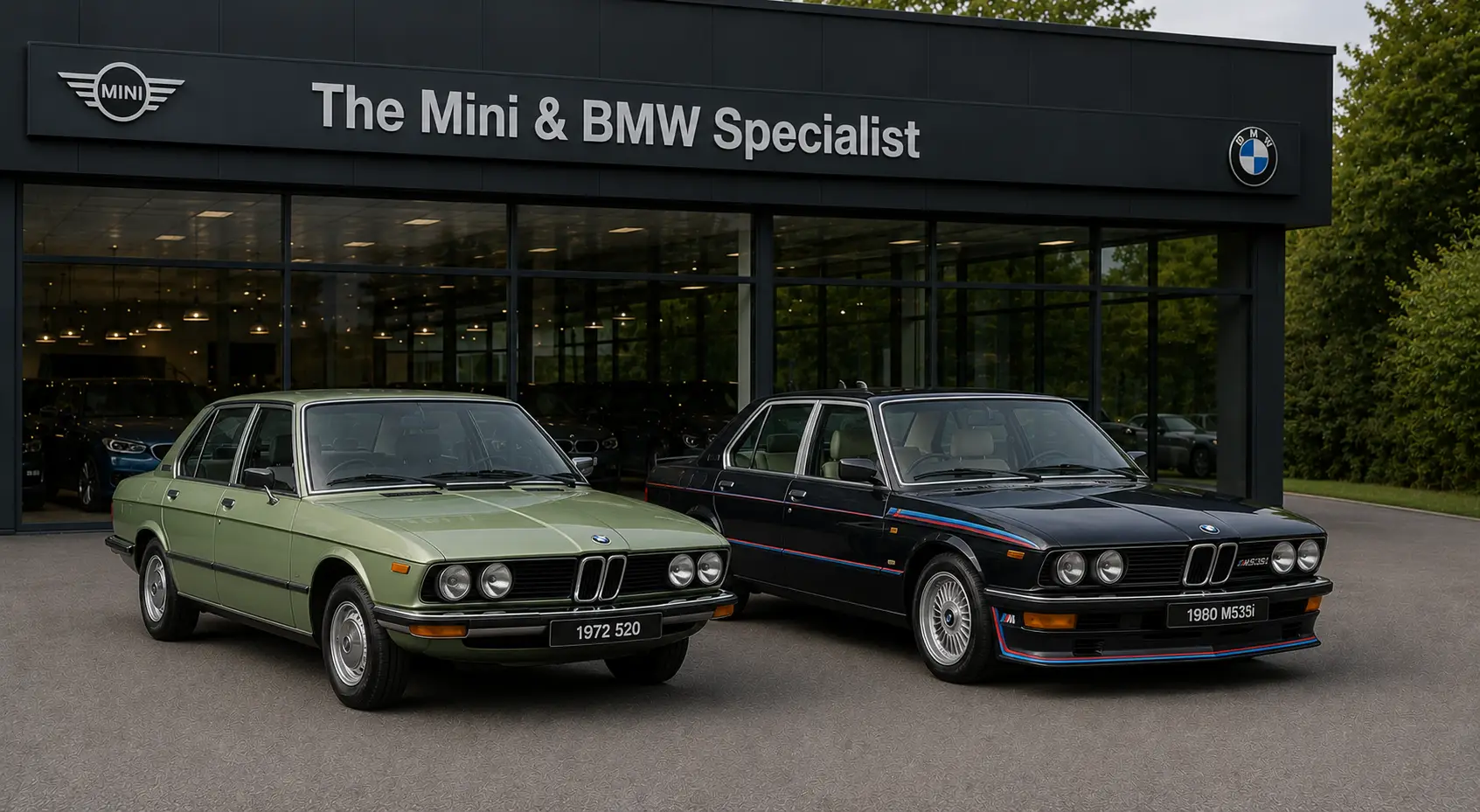
Engines
Service points for this generation
Show details for the Second generation (E28)
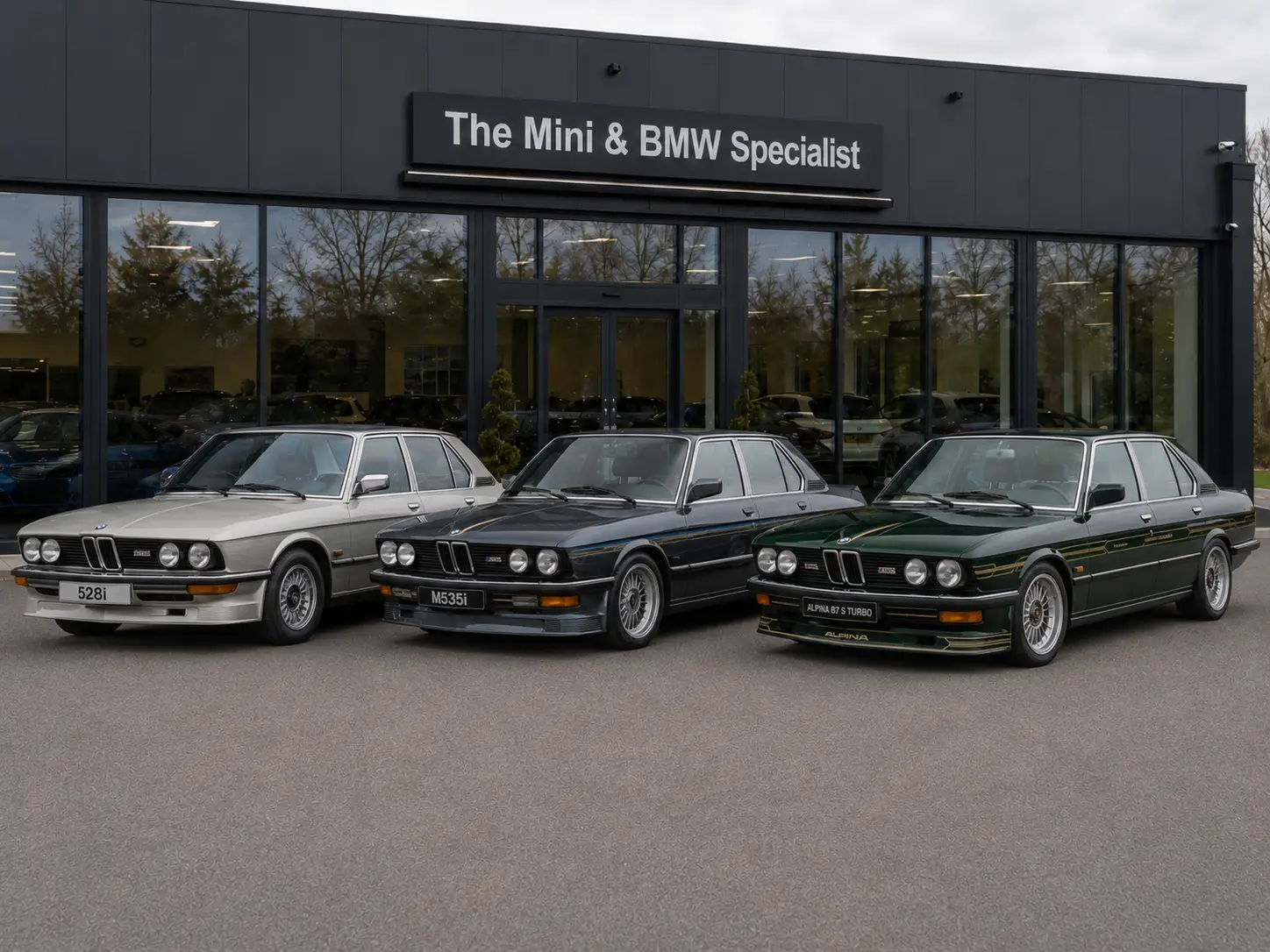
Engines
Service points for this generation
Show details for the Third generation (E34)
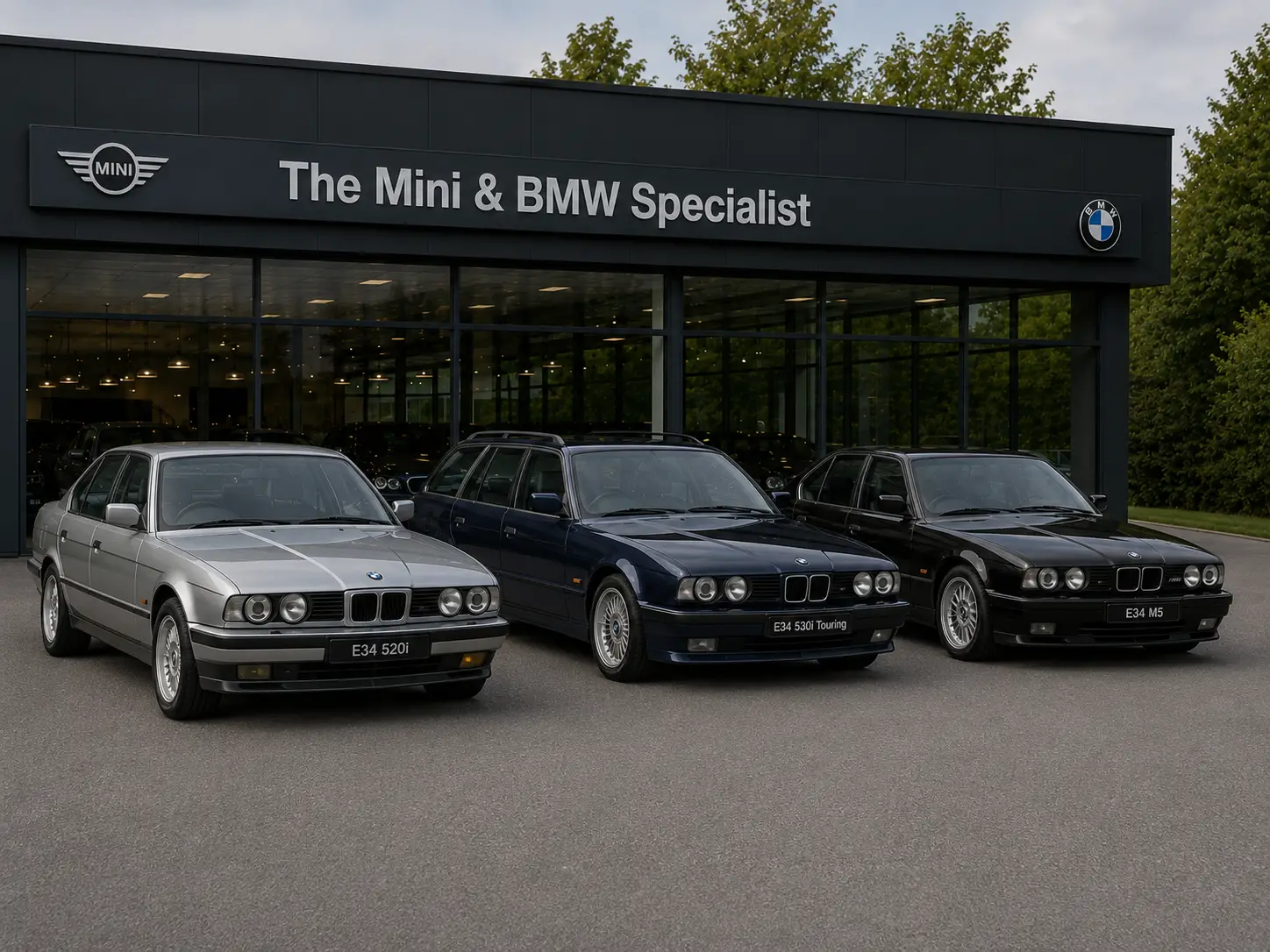
Engines
Service points for this generation
Show details for the Fourth generation (E39)
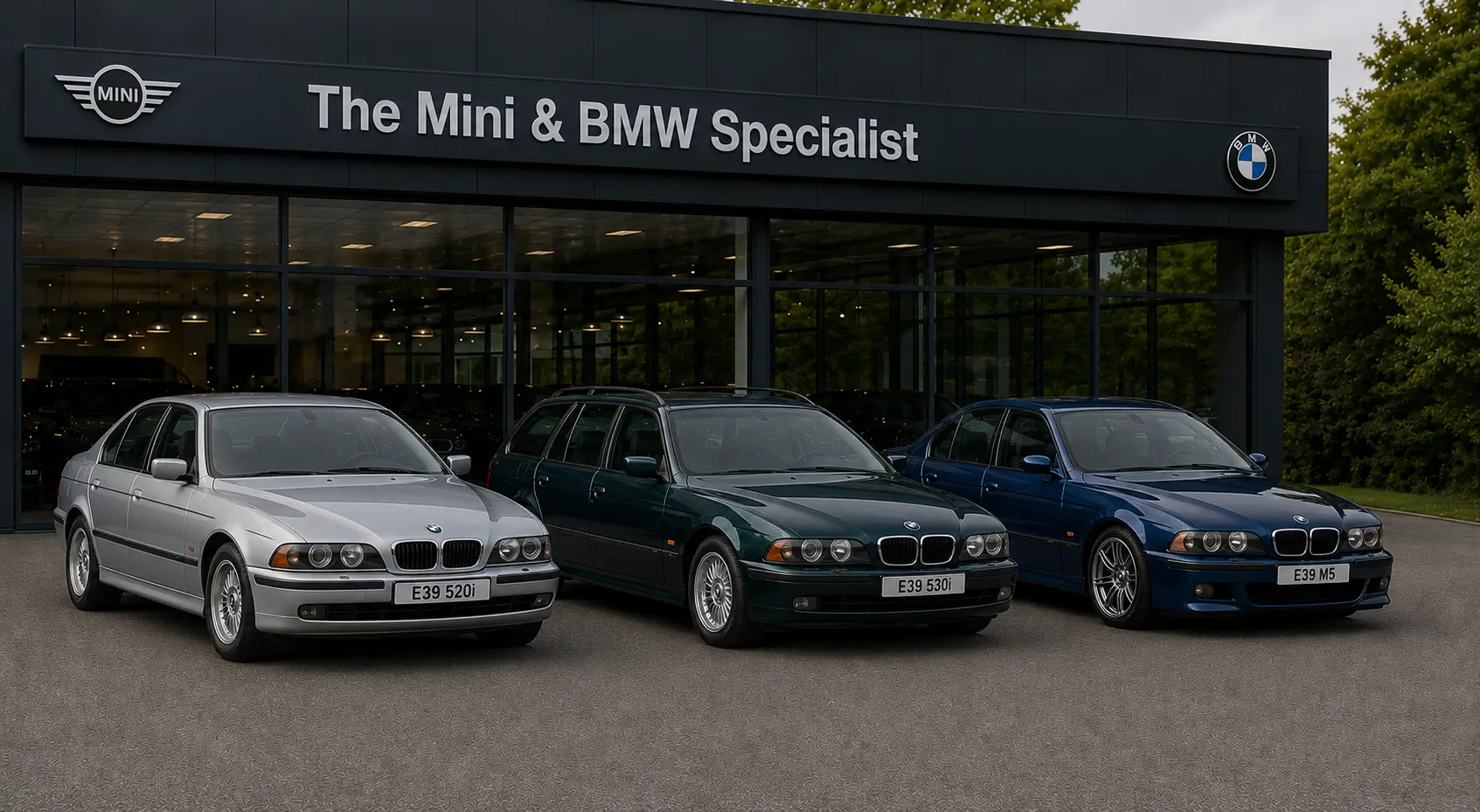
Engines
Service points for this generation
Show details for the Fifth generation (E60/E61)
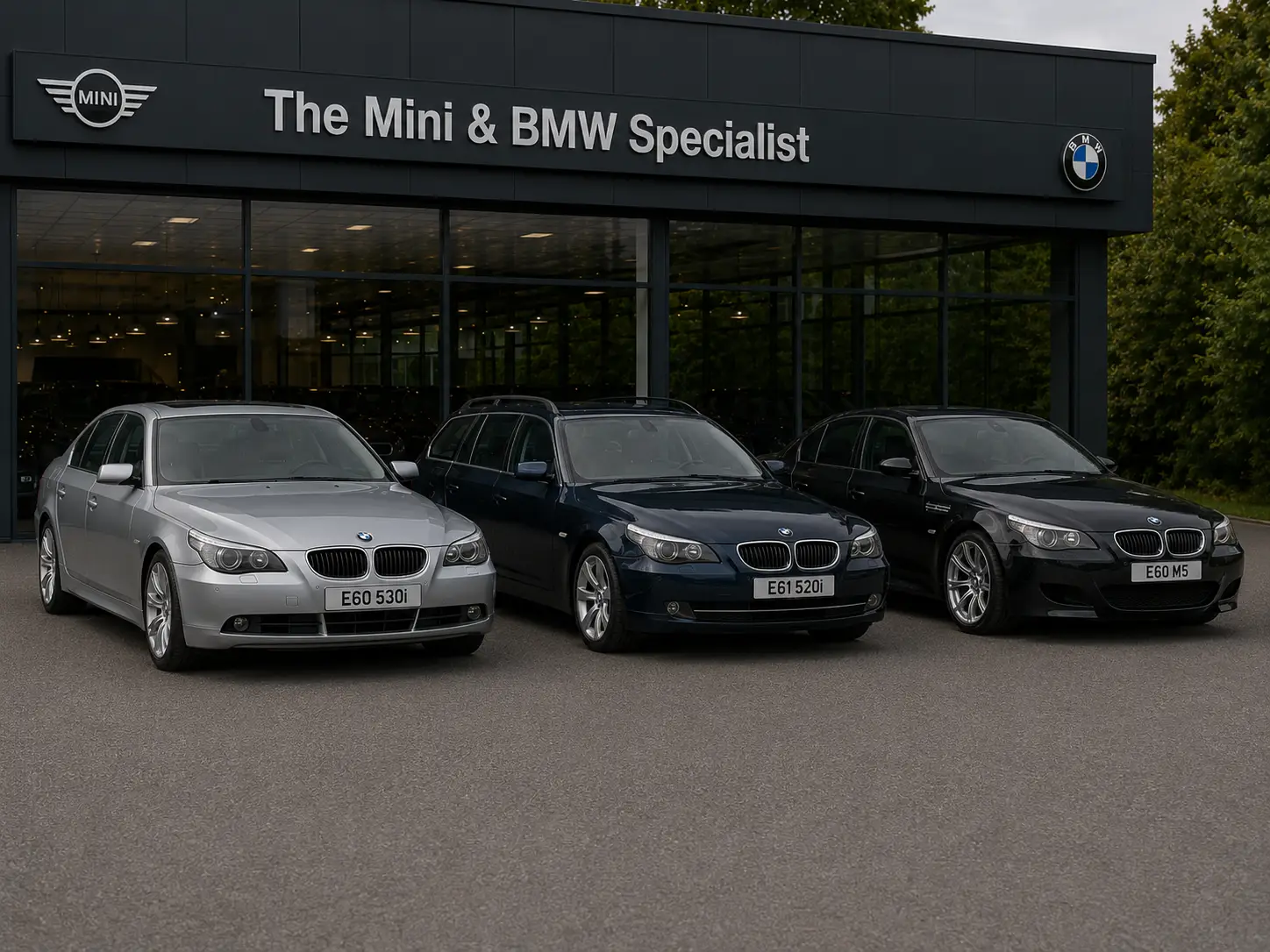
Engines
Service points for this generation
Show details for the Sixth generation (F10/F11/F07)
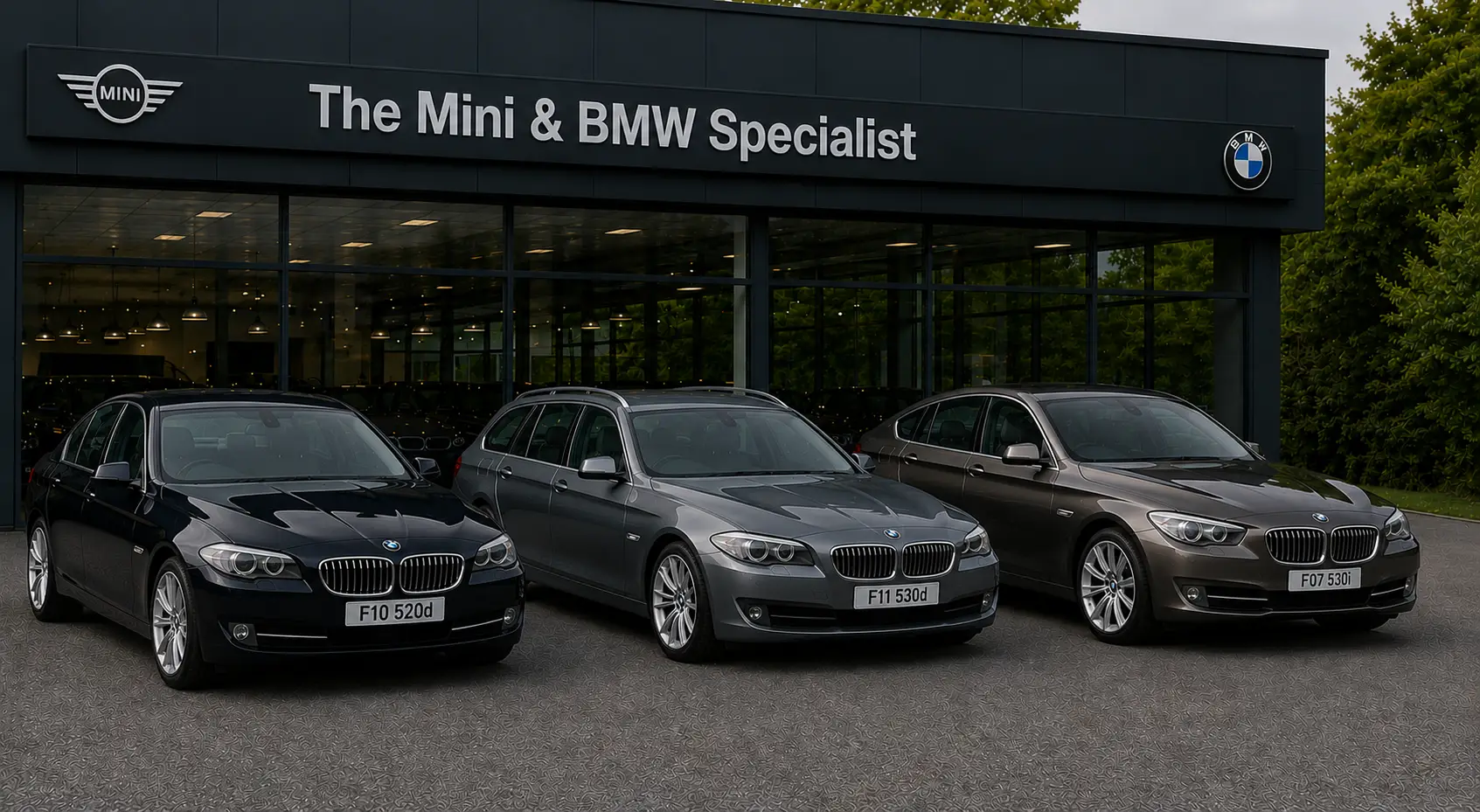
Engines
Service points for this generation
Show details for the Seventh generation (G30/G31)
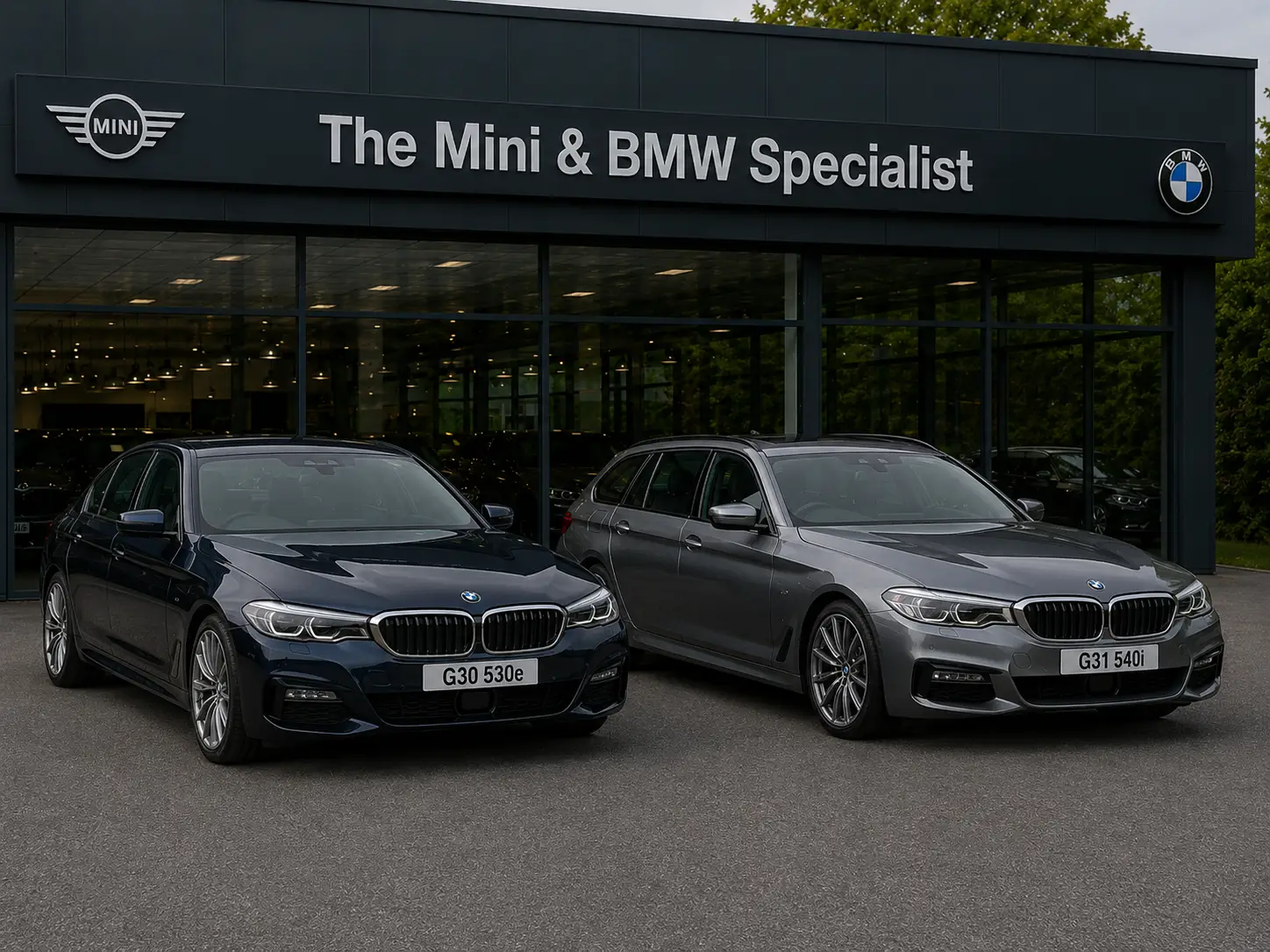
Engines
Service points for this generation
Show details for the Eighth generation (G60/G61)
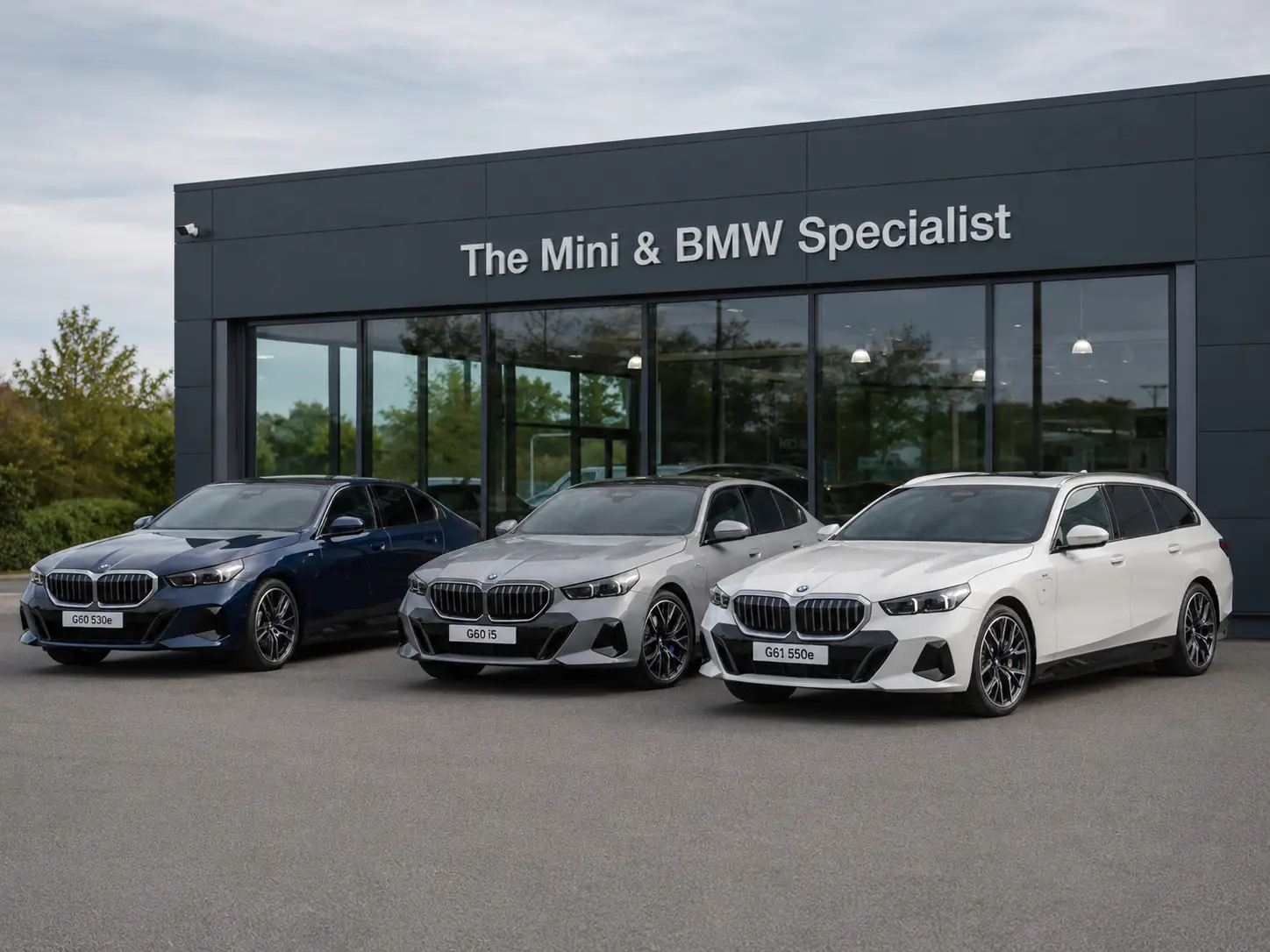
Engines
Service points for this generation
BMW 5 Series Servicing FAQs
- What oil is best for a BMW 5 Series?
- Modern BMW 5 Series petrol engines (N52, N53, N54, N55, N63, B48, B58) require BMW Longlife-01 or Longlife-14 FE specification oil — typically a 0W-20 or 5W-30 fully synthetic, depending on engine and model year. Diesel variants (M47, N47, M57, N57, B47, B57) require BMW Longlife-04, a 5W-30 fully synthetic compatible with the diesel particulate filter. Earlier-era petrol engines (M54, M62) accept BMW Longlife-98 or Longlife-01 5W-30 fully synthetic. We use the correct BMW-approved specification for your specific engine and year, supplied by Castrol or equivalent OE-standard suppliers, and update your onboard service computer with the oil grade and date.
- How often does a BMW 5 Series need servicing?
- We recommend servicing your BMW 5 Series every 12 months or 12,000 miles, whichever comes first — regardless of what the onboard service computer (CBS) says, since CBS intervals can stretch to 18,000+ miles on light usage and that's too long for modern turbocharged engines. Diesel variants (520d, 525d, 530d, 535d, 540d) benefit from shorter intervals if used predominantly on short journeys, due to DPF regeneration and oil dilution. Plug-in hybrid variants (530e, 545e, 550e) follow the same 12-month interval but have additional checks for the high-voltage cooling system and onboard charger. The fully electric i5 has a different service schedule — typically 24-month intervals between major services, with brake fluid, cabin filter, and high-voltage system checks the main service items.
- Does a BMW 5 Series service include a brake fluid change?
- Brake fluid changes are separate from a standard service but are recommended every two years on the 5 Series, in line with BMW's published schedule. Brake fluid is hygroscopic — it absorbs moisture over time, which lowers its boiling point and risks vapour lock under hard braking. We offer a fixed-price brake fluid flush using DOT 4 LV (low viscosity) fluid as required by all F10, G30, and G60 generation 5 Series, including M Sport variants with larger brakes and the i5 fully electric variants. See your model's service options for current pricing.
- Will servicing my BMW 5 Series at an independent garage affect the warranty?
- No — under EU Block Exemption Regulation 461/2010 (retained in UK law post-Brexit), you can have your BMW 5 Series serviced at any independent garage without affecting your manufacturer or extended warranty, provided OE-standard parts are used and the BMW service schedule is followed. This applies equally to petrol, diesel, plug-in hybrid (530e/550e), and fully electric (i5) variants. We use genuine BMW or OE-standard parts throughout, follow BMW's published service intervals and procedures, and provide a full digital service history that satisfies warranty requirements. Your warranty remains intact.
- How much is a full service on a BMW 5 series?
- BMW 5 Series servicing costs depend on the model, engine, and service type. Interim services start from around £198, full services from around £290, with diesel variants and M Sport models typically £20–£40 higher due to additional consumables. Six-cylinder variants (530d, 540i, 540d, 535d) and V8 variants (550i, M550i) sit at the upper end due to larger oil capacities and more consumables. Plug-in hybrids (530e, 545e, 550e) sit at the upper end of the petrol four-cylinder range due to HV system checks. The fully electric i5 follows a different service profile — no engine oil service, brake servicing typically less frequent due to regenerative braking, but high-voltage system diagnostics and cooling-system maintenance are required. The Touring estate variants (E34, E39, E60, F11, G31, G61) use the same service pricing as the saloon equivalents. Use our BMW 5 Series Service Calculator at the top of this page for fixed prices on your exact model, or call us on 0330 999 0020 for advice.
- How do you service a BMW 5 Series plug-in hybrid (530e, 545e, or 550e)?
- The 530e (B48 four-cylinder PHEV, F10 ActiveHybrid 5 onwards), 545e xDrive (B58 inline-six PHEV, late G30), and 550e xDrive (B58 inline-six PHEV, G60) share the same general service profile as their non-hybrid equivalents — same engines, same oil, same scheduled intervals. The differences are around the hybrid system: a separate low-temperature cooling loop for the high-voltage battery and power electronics that needs its coolant level and condition checked, an onboard charger that benefits from periodic diagnostic interrogation, and a 12V auxiliary battery that works harder than on a pure ICE car (powering the BCM whenever the high-voltage system is dormant) and tends to need earlier replacement. We're set up for plug-in hybrid servicing with isolation procedures and HV-rated tooling. The high-voltage battery itself is sealed and warrantied separately by BMW (typically 8 years / 100,000 miles when new). The 530e drivetrain is shared with the 330e in the 3 Series range and the 420e in the 4 Series; the 545e and 550e drivetrains are unique to the larger 5 Series and 7 Series ranges.