

BMW 2 Series Service Costs
Transparent pricing, OE-quality parts and open, honest advice.
BMW 2 Series Service Costs – Reliable Care Without Main Dealer Prices
Select your BMW model below (or enter your registration) to view fixed service costs using our Service Calculator.
Looking for Affordable BMW 2 Series Servicing?
Use our BMW 2 Series Service Calculator to check fixed pricing, compare service packages, and plan your maintenance confidently.
We service all BMW 2 Series models — from the 216d and 218i to the powerful 230i and 225xe plug-in hybrids — using only OE-standard parts to protect your BMW’s performance and warranty.
Our prices include parts, labour, and VAT as standard, with no hidden costs.
We always reset the onboard service computer and update digital service records where fitted.
Conveniently located near Birmingham with easy access to the M5 and M6 motorways, we are trusted specialists for petrol, diesel, and hybrid BMW 2 Series servicing across the West Midlands.
Warranty Protection for Your BMW 2 Series
Thanks to the UK Block Exemption Regulation, you can have your BMW 2 Series serviced by us without affecting your manufacturer’s warranty. We use OE-standard (Original Equipment) parts and service schedules that meet or exceed BMW requirements. Learn more about Block Exemption here.
Why Choose Us for Your BMW 2 Series Servicing?
Transparent Pricing
Fixed prices with parts, labour, and VAT included — no hidden costs.
Digital Service Updates
Service computer reset and digital history updated (where fitted).
Genuine OE-Standard Parts
We use OE-spec parts to protect your performance and warranty.
All Models Expertly Serviced
Petrol, diesel, and hybrid BMW 2 Series models serviced with care.
Convenient Location
Located in Great Bridge, West Midlands (DY4 7LH) — easy access from Birmingham, Wolverhampton, Dudley, M5 and M6.
Trusted by BMW Owners
Proven track record for honest advice, expert service, and lasting customer relationships.
BMW 2 Series Service Pricing Guide
Important: The service prices shown below are typical examples. Exact pricing varies by model, engine size, and fuel type. For an exact quote, please select your model using the Service Calculator above.
All services include VAT, parts, labour, service computer reset, and digital service record updates (where fitted). No hidden charges — just clear, honest pricing.
| Service | What’s Included | Price |
|---|---|---|
| Bronze Service | Oil and filter change using BMW spec oil and filter | From £150.00 |
| Silver Service (4 Cylinder) | Oil, filter, and air filter change using BMW spec parts | From £200.00 |
| Gold Service (4 Cylinder) | Oil, filter, air filter, and cabin filter change using BMW spec parts | From £280.00 |
| Platinum Service (Petrol) | Gold Service plus spark plug replacement | From £425.00 |
| Platinum Service (Diesel) | Gold Service plus fuel filter replacement | From £375.00 |
| Brake Fluid Flush | Flush and replacement using high-performance DOT4 brake fluid | £100.00 |
| MOT | Official Ministry of Transport test for vehicles over 3 years old | £50.00 |
| Diagnostic Check | Dealer-level BMW diagnostic scan and technician report | £80.00 |
What’s Included with Your BMW 2 Series Service?
- Fixed-price servicing with genuine or OE-standard parts
- Onboard service computer reset and digital history update (where fitted)
- Brake, steering, suspension, and engine health checks
- Service options tailored for petrol, diesel, and hybrid models
- Full invoice transparency — no hidden charges
Need Help Choosing the Right Service?
Use our BMW 2 Series Service Calculator at the top of this page to compare service packages and find the best fit for your car. Prefer to talk? Call us on 0330 999 0020 — we’re ready to help.
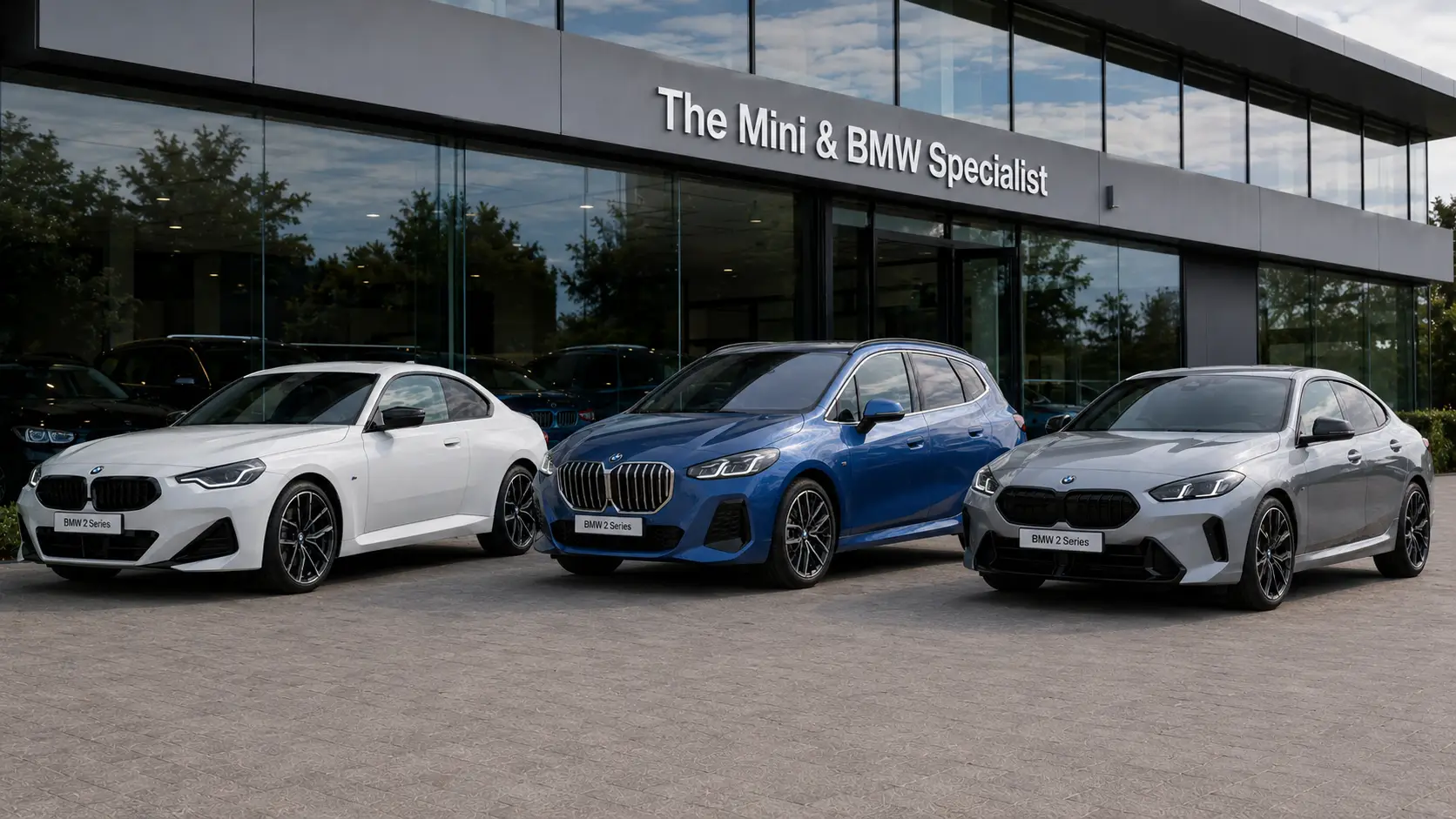
Knowing which generation your BMW 2 Series belongs to matters for servicing. Engines, oil specifications, service intervals, and common faults all vary significantly between generations. Use the table below to identify your generation, then explore the details for engine codes, body styles, and service points. The BMW 2 Series was created in 2014 when BMW spun off the 2-door variants (coupé and convertible) of the BMW 1 Series into a separate range. It launched first as the F22 coupé and F23 convertible — both rear-wheel-drive, longitudinally-engined cars that inherited the driving character of the E82/E88 1 Series they replaced. The same generation then expanded into front-wheel-drive territory with the F45 Active Tourer (5-seat MPV) in 2014, the F46 Gran Tourer (7-seat MPV) in 2015, and the F44 Gran Coupé (4-door fastback) in 2019 — all built on the UKL2 platform shared with the Mini Hatch and Countryman. The result is one generation under one badge but two genuinely different families of car. An F22 coupé and an F45 Active Tourer share virtually nothing mechanically: different platforms, different engine mounting, different drivetrains. Engines, oil specifications, service intervals, and known fault patterns vary significantly between body styles, which matters for servicing. An LCI (Life Cycle Impulse, BMW's mid-life facelift) was applied to most body styles in 2017–2018 with revised bumpers, lights, and engine refinements. The F22 coupé received the new B58 inline-six engine in the M240i variant, replacing the older N55. Production of the various body styles ended at different points: the F22 coupé and F23 convertible in 2021 (replaced by the G42 coupé only — no convertible successor), the F45 Active Tourer in 2021 (replaced by U06), the F46 Gran Tourer in 2021 (not replaced), and the F44 Gran Coupé in 2024 (replaced by F74). N20 — 2.0 litre four-cylinder turbocharged petrol. Fitted to the F22 220i and 228i, and the F23 220i and 228i (2014–2016). Same N20 engine family used in the pre-LCI F20 125i — and shares its known timing chain weakness. Chain guides can fail and lead to chain stretch on high-mileage cars with extended service intervals. B48 — 2.0 litre four-cylinder turbocharged petrol. Replaced the N20 from 2016 onwards across the range. Used in F22/F23 220i and 230i (RWD), and in F44/F45/F46 220i, 225i, and 228i (FWD with transverse mounting). Same engine family but mounted very differently depending on body style. Far more reliable than the N20. B38 — 1.5 litre three-cylinder turbocharged petrol. Used only in the front-wheel-drive variants (F45/F46 216i, 218i). Same B38 engine family used in the F40 1 Series, post-LCI F20, and current Mini Cooper. Idle vibration is more noticeable than from a four-cylinder. N55 — 3.0 litre single-turbocharged inline-six. Fitted to the F22 M235i (2014–2016). Same engine as the late F20 M135i. The high-pressure fuel pump and charge pipe are known weak points on hard-driven cars; both items are easily replaced. B58 — 3.0 litre single-turbocharged inline-six. Replaced the N55 in the M240i from 2016 onwards. Widely considered one of the best modern BMW engines — strong, smooth, and reliable. The M240i in coupé form is now a sought-after car specifically because the B58 rear-wheel-drive 2 Series coupé occupies a niche unlikely to be repeated by any manufacturer. Plug-in hybrid (225xe) — F45 Active Tourer 225xe combined a 1.5 litre three-cylinder B38 petrol engine driving the front wheels with an electric motor driving the rear wheels. Total system output around 224 hp. The high-voltage battery sits under the rear seats, reducing boot space. The petrol engine itself is standard B38 from a service standpoint, but the hybrid system adds complexity around the rear motor, inverter, and high-voltage circuit. N47 — 2.0 litre four-cylinder turbo-diesel. Used in early F22/F23 220d (2014–2015) and early F45/F46 218d/220d. Carried over from the late E8x and early F20 generations. The N47's rear-of-engine timing chain remains a major service consideration on this engine — inspect carefully on any pre-2015 diesel with more than 60,000 miles. Symptoms: cold-start rattle, EML warnings. B47 — 2.0 litre four-cylinder turbo-diesel. Replaced the N47 from 2015 onwards across the range. Used in F22/F23 218d, 220d, and 225d. Used in F45/F46 218d, 220d, and 225d (FWD with transverse mounting). The B47 retains the same chain location between the engine and gearbox as the N47, but uses a redesigned chain, guides, tensioner, and improved oil supply that address the failure modes of the older engine. Significant reliability improvement over the N47, though timing chain replacement remains a substantial labour job because the access is unchanged. B37 — 1.5 litre three-cylinder turbo-diesel. Used only in front-wheel-drive variants (F45/F46 216d). Chain-driven, fitted with diesel particulate filter and AdBlue selective catalytic reduction. Genuinely economical, three-cylinder vibration is more noticeable at idle than under load. Platform matters more than badge. A first-generation 2 Series can be one of two completely different cars depending on body style. F22 coupé and F23 convertible are rear-wheel-drive, longitudinal-engine cars closely related to the F20 1 Series hatchback and F30 3 Series. F44 Gran Coupé, F45 Active Tourer, and F46 Gran Tourer are front-wheel-drive, transverse-engine cars on the UKL2 platform shared with the Mini Hatch and Countryman. Service procedures, parts, oil quantities, and labour times differ between the two families even where the engine code is identical. N20 timing chain (pre-2016 220i and 228i coupé/convertible). Same N20 chain issue documented on the pre-LCI 125i. Chain guides can fail and cause chain stretch. Cars in the 60,000–100,000 mile band with unknown service history warrant careful inspection. Symptoms: cold-start rattle, eventual misfire codes. N47 timing chain (pre-2015 diesels). Same rear-of-engine chain issue documented on E8x and early F20 diesels. Applies to both the RWD F22/F23 220d and the FWD F45/F46 218d/220d in their pre-LCI form. The post-2015 B47 is a meaningful reliability improvement but is still rear-mounted, so labour cost for replacement remains significant. Oil specification. All petrol engines (N20, B38, B48, N55, B58) use BMW Longlife-01 specification — newer cars from 2018 onwards on the LL-01 FE (Fuel Economy) lower-viscosity variant. All diesels (N47, B47, B37) use Longlife-04. Using the wrong specification can shorten service intervals, contribute to timing chain wear, and trigger early service warnings. We supply the correct specification per car and engine code as standard. Electric water pump and thermostat housing (N55 and B58 inline-six). The plastic thermostat housing on the inline-six engines can crack and weep coolant, typically as the car ages past 80,000 miles. The electric water pump is also a wear item with a finite service life. Symptoms include overheating warnings, sometimes intermittent at first, and visible coolant residue around the front of the engine. HPFP and charge pipe (N55 M235i and B58 M240i). Both inline-six performance engines have known weak points around the high-pressure fuel pump (symptoms: long crank, rough idle, limp mode) and the plastic charge pipe between the turbo and intercooler (symptoms: sudden boost loss, flapping noise under acceleration). Both items are easily replaced and aftermarket charge pipes are common on enthusiast cars. UKL2 platform service access (F44, F45, F46). The transverse FWD layout packs the engine bay tightly. Routine service items like oil and filter changes are accessible but more involved work (timing chain on petrol engines, gearbox-related repairs) requires more dismantling than the equivalent F22/F23 RWD layout. Labour times on some FWD 2 Series jobs are noticeably longer than the same job on the coupé, which we factor into our service pricing. Active Tourer / Gran Tourer specifics. The F45 and F46 share their platform and most service procedures with the Mini Countryman F60 and F54 Clubman. If you've serviced one of those Minis, the procedures translate directly. The seven-seat F46 Gran Tourer has slightly more complex rear suspension to handle the extra passenger weight, but is otherwise mechanically identical to the F45. Plug-in hybrid (F45 225xe) specifics. The rear-axle electric motor and high-voltage battery are additional service considerations not present on conventional 2 Series variants. The 12V battery still exists and still wears out. The high-voltage battery's cooling circuit requires periodic checks. The combustion engine itself (the front-mounted B38) serves the front wheels and is largely conventional from a service standpoint. The rear-motor brake system uses regenerative braking, which means brake discs and pads tend to last significantly longer than on a non-hybrid 2 Series — worth knowing when budgeting service intervals. F46 Gran Tourer discontinued — still serviceable. The 7-seat F46 was withdrawn from production in 2021 and has no direct replacement (the second-generation Active Tourer U06 is 5-seat only). F46 owners are sometimes told by main dealers that parts and service availability is limited. In our experience this is overstated — the F46 shares almost all service-relevant parts with the F45 Active Tourer and the Mini Countryman F60, both of which remain well-supported. M2 (F87) and M235i / M240i performance variants. The standard 220i and 220d service items apply, but the M2 has additional performance-specific service considerations (track-use brake fluid, more frequent oil changes if driven hard, specific suspension wear patterns). M2 service is covered in detail on our dedicated M cars page. The second generation of the 2 Series replaced the first-generation cars across three production windows: the G42 coupé in 2021 (replacing the F22), the U06 Active Tourer in 2021 (replacing the F45), and the F74 Gran Coupé in 2025 (replacing the F44). Two body styles from the first generation were dropped entirely: the F23 convertible has no successor, and the F46 Gran Tourer (the 7-seat MPV) was discontinued without replacement. BMW decided customers wanting open-top compact driving should look to the 4 Series convertible, and customers needing seven seats should look to the 2 Series Active Tourer's row layout or move up to the X-range SUVs. The platform split that defined the first generation continues into the second, but more cleanly. The G42 coupé is built on BMW's CLAR rear-wheel-drive platform, shared with the G20 3 Series and G22 4 Series. It is the only rear-wheel-drive 2 Series in current production. The U06 Active Tourer and F74 Gran Coupé are built on the front-wheel-drive UKL2 platform, shared with the F70 1 Series and current Mini range. As with the first generation, this means an "I have a 2 Series" customer can have one of two completely different cars depending on body style. The G42 coupé is notable as a deliberately old-school car: BMW's marketing emphasised its rear-wheel-drive layout, longer bonnet, near 50:50 weight distribution, and refusal to follow the move to front-wheel drive that defined the F40 1 Series and F44 Gran Coupé. Manual transmission was available at launch but withdrawn in subsequent years. The U06 Active Tourer launched with a curved BMW Operating System 9 display arrangement and the same touchscreen-and-voice cabin philosophy that defines the current Mini and F70 1 Series. The F74 Gran Coupé followed in 2025 with the same OS9 interior treatment. The M2 (G87) performance variant of the G42 has its own page — covered separately from the standard 2 Series range. B48 — 2.0 litre four-cylinder turbocharged petrol. Used in the G42 220i and 230i, and in the U06 220i and 223i mild hybrid. Same B48 engine family used across the current BMW range. Mounted longitudinally in the G42 (driving the rear wheels) and transversely in the U06 and F74 (driving the front wheels) — same engine code, very different installation, different service procedures. B58 — 3.0 litre single-turbocharged inline-six. Fitted to the G42 M240i xDrive (374 hp). Same B58 engine family as the F20 M140i and current 3 Series M340i. Widely regarded as one of the best modern BMW engines — strong, smooth, reliable. The G42 M240i xDrive adds all-wheel drive (the F22 M240i was rear-wheel drive only), so the driving character differs from the previous generation. B38 (mild hybrid) — 1.5 litre three-cylinder turbocharged petrol paired with 48-volt mild hybrid system. Used in the U06 218i and F74 218 and 220 variants. The mild hybrid system adds a small motor-generator (around 19 hp boost) and a 48-volt battery for stop-start and acceleration assistance. Same powertrain architecture as the F70 1 Series mild hybrid variants. B47 — 2.0 litre four-cylinder turbo-diesel. Used in the G42 220d and 220d xDrive, and in the U06 218d. Same B47 engine family that has powered BMW diesels since 2015 — chain redesigned versus the older N47, but the chain location between engine and gearbox is unchanged. The B47 is a meaningfully reliable engine but timing chain replacement remains a substantial labour job. Some second-generation 2 Series diesels use a mild hybrid variant of the B47 with the same 48-volt system as the petrol mild hybrids. No three-cylinder diesel. Unlike some F40 1 Series variants, the second-generation 2 Series does not offer a three-cylinder diesel. The 218d B47 is the entry diesel. Two genuinely different cars, same badge. Same caveat as the first generation — a G42 coupé and a U06 Active Tourer share virtually nothing mechanically. Different platforms, different drivetrains, different service procedures. Different parts even when the engine code is identical. The G42 is closely related to the G20 3 Series and G22 4 Series. The U06 and F74 are closely related to the F70 1 Series and current Mini Hatch / Countryman. Knowing which body style sits under the badge matters more than the generation number when planning a service. 48-volt mild hybrid system (U06 and F74 most variants). The 48-volt system is shared with the F70 1 Series and X1 (U11). A motor-generator integrated between the engine and gearbox provides torque assistance and supports stop-start operation. The 20 Ah lithium-ion battery sits under the boot floor. Routine service does not interact with the high-voltage components, but any work involving disconnection or disturbance of the boot floor area should follow proper isolation procedure. The 48-volt battery is a long-life item but is not the same as a conventional 12-volt battery and replacement costs are accordingly higher. DPF, GPF, and AdBlue. All second-generation 2 Series diesels use AdBlue selective catalytic reduction. All petrol models include a gasoline particulate filter (GPF). Diesel particulate filters and GPFs both depend on regular long-run motorway driving to regenerate cleanly. Cars used only for short urban trips can suffer from incomplete regeneration cycles, leading to fault codes, reduced performance, and eventually expensive replacement. Worth raising directly with urban-use customers. Oil specification. Petrol B38 and B48 engines use BMW Longlife-01 FE (Fuel Economy) specification. B58 inline-six uses standard Longlife-01. B47 diesel uses Longlife-04. Hybrid variants use the same specification as their non-hybrid equivalents. The correct specification matters particularly on the emissions-compliant engines because incorrect oil can affect particulate filter regeneration directly. iDrive 8 and OS9 transition. Early G42 cars launched with iDrive 8 (rotary controller still present). The U06 launched with BMW Operating System 9 on a curved dual-display arrangement, with the rotary controller removed in favour of touchscreen and voice control. The F74 Gran Coupé launched with OS9. From a reliability standpoint, OS9 is still relatively new and we have limited long-term data, though early indications are that the system is robust. Some early-OS9 cars have benefited from software updates resolving sensor and CAN bus glitches. CLAR platform (G42 coupé). The G42 shares its CLAR platform with the G20 3 Series and G22 4 Series. Service procedures, parts catalogues, and labour times are very close to those models. If you've serviced a G20 320i, the G42 220i is largely the same job. The engine bay is more accessible than the UKL2 transverse cars — chain access, gearbox work, and inline-six service items are all easier on the G42 than on the U06. UKL2 platform (U06 and F74). The transverse FWD layout packs the engine bay tightly. Routine service items are accessible but more involved work (timing chain on petrol engines, gearbox-related repairs) requires more dismantling than the equivalent G42 RWD layout. Labour times on some FWD 2 Series jobs are noticeably longer than the equivalent job on the G42, which we factor into our service pricing. Dual-clutch transmission (G42 M240i xDrive, F74 launch range). The G42 M240i xDrive uses BMW's ZF 8HP automatic; many F74 variants and some U06 variants use a seven-speed Steptronic dual-clutch automatic. DCTs are sensitive to fluid condition and require periodic transmission oil services, sometimes overlooked on standard service schedules. We strongly recommend transmission service at manufacturer's specified interval — neglecting it on a DCT can lead to expensive consequences. Front-wheel-drive tyre wear (U06, F74). The FWD variants wear front tyres faster than rear, particularly on higher-output engines. Tyre rotation between front and rear positions is more important than it was on the previous generation's RWD-only coupé. The G42 has the conventional RWD wear pattern (rear tyres wear faster on hard-driven cars, front tyres wear faster on heavily-cornered cars). Limited service history at present (F74). The F74 Gran Coupé entered production in late 2024 with market launch in early 2025. Cars are still under manufacturer warranty for most owners. We have not yet seen significant volumes of out-of-warranty F74s, so long-term service patterns are still emerging. The notes above cover what is known from the engineering and from the closely-related F70 1 Series and U06 Active Tourer. M2 (G87) performance variant. The G42-based M2 has additional performance-specific service considerations not covered here. M2 service is covered in detail on our dedicated M cars page. Found your model? Get an exact service price in seconds using the Service Calculator at the top of this page, or call us to discuss your specific car.Generations of the BMW 2 Series
Generation
Years
Chassis codes
Body styles
Platform
First generation (F22/F23/F44/F45/F46)
2014–2024
F22, F23, F44, F45, F46
2-door coupé, 2-door convertible, 4-door Gran Coupé, 5-seat Active Tourer MPV, 7-seat Gran Tourer MPV
Mixed: F22/F23 rear-wheel drive longitudinal; F44/F45/F46 front-wheel drive UKL2 (transverse)
Second generation (G42/U06/F74)
2024–present
G42, U06, F74
2-door coupé, 5-seat Active Tourer MPV, 4-door Gran Coupé
Mixed: G42 rear-wheel drive longitudinal (CLAR); U06 and F74 front-wheel drive UKL2 transverse
Show details for the First generation (F22/F23/F44/F45/F46)
Engines
Service points for this generation
Show details for the Second generation (G42/U06/F74)
Engines
Service points for this generation
BMW 2 Series Servicing FAQs
- What oil is best for a BMW 2 Series?
The correct oil depends on the engine and year of your BMW 2 Series. Most petrol engines (N20, B38, B48, N55, B58) use BMW Longlife-01 specification. Newer petrol cars from 2018 onwards typically use the lower-viscosity Longlife-01 FE (Fuel Economy) variant. All diesel engines (N47, B47, B37) use BMW Longlife-04 specification.
Using the wrong specification can shorten service intervals, contribute to timing chain wear, and trigger early service warnings. On emissions-compliant engines, incorrect oil can also affect particulate filter regeneration. We supply the correct specification per car and engine code as standard — you don't need to specify when booking.
- How often does a BMW 2 Series need servicing?
BMW uses Condition Based Servicing (CBS) across the 2 Series range rather than fixed mileage intervals. The car monitors actual driving conditions — oil condition, cold starts, short trips, driving style, time elapsed — and calculates when each service item is due. The result is shown on the iDrive service information screen, typically as a remaining mileage figure or a date, whichever comes first.
The interval varies meaningfully depending on use. A 220d on regular motorway runs will see longer intervals between oil services than the same car doing short urban trips. As a rough guide, oil service intervals on a moderately-used 2 Series typically fall between 9,000 and 18,000 miles, but the right answer for your car is whatever your iDrive screen shows.
The one fixed maximum BMW applies is 2 years for an oil service regardless of mileage — oil degrades chemically over time even if the car is barely driven. Brake fluid is also on a 2-year cycle, separate from the oil service. Other items (spark plugs, fuel filter, air filter, cabin micro-filter) appear on their own CBS counters in iDrive when they're due.
If you're not sure where to find the CBS information on your iDrive, we're happy to talk you through it on the phone — or bring the car in and we'll pull the full CBS readout as part of any service visit.
- Does a BMW 2 Series service include a brake fluid change?
Brake fluid changes are separate from a standard service but are recommended every two years on all BMW 2 Series. Brake fluid is hygroscopic — it absorbs moisture from the air over time, which reduces its boiling point and can cause brake fade under heavy use. BMW's service schedule reflects this with a fixed two-year interval regardless of mileage.
We offer a fixed-price brake fluid flush using high-performance DOT4 brake fluid as an optional extra on any service booking. The job takes around 30–40 minutes and is genuinely worth doing at the manufacturer's interval — see our Service Calculator above for the current price.
- Will servicing my BMW 2 Series at an independent garage affect the warranty?
No. Under the UK Motor Vehicle Block Exemption Regulation (BER), independent garages can service your BMW 2 Series during the manufacturer warranty period without affecting your warranty cover, provided two conditions are met: we use parts that meet or exceed OE specification, and we follow BMW's service schedule. We do both as standard, and we update your digital service history directly so the work is fully recorded.
The Block Exemption rules exist specifically to prevent manufacturers tying owners to main dealers for routine work. The only thing that can void warranty is using non-spec parts or skipping scheduled service items — neither of which we do.
- How much does it cost to service a BMW 2 Series?
Our BMW 2 Series servicing starts from £150 for a Bronze Service (oil and filter change). A Silver Service is from £200, a Gold Service is from £280, and Platinum Service is from £375 (diesel) or £425 (petrol). All prices include VAT, parts, labour, service computer reset, and digital history update where fitted.
The exact price for your car depends on its engine and trim. The 2 Series covers a wide range — from the 218i with the B38 three-cylinder mild hybrid to the M240i xDrive with the B58 inline-six and the 225xe plug-in hybrid — and each has slightly different service requirements. Use the Service Calculator at the top of this page to get an exact price for your specific car, or call us to discuss.
- I have a 2 Series Active Tourer (or Gran Coupé) — is it the same to service as a 2 Series Coupé?
No — they are genuinely different cars. The F22/F23 Coupé and Convertible, and the G42 Coupé, are rear-wheel-drive cars with longitudinally-mounted engines. They share their platform and most service procedures with the 3 Series. The F45 Active Tourer, F46 Gran Tourer, F44 Gran Coupé, U06 Active Tourer, and F74 Gran Coupé are front-wheel-drive cars with transverse engines, built on the UKL2 platform shared with the Mini Hatch and Countryman.
The implications are real. Engines are mounted differently. Service access varies — some routine items are easier on the rear-wheel-drive cars, some are easier on the front-wheel-drive cars. Even when the engine code is identical (the B48 2.0 litre petrol appears in both families), the labour times and parts can differ. We service both families regularly and price each car based on its actual configuration, not just the badge.
The Service Calculator at the top of this page handles this automatically — enter your registration and it returns the correct price for your specific car, not a generic 2 Series figure.