

BMW 1 Series Service Costs
Transparent pricing, OE-quality parts and open, honest advice.
BMW 1 Series Service Costs – Reliable Care Without Main Dealer Prices
Select your BMW model below (or enter your registration) to view fixed service costs using our Service Calculator.
Looking for Affordable BMW 1 Series Servicing?
Use our BMW 1 Series Service Calculator to view fixed prices, compare service options, and book your next service online with confidence.
We service all BMW 1 Series models — from the 114d and 116i to the powerful M135i and M140i — using OE-standard parts to protect your BMW’s performance and warranty.
Our prices include parts, labour, and VAT as standard.
We also reset the onboard service computer and update your BMW’s digital service history where fitted.
Conveniently located near Birmingham with easy access to the M5 and M6 motorways, we are trusted specialists for petrol, diesel, and M Sport BMW 1 Series servicing across the West Midlands.
Why Choose Us for Your BMW 1 Series Servicing?
Transparent Pricing
Fixed prices with parts, labour, and VAT included — no hidden costs.
Digital Service Updates
Service computer reset and digital history updated (where fitted).
Genuine OE-Standard Parts
We use OE-spec parts to protect your performance and warranty.
All Models Expertly Serviced
Petrol, diesel, and M Sport BMW 1 Series models serviced with care.
Convenient Location
Near Birmingham with easy access to M5 and M6 motorways — serving Great Bridge, Dudley, Wolverhampton, and beyond.
Trusted by BMW Owners
Proven track record for honest advice, expert service, and lasting customer relationships.
BMW 1 Series Fixed-Price Servicing Guide
Important: The service prices shown below are typical examples. Exact pricing varies by model, engine size, and fuel type. For an exact quote, please select your model using the Service Calculator above.
All services include VAT, parts, labour, service computer reset, and digital service record updates (where fitted). No hidden charges — just clear, honest pricing.
| Service | What’s Included | Price |
|---|---|---|
| Bronze Service | Oil and filter change using BMW spec oil and filter | From £150.00 |
| Silver Service (4 Cylinder) | Oil, filter, and air filter change using BMW spec parts | From £200.00 |
| Gold Service (4 Cylinder) | Oil, filter, air filter, and cabin filter change using BMW spec parts | From £280.00 |
| Platinum Service (4 Cylinder Petrol) | Gold Service plus spark plug replacement | From £425.00 |
| Platinum Service (Diesel) | Gold Service plus fuel filter replacement | From £375.00 |
| Brake Fluid Flush | Flush and replacement using high-performance DOT4 brake fluid | £100.00 |
| MOT | Official Ministry of Transport test for vehicles over 3 years old | £50.00 |
| Diagnostic Check | Dealer-level BMW diagnostic scan and technician report | £80.00 |
What’s Included with Your BMW 1 Series Service?
- Fixed-price servicing with genuine or OE-standard parts
- Onboard service computer reset and digital history update (where fitted)
- Brake, steering, suspension, and engine health checks
- Service options tailored for petrol, diesel, and M Sport models
- Full invoice transparency — no hidden charges
Need Help Choosing the Right BMW 1 Series Service?
Use our BMW 1 Series Service Calculator at the top of this page to explore all service options for your car, compare prices, and book online with confidence.
Prefer to talk? Call us on 0330 999 0020 — our team is happy to help with advice and bookings.
Knowing which generation your BMW 1 Series belongs to matters for servicing. Engines, oil specifications, service intervals, and common faults all vary significantly between generations. Use the table below to identify your generation, then explore the details for engine codes, body styles, and service points. BMW launched the first 1 Series at the Paris Motor Show in September 2004 as the successor to the 3 Series Compact (E36/E46), which had sold over 570,000 units across 11 years. Rather than continuing the Compact branding, BMW gave the new entry-level car its own identity — the 1 Series — and developed it alongside the E90 3 Series, with which it shares approximately 60% of mechanical components. The defining feature of the E8x was its layout: a longitudinally-mounted engine driving the rear wheels, giving a near 50:50 weight balance. In the early 2000s this was almost unique in the compact hatchback segment, where virtually every competitor used a transverse front-wheel-drive layout. For BMW it was a deliberate choice — the brand's "ultimate driving machine" identity required rear-wheel drive even at the entry level. The range covered four body styles across nine years: the E87 five-door hatchback launched first in 2004, followed by the E81 three-door hatchback in May 2007, the E82 coupe in late 2007, and the E88 convertible shortly after. The five-door hatchback was always the volume seller — at peak sales in 2008, it accounted for over half the 225,095 1 Series units sold that year. An LCI (Life Cycle Impulse — BMW's term for a mid-life facelift) was applied to the E87 hatchback in March 2007 and to the coupe and convertible in 2011. Total production across all E8x models from 2004 to 2013 was over 1.5 million cars, including just over 6,300 examples of the high-performance 1 Series M Coupé (the "1M"), built only as an E82 coupe and powered by the N54 inline-six from the Z4 35is. N43 — 1.6 and 2.0 litre four-cylinder petrol. Direct injection. Introduced in the 2007 LCI facelift, replacing the older N45/N46 engines. Powered the 116i and 118i post-LCI. N45 / N46 — 1.6 and 2.0 litre four-cylinder petrol with BMW's Valvetronic variable valve lift. Used in pre-LCI 116i and 118i (2004–2007). The N46 is a known consumer of timing chains, particularly in cars with poor service history. N52 — 3.0 litre naturally aspirated inline-six. Used in the 130i hatchback (UK) and 125i / 128i post-LCI. Magnesium-aluminium block, rated up to 265 bhp. Generally robust if serviced regularly with the correct oil. N54 — 3.0 litre twin-turbocharged inline-six. Fitted to the 135i (2007–2010) and the 1 Series M Coupé. The first BMW turbocharged petrol engine since the 1980s. Known for HPFP (high-pressure fuel pump) issues and charge-pipe failures, both well-documented and serviceable. N55 — 3.0 litre single-twin-scroll turbocharged inline-six. Replaced the N54 in the 135i from 2010 onwards. Simpler turbo arrangement, generally considered more reliable than the N54. M47 — 2.0 litre four-cylinder turbo-diesel. Used in early 118d and 120d models (2004–2007). The older of the two diesel engines fitted to the E8x. N47 — 2.0 litre four-cylinder turbo-diesel. Replaced the M47 from 2007 onwards in 118d and 120d models. The N47 is widely known for timing chain wear — the chain is at the rear of the engine, and replacing it requires removing the engine or working from under the car with significant disassembly. Chains typically begin failing between 60,000 and 100,000 miles, particularly on cars with extended oil change intervals or poor servicing history. M57 — 3.0 litre inline-six turbo-diesel. Fitted to the 123d twin-turbo (post-LCI) — the only six-cylinder diesel ever offered in the 1 Series. A relatively rare car with strong torque output. N47 timing chain. The single most important service point for this generation. The chain is at the back of the engine, runs in oil, and stretches over time. Symptoms include a rattle on cold start, an EML or service warning, or in worst cases full chain skip and engine failure. We see these between 60-100k miles and recommend proactive replacement on any high-mileage car with unknown service history. The repair is significant labour but considerably cheaper than the alternative. N54 HPFP failure. The high-pressure fuel pump on N54-engined 135i and 1M models is a known weak point. Symptoms include rough running, long cranking, or limp mode. BMW extended the warranty on these pumps for many years; aftermarket replacements are now reliable. Oil specification matters. All petrol E8x engines except the post-LCI N43 take BMW Longlife-01 (LL-01) specification oil. The N43 and all diesels use Longlife-04 (LL-04). Using the wrong specification can shorten service intervals, contribute to timing chain wear, and trigger early service warnings. Coolant system. The electric water pump fitted to N52 inline-six cars is a known wear item, typically failing between 60-80k miles. Symptoms range from overheating to a chattering sound from the engine bay. The plastic thermostat housing on diesel models is similarly known to crack and weep coolant. Suspension and steering. The post-LCI cars (2007 onwards) switched to electric power steering, which is generally trouble-free. Rear shock absorber mounts on hatchback models are a common MOT advisory item by 80k miles. The aluminium front subframe bushes can deteriorate and produce a knock over uneven surfaces. Convertible-specific. The E88 convertible roof mechanism is hydraulic and motor-driven; failures of the hydraulic pump or motor are rare but expensive. Roof drain channels block easily with leaves and debris, leading to water ingress in the boot floor. BMW launched the second-generation 1 Series at the 2011 Frankfurt Motor Show, as the F20 five-door hatchback. As with the first generation, the three-door hatchback (F21) followed a year later, unveiled at the Leipzig motor show in 2012. The coupe and convertible body styles that had been part of the E8x range moved away to a new model name — the 2 Series (F22/F23) — meaning the second-generation 1 Series became hatchback-only for the first time. BMW retained the rear-wheel drive layout that defined the E8x, making the F20/F21 one of the only rear-wheel-drive hatchbacks on sale anywhere. This generation also introduced xDrive all-wheel drive as an option on the 120d and M135i — the first time a 1 Series had offered four-wheel drive. The engine range evolved significantly during the F20/F21's lifespan. The early cars used four-cylinder petrol engines (N13) and four-cylinder diesels (N47) carried over from the late E8x. The 2015 LCI facelift was substantial: most diesel engines moved to the new B47 four-cylinder, and the 114d and 116d switched to three-cylinder B37 engines. On the petrol side, the 116i and 118i moved to three-cylinder B38 engines — a notable departure for BMW, who had never previously fitted a three-cylinder engine to a non-Mini car. Power dropped roughly 20% on those models but emissions improved sharply. The performance variant was the M135i (2012–2016), powered by the N55 turbocharged inline-six producing 320 PS, replaced in 2016 by the M140i with the newer B58 engine producing 340 PS. Both models offered xDrive optionally and are highly regarded by enthusiasts as the last true rear-wheel-drive hot hatches BMW made. The 125i M Sport won the British Touring Car Championship drivers' and manufacturers' titles in 2014 and 2018 with Colin Turkington. Total F20/F21 production was approximately 1.3 million units before the front-wheel-drive F40 replaced it in 2019. N13 — 1.6 litre four-cylinder turbocharged petrol. Used in pre-LCI 114i, 116i, 118i (2011–2015) and the 120i (2015–2016). A joint BMW/PSA Peugeot-Citroën development, which is unusual for a BMW engine. The N13 has a known weakness for timing chain stretch and turbocharger oil-feed problems if servicing is neglected. B38 — 1.5 litre three-cylinder turbocharged petrol. Introduced at the 2015 LCI facelift, fitted to the 116i and 118i (2015–2019). The first three-cylinder engine BMW ever fitted to a non-Mini car. Compact, efficient, and generally robust. Idle vibration is more noticeable than from a four-cylinder, which surprises some owners coming from earlier 1 Series. N20 — 2.0 litre four-cylinder turbocharged petrol. Fitted to the pre-LCI 125i (2012–2015). The N20 has a documented timing chain issue similar to the N47 diesel — chains stretch and can skip teeth, sometimes catastrophically. Symptoms include rattling on cold start. Cars with extended service intervals are at higher risk. B48 — 2.0 litre four-cylinder turbocharged petrol. Replaced the N20 in the 120i (2016 onwards) and 125i (2016 onwards). The B48 is generally considered far more reliable than the N20 — BMW addressed most of the older engine's weak points. N55 — 3.0 litre single-turbocharged inline-six. Fitted to the M135i (2012–2016). Produces 320 PS, 450 Nm of torque. A continuation of the engine first used in the late E8x 135i. Robust if oil changes are maintained at proper intervals; the high-pressure fuel pump and charge pipe can be weak points on hard-driven cars. B58 — 3.0 litre single-turbocharged inline-six. Replaced the N55 in the M140i from 2016 onwards. Produces 340 PS, 500 Nm of torque. Widely considered one of the best engines BMW has ever made — strong, smooth, and reliable. The M140i is now sought after specifically because the B58 in a rear-wheel-drive hatchback is unlikely to be repeated by any manufacturer. N47 — 2.0 litre four-cylinder turbo-diesel. Carried over from the late E8x, fitted to pre-LCI 114d, 116d, 118d, 120d and 125d (2011–2015). The N47's rear-mounted timing chain remains a major service consideration on this generation — the engineering reality didn't change between E8x and F20. Cars in the 60,000–100,000 mile band should be inspected carefully. B37 — 1.5 litre three-cylinder turbo-diesel. Introduced at the 2015 LCI facelift, fitted to 114d and 116d (2015–2019). Genuinely economical, three-cylinder vibration is present but better damped than some competitors. The wet-belt arrangement found on some related PSA-derived engines is not used here — the B37 has a chain drive. B47 — 2.0 litre four-cylinder turbo-diesel. Replaced the N47 in the 118d, 120d and 125d from 2015 onwards. A substantial redesign with improved timing chain, guides, tensioner, and oil supply — the chain itself remains between the engine and gearbox, the same architecture as the N47, but the components and supply have been engineered to address the failure modes. Widely considered a meaningful reliability improvement over the N47. N47 timing chain (pre-2015 cars). The same rear-of-engine timing chain issue documented on E8x diesels carries directly into early F20/F21 diesels. Inspection is essential on any pre-LCI diesel of this generation with more than 60,000 miles. Symptoms: cold-start rattle, EML warnings, occasional misfires. The post-LCI B47 retains the same chain location between the engine and gearbox but uses a redesigned chain, guides, and tensioner, plus an improved oil supply. The B47 has a much better reliability record but the labour cost of timing chain replacement remains substantial because the access is unchanged. N20 timing chain (2012–2015 125i). Pre-LCI 125i petrol cars have their own timing chain issue, separate from the diesel N47 problem but with similar symptoms and similar repair cost. The N20 chain guides can fail and cause chain stretch. Affected mileage band is broadly similar — high-mileage cars with unknown service history warrant careful inspection. Oil specification. The N13, N20, B38 and B48 petrol engines all use BMW Longlife-01 (LL-01) specification oil. The N55 and B58 inline-six engines also use LL-01. All diesels (N47, B37, B47) use Longlife-04 (LL-04). Using LL-04 in a petrol engine — or vice versa — will not always trigger an immediate warning but can cause real damage over time and reduce service interval to half. Electric water pump and thermostat housing. The plastic thermostat housing on the inline-six engines (N55 and B58) can crack and weep coolant, typically as the car ages past 80,000 miles. The electric water pump is also a wear item with a finite service life — failures are characterised by overheating warnings, sometimes intermittent at first. HPFP and charge pipe (N55 M135i and B58 M140i). Both inline-six performance engines have known weak points around the high-pressure fuel pump (symptoms: long crank, rough idle, limp mode) and the plastic charge pipe between the turbo and intercooler (symptoms: sudden loss of boost, flapping noise under acceleration). Both items are easily replaced and aftermarket charge pipes are common on enthusiast cars. Suspension. The F20/F21 uses aluminium multi-link rear suspension carried over from the E8x. Rear shock mounts and subframe bushes are typical wear items by 80,000–100,000 miles. The M135i and M140i ride on stiffer suspension and tend to wear front bushes faster. iDrive and electronics. The 2017 mid-cycle update moved iDrive to version 6.0 with a revised dashboard. Cars from 2017 onwards are noticeably more refined inside than the early F20 cars. iDrive can suffer from software-update glitches but no widespread hardware reliability issues are reported. xDrive system (120d xDrive and M135i/M140i xDrive). The xDrive all-wheel-drive system used on the F20/F21 is the first time it was offered on a 1 Series. The transfer case has its own oil that requires periodic changes (sometimes overlooked on standard service schedules). Failure of the transfer case is uncommon but expensive. The third-generation 1 Series marked the most significant change in the model's history. After fifteen years of rear-wheel-drive hatchbacks, BMW switched the F40 to a transverse front-wheel-drive layout, built on the UKL2 platform shared with the 2 Series Gran Coupé and post-2014 MINI models. This was the same engineering decision that had previously caused controversy when BMW applied it to the MINI Countryman and X1 — committed BMW enthusiasts saw it as a departure from the brand's identity. For most customers, the result was a more practical car. The F40 launched at the 2019 Frankfurt Motor Show and went on sale in September 2019. Only one body style was offered — a five-door hatchback — the three-door F21 having been discontinued without replacement. Engines became exclusively three- or four-cylinder transverse-mounted units; the inline-six performance variant that had defined the F20's M135i and M140i was gone. The new range-topping M135i xDrive used a 2.0 litre B48 four-cylinder producing 302 PS and standard all-wheel drive. Despite external dimensions that are similar to the F20, the F40's tighter front-wheel-drive packaging delivered substantially more interior space. Front legroom increased by 42 mm, rear legroom by 33 mm, rear headroom by 19 mm, and boot capacity grew by 20 litres to 380 litres. The F40 is also approximately 30 kg lighter than the F20, due to increased aluminium use in the body structure. For families and daily drivers, it is a meaningfully more usable car than its predecessor. The trim hierarchy was Advantage, Luxury, Sport, and M Sport, with a 128ti hot-hatch variant launched in late 2020 as a Volkswagen Golf GTI competitor — 261 PS, front-wheel drive, mechanical limited-slip differential. The M135i xDrive received a suspension revision in October 2021 with retuned springs, dampers, and added hydromount bushings to improve grip. Production ended in mid-2024 after approximately 443,000 units, with the F70 fourth-generation replacement entering production shortly after. B38 — 1.5 litre three-cylinder turbocharged petrol. Fitted to the 116i (107 hp) and 118i (138 hp). The same engine family used in the post-LCI F20, MINI Cooper, and several other BMW Group models. Compact, efficient, well-understood by independent specialists. The three-cylinder vibration is more noticeable at idle than from a four-cylinder but generally well-damped under load. B48 — 2.0 litre four-cylinder turbocharged petrol. Used in the 120i (176 hp), 128ti (261 hp) and M135i xDrive (302 hp). One of BMW's most refined modern engines, the B48 has proven reliable across many models. Higher-output variants run higher boost pressure and place more load on cooling and timing components. No inline-six option. Unlike the F20 generation, no six-cylinder petrol engine was offered in the F40. Customers wanting a six-cylinder BMW hatchback experience needed to move to the 2 Series or 3 Series. The M135i xDrive uses the B48 four-cylinder with all-wheel drive to compensate, but the change in character compared to the M140i is genuinely substantial. B37 — 1.5 litre three-cylinder turbo-diesel. Fitted to the 116d (114 hp). Chain-driven, fitted with diesel particulate filter (DPF) and AdBlue selective catalytic reduction. Designed for compliance with Euro 6d-TEMP from launch, so DPF and AdBlue function are central to its operation rather than retrofit add-ons. B47 — 2.0 litre four-cylinder turbo-diesel. Used in the 118d (148 hp) and 120d (188 hp, available with xDrive). A continuation of the same B47 engine family that replaced the troublesome N47 during the F20 LCI in 2015. The B47 retains the same chain location between the engine and gearbox as the N47, but uses a redesigned chain, guides, tensioner, and improved oil supply, addressing the failure modes of the older engine rather than relocating it. The result is a meaningful reliability improvement over the N47, though timing chain replacement remains a significant labour job because the access is unchanged. AdBlue system. All F40 diesels use AdBlue selective catalytic reduction, which requires regular topping-up between services. The dashboard warning appears with sufficient remaining miles to act, but ignoring it will eventually cause the car to refuse to start. The AdBlue tank, injector and quality sensor can all fail and produce expensive fault codes. We see AdBlue-related issues regularly on cars that have done a lot of urban short-trip use, where the system does not get up to operating temperature reliably. DPF and GPF. Diesel models have a diesel particulate filter; petrol models from this generation now have a gasoline particulate filter (GPF). Both rely on regular long-run motorway driving to regenerate cleanly. Cars used only for short urban trips can suffer from incomplete regeneration cycles, leading to fault codes, reduced performance, and eventually expensive replacement. This is worth raising directly with customers buying ex-fleet or urban-use F40s. Oil specification. Petrol B38 and B48 engines use BMW Longlife-01 FE (Fuel Economy) — a lower-viscosity specification than older Longlife-01 oils. Diesels use Longlife-04. The correct specification matters more than ever on these emissions-compliant engines: the wrong oil can affect particulate filter regeneration directly. Transverse engine bay packaging. The UKL2 platform packs everything tightly under the bonnet. Routine service items such as auxiliary belts, top hoses, and sensors are generally accessible, but more involved work (timing chain on petrol engines, gearbox-related repairs) requires more dismantling than the older longitudinal layout. Labour times are slightly longer on some F40 jobs than the equivalent F20 work, which we factor into our service pricing. iDrive 7.0 and electronics. The F40 launched with iDrive 7.0 on dual 10.25-inch displays and includes a digital key system that uses near-field communication via smartphone. Software updates have improved early-car reliability significantly; we occasionally see CAN bus or sensor faults that respond to a coding refresh rather than parts replacement. M135i xDrive suspension revision (October 2021 onwards). The factory suspension update applied to M135i xDrive models from late 2021 means there are effectively two specifications of M135i xDrive on the road. The later cars have retuned springs, dampers and trailing-arm/control-arm bushings. When sourcing replacement suspension components, it is essential to know which specification a particular car is. Front-wheel-drive consequences for tyre wear. Unlike the rear-wheel-drive F20, the F40 wears front tyres faster than rear, particularly on higher-power variants (128ti, M135i xDrive). Rotation between front and rear positions is more important than it was on previous 1 Series generations. The mechanical front limited-slip differential on the 128ti can be unusually demanding of front tyre quality. xDrive on M135i. The M135i xDrive uses a Haldex-style on-demand all-wheel-drive system rather than a fully permanent BMW xDrive arrangement. The system is largely fit-and-forget but does benefit from periodic transfer-case oil changes, often overlooked in standard service schedules. The fourth-generation 1 Series was unveiled in June 2024 and entered production at BMW's Leipzig plant in July 2024. Like the F40 before it, the F70 is built on the BMW UKL2 platform with a transverse front-wheel-drive layout and an optional xDrive all-wheel-drive system reserved for the range-topping M135. The body is a heavy facelift of the F40 rather than a complete redesign — the chassis, dimensions and packaging are very close to the previous generation, with the F70 being 42 mm longer and 25 mm taller than the F40. Three changes define this generation. First, the F70 is the first 1 Series available as a mild hybrid, with most variants pairing the engine to a 48-volt electrical system and a small motor-generator producing 19 hp. The 48-volt battery sits under the boot floor, reducing luggage capacity from 380 litres to 300 litres on hybrid models. Second, the iDrive rotary controller has been removed entirely — cabin controls are now touchscreen or voice-operated through BMW Operating System 9 on a curved dual-display arrangement. Third, the F70 is the first 1 Series in the model's history not to offer a manual gearbox. All variants use a seven-speed Steptronic dual-clutch automatic. The launch range comprised the 120 (1.5 litre three-cylinder petrol mild hybrid, 168 hp) and M135 xDrive (2.0 litre four-cylinder petrol, 296 hp / 221 kW). Power output on the M135 is detuned slightly compared to the F40 M135i xDrive (302 hp) to meet European emissions standards. Diesel returned with the 118d (2.0 litre four-cylinder, 150 hp) — the same B47 engine family that has powered 1 Series diesels since 2015. Late 2024 added the 123 mild hybrid (2.0 litre four-cylinder, 218 hp combined) and the 120d xDrive mild hybrid diesel (163 hp combined). BMW has also dropped the 'i' suffix on petrol models for the first time. The car previously sold as the "118i" is now simply the "118"; the "i" prefix is reserved for fully electric BMW models such as the i4 and iX. The diesel "d" suffix remains in place. This rebadging is a marketing decision but a useful one to know about when discussing F70 variants — owners and dealers alike sometimes still refer to "118i" out of habit, and both conventions appear in print and on Wikipedia. B38 — 1.5 litre three-cylinder turbocharged petrol. Used in the entry-level 116 and 118 (non-UK markets) and as the petrol component of the 120 mild hybrid. The same B38 engine family found in the F40, the post-LCI F20, and the current MINI Cooper. The mild hybrid 120 pairs the engine with a 48-volt motor-generator producing an additional 19 hp for a combined 168 hp. B48 — 2.0 litre four-cylinder turbocharged petrol. Used in the 123 mild hybrid (218 hp combined) and the M135 xDrive (296 hp in European specification). Same engine family as the F40 M135i and 128ti. The M135 in F70 form is detuned compared to the F40 M135i xDrive (302 hp), to meet European emissions standards. Mild hybrid system. The 48-volt mild hybrid arrangement is shared with the X1 (U11) and the 2 Series Gran Coupé (F74). A small motor-generator integrated between the engine and gearbox provides torque assistance during acceleration and recovers energy under braking. The system does not provide electric-only driving; it supplements the combustion engine and supports stop-start operation. The 20 Ah lithium-ion battery is positioned under the boot floor. B47 — 2.0 litre four-cylinder turbo-diesel. Used in the 118d (150 hp) and the 120d xDrive mild hybrid (163 hp combined). The same B47 engine family that replaced the troublesome N47 in the F20 LCI back in 2015 — redesigned chain, guides, tensioner and oil supply rather than chain relocation, but a meaningful and well-documented reliability improvement over the N47. The 120d xDrive mild hybrid adds the same 48-volt motor-generator system used on the petrol mild hybrid variants. No three-cylinder diesel. Unlike the F40, the F70 does not offer the B37 1.5 litre three-cylinder diesel. The 118d is now the entry-level diesel option. Limited service history at present. The F70 entered production in mid-2024 and is still under manufacturer warranty for most owners. We have not yet seen significant volumes of out-of-warranty F70s, so the long-term patterns familiar from earlier generations are still emerging. The notes below cover what is known from the engineering and from related models, rather than from extensive workshop experience with this generation specifically. Mild hybrid 48-volt system. The 48-volt system is a new layer of complexity for the 1 Series. The battery sits under the boot floor and has its own cooling and management electronics. Routine service does not interact with the high-voltage components, but any work involving disconnection of the battery or disturbance of the boot floor area should follow the proper isolation procedure. The 48-volt battery is a long-life item but is not the same as a conventional 12-volt battery and replacement costs are accordingly higher. DPF, GPF and AdBlue. All F70 diesels use AdBlue selective catalytic reduction and a diesel particulate filter. All petrol models include a gasoline particulate filter. The same operational considerations apply as on the F40: short urban-trip use can leave the particulate filters unable to complete regeneration cycles, which eventually triggers warnings and reduced performance. AdBlue requires topping-up between services and the system can develop sensor or injector faults. Touchscreen-only interior. The removal of the iDrive rotary controller and most physical buttons means that almost every cabin function is adjusted through the touchscreen or voice control. For service customers used to earlier generations this is a substantial change in how the car is operated and we frequently spend time at handover walking new owners through how to find settings they previously adjusted with physical controls. From a reliability perspective the implications are not yet established — first-generation OS9 in this form is roughly 18 months into mass production. No manual gearbox. All F70 variants use the seven-speed Steptronic dual-clutch automatic. Dual-clutch transmissions are sensitive to fluid condition and require periodic transmission oil services, sometimes overlooked on standard service schedules. We strongly recommend transmission service at the manufacturer's specified interval — neglecting it on a DCT can lead to expensive consequences. Oil specification. The current B38 and B48 petrol engines, including their mild hybrid variants, use BMW Longlife-01 FE specification. The B47 diesel uses Longlife-04. Hybrid variants do not require any different oil specification from non-hybrid equivalents. As ever, the correct specification matters more than ever on emissions-compliant engines: incorrect oil can affect particulate filter regeneration. M135 xDrive. The performance variant retains all-wheel drive through the same Haldex-style on-demand system used on the F40 M135i xDrive. The M Compound brake system fitted to M135 models when specified with the M Technology package uses 385 mm front and 330 mm rear disc brakes — larger and more expensive than standard 1 Series brakes when replacement is needed. Found your model? Get an exact service price in seconds using the Service Calculator at the top of this page, or call us to discuss your specific car.Generations of the BMW 1 Series
Generation
Years
Chassis codes
Body styles
Platform
First generation (E8x)
2004–2013
E81, E82, E87, E88
3-door hatchback, 5-door hatchback, coupe, convertible
BMW L2 platform (longitudinal engine, rear-wheel drive)
Second generation (F20/F21)
2011–2019
F20, F21
3-door hatchback, 5-door hatchback
BMW L7 platform (longitudinal engine, rear-wheel drive, optional xDrive all-wheel drive)
Third generation (F40)
2019–2024
F40
5-door hatchback
BMW UKL2 platform (transverse engine, front-wheel drive, optional xDrive all-wheel drive)
Fourth generation (F70)
2024–present
F70
5-door hatchback
BMW UKL2 platform (transverse engine, front-wheel drive, optional xDrive all-wheel drive, 48V mild hybrid on most variants)
Show details for the First generation (E8x)
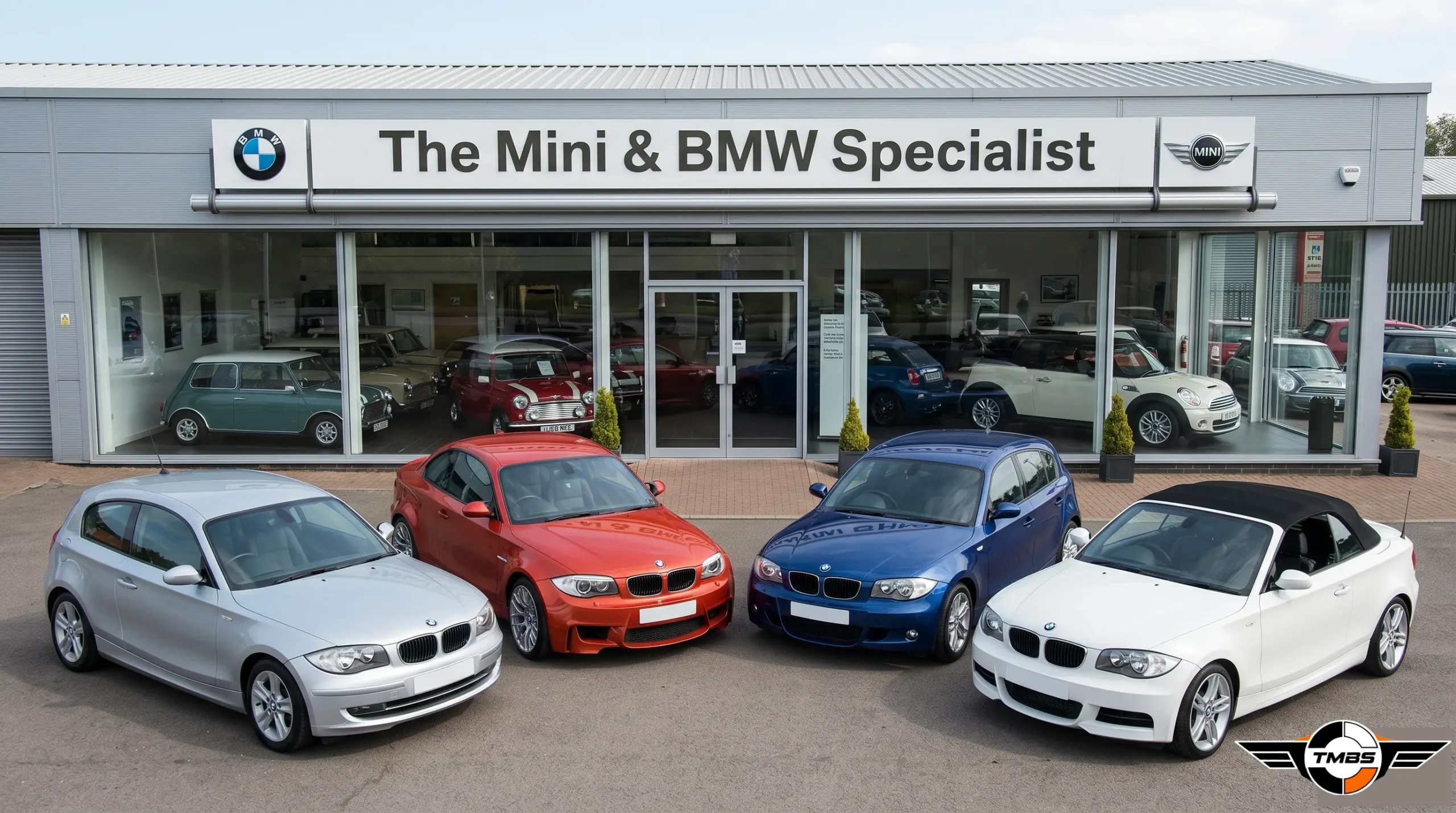
Engines
Service points for this generation
Show details for the Second generation (F20/F21)
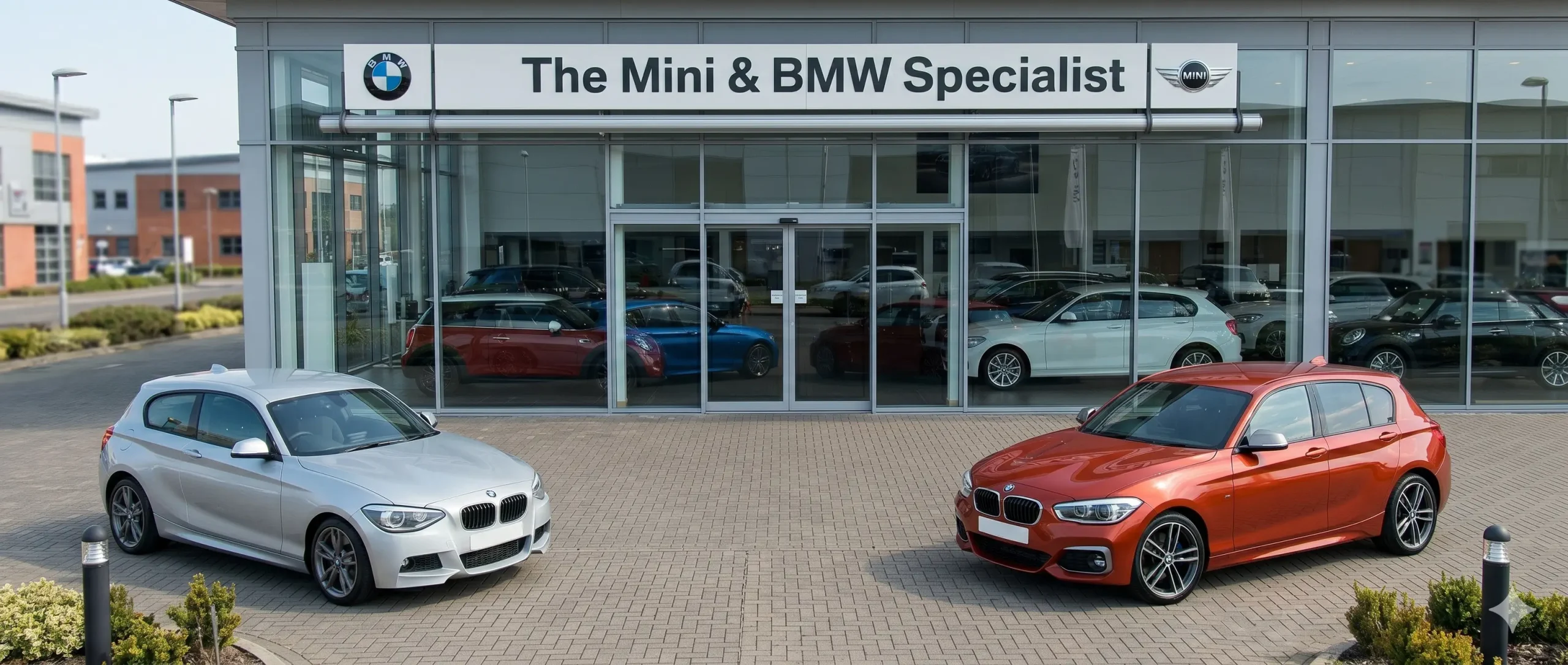
Engines
Service points for this generation
Show details for the Third generation (F40)
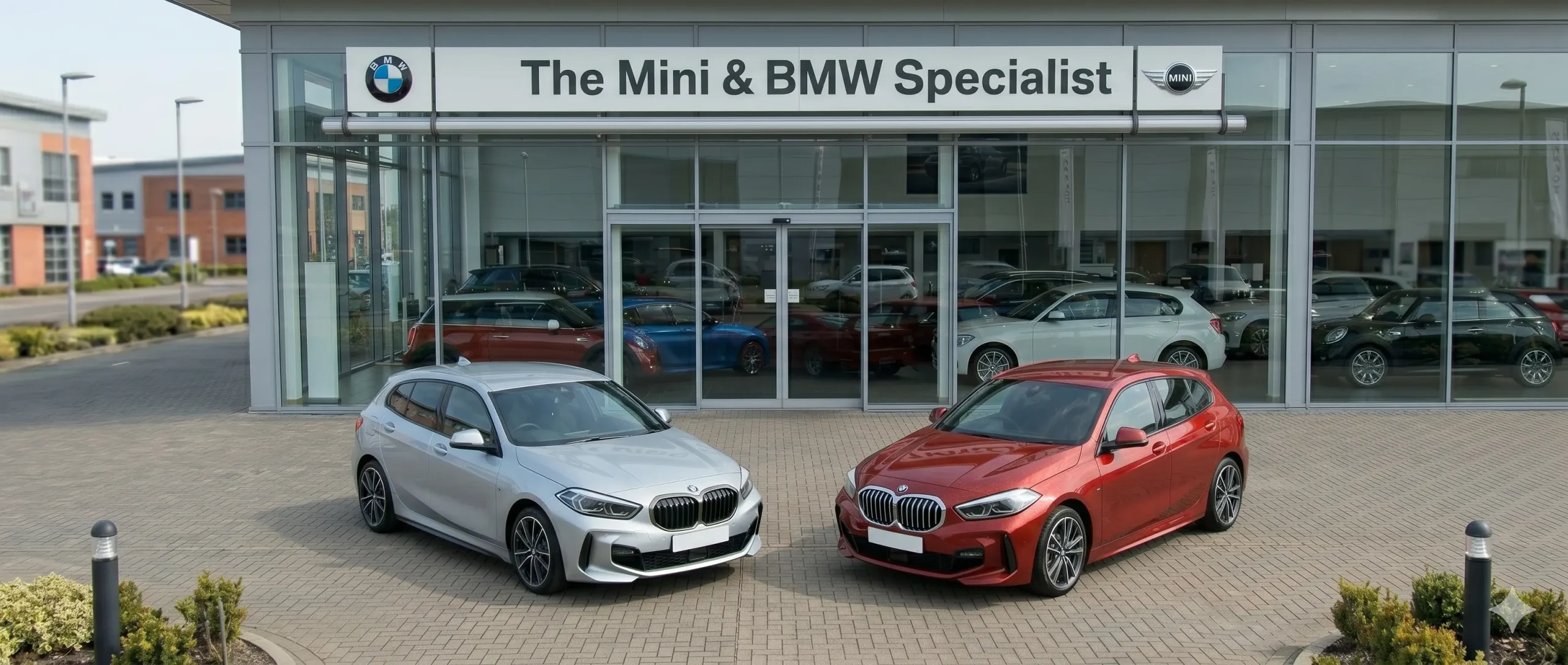
Engines
Service points for this generation
Show details for the Fourth generation (F70)
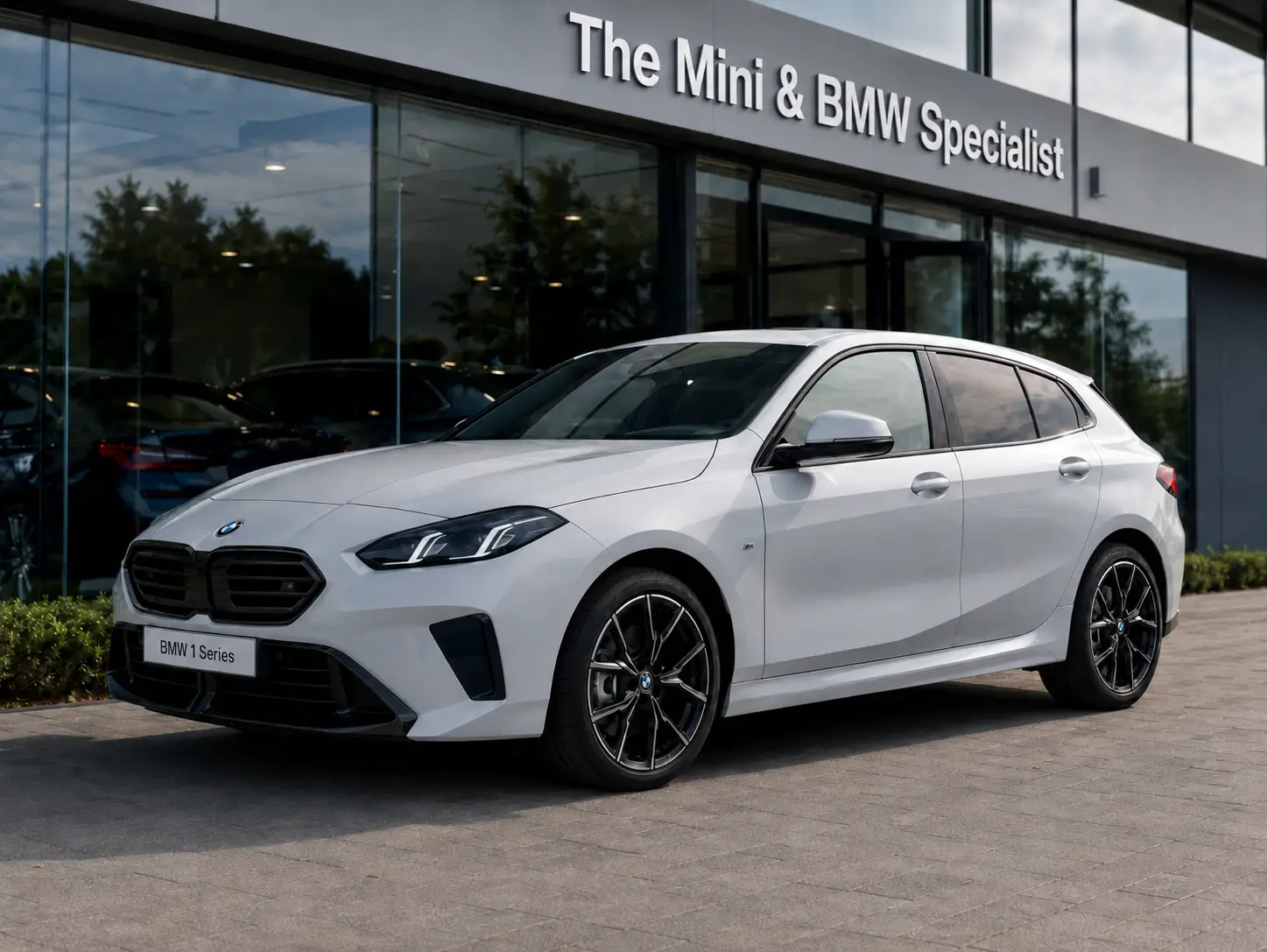
Engines
Service points for this generation
BMW 1 Series Servicing FAQs
- How much does it cost to service a BMW 1 Series?
BMW 1 Series servicing at The Mini & BMW Specialist is offered at fixed prices tailored to your exact model, engine size, and fuel type. Typical 4-cylinder prices start from around £150 for a Bronze service (oil and filter), £200 for Silver (adds air filter), and £280 for Gold (adds cabin filter). All prices include parts, labour, and VAT.
Exact pricing depends on your specific BMW because a 116i, 120d, and M140i each take different parts, oil quantities, and labour times. The published examples are 4-cylinder petrol guide prices — your actual price could be lower or higher.
To see your exact fixed price, visit the 1 Series service costs page and select your specific model — or enter your registration and the Service Calculator returns every tier price for your car in seconds.
- What oil is best for a BMW 1 Series?
Most BMW 1 Series models built since 2007 use fully synthetic 5W-30 engine oil meeting BMW Longlife-04 (LL-04) specification. Earlier petrol N43, N45, N46, and N13 engines (2004–2015) take BMW Longlife-01 (LL-01).
The exact specification matters because BMW engines run extended service intervals based on oil condition sensing. A non-approved oil can trigger early service warnings or, in worst cases, contribute to timing chain wear on N47 diesels and B47 engines.
Every fixed-price service we carry out uses the correct specification oil for your specific model and engine code, supplied by our trade account with BMW-approved manufacturers. View 1 Series service options and book online.
- How often does a BMW 1 Series need servicing?
BMW's standard service guidance for the 1 Series is every 12 months or 12,000 miles, whichever comes first. This applies across the petrol and diesel range — 116i, 118i, 118d, 120d, M135i, M140i, and the rest.
In practice the exact interval is set by your car's Condition Based Servicing (CBS) system, which monitors oil quality, brake wear, and other consumables and projects the actual due date or mileage. You'll see it on your iDrive service information screen. Hard urban driving with lots of cold starts shortens intervals; gentle motorway use can extend them — sometimes substantially.
The one fixed maximum BMW applies is 2 years for an oil service regardless of mileage, because oil degrades chemically over time even when the car is barely driven. Brake fluid is on a separate 2-year cycle.
If your service indicator is on or you're overdue, view fixed-price service options for the 1 Series — every service includes a full CBS reset and digital history update where fitted.
- Does a BMW 1 Series service include a brake fluid change?
No — brake fluid is not part of a standard service. BMW recommends a brake fluid flush every two years regardless of mileage, because brake fluid absorbs moisture and gradually loses its boiling point. Old fluid causes spongy pedal feel and reduced braking under heavy use.
We offer a fixed-price brake fluid flush using high-performance DOT4 fluid for £100, which can be added to any service or booked on its own. Your BMW's CBS display will tell you when it's due.
- Will servicing my BMW at an independent garage affect the warranty?
No. Under EU Block Exemption Regulation, retained in UK law, you can have your BMW serviced by any qualified independent garage without affecting the manufacturer's warranty — provided the garage uses parts of equivalent quality and follows BMW's service schedule.
We use genuine BMW or OE-standard parts (often supplied by the same manufacturers that supply BMW directly), follow BMW's service schedules to the letter, and update your digital service history where fitted. Your warranty stays fully intact, typically at 30–50% less than main dealer prices.